It has been a number of months since I have contributed anything for the REVIEW from this part of the world. During this time much more has taken place than I can report in these columns, so the most important features must suffice.
The greater part of the past eight months we have tried to throw our energies directly into the channels of evangelistic work. In fact, there has been little else that we could do; for we have had no funds with which to create other enterprises that would call for our time. This is not to say that we have no need, nor that there is no place for such things in our work; for we feel the need of some auxiliaries very much. One can not carry forward school and medical work without some kind of equipment. A school without books is a possible thing; but in this country we have to have at least a shelter from the sun. We have been in dire need of a proper building both for a school and for a dispensary ever since the work started in this place. The buildings we now occupy are native bazaars. At best they are poorly adapted to the uses to which we are putting them, but in addition they are greatly dilapidated.
At the close of our general meeting in Lucknow, we were favored with a visit from Elder W. W. Prescott, who remained with us four days, speaking twice to the people, and counseling with us in our plans for the work. We all greatly appreciated this visit, and the counsel and encouragement given by one who has had so much experience in the work. During his visit the local committee decided to purchase a small tract of land, and erect a schoolhouse as soon as funds could be secured for that purpose. Since then the union committee has forwarded us some money; the land has been purchased; and the work of building is now going forward.
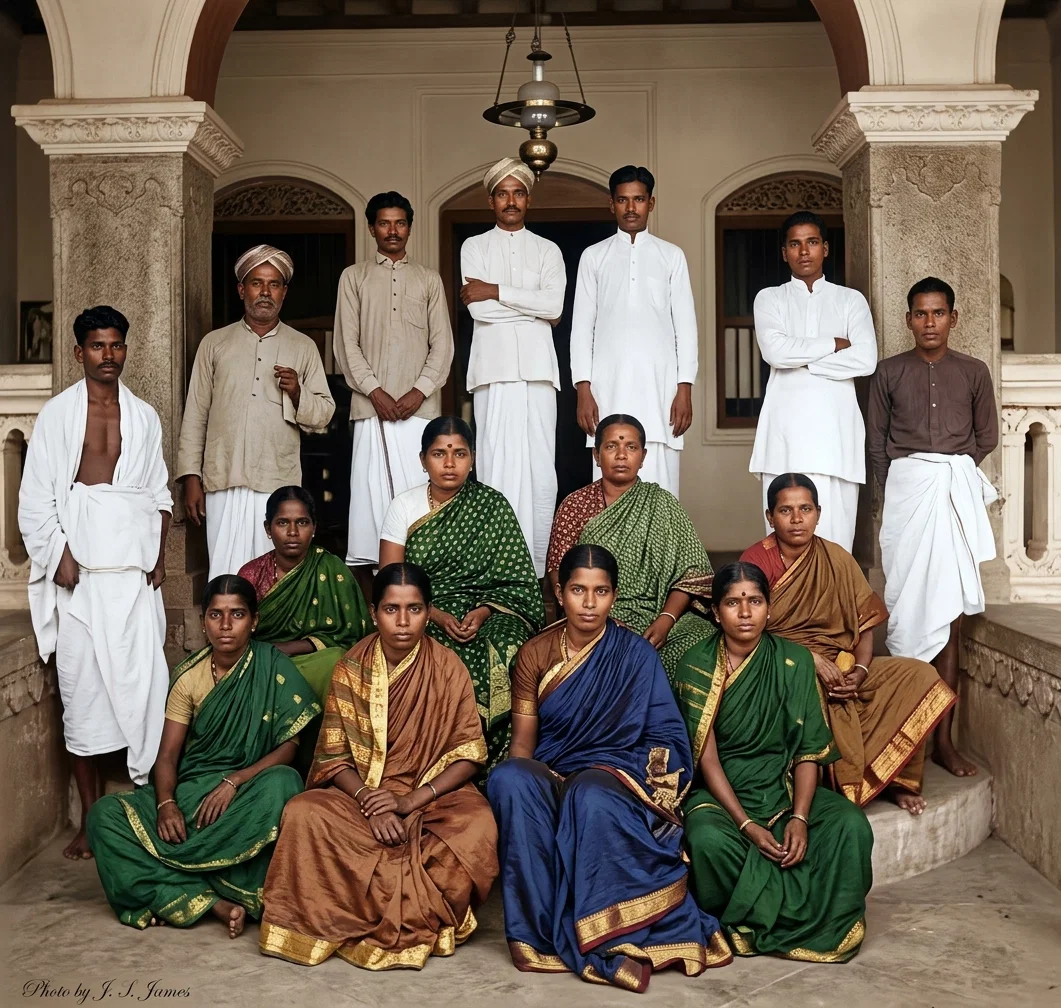
Early in December, 1910, a series of Bible studies for the public was begun on our front veranda. These studies were carried on entirely in the Tamil language by our Tamil evangelist, Brother Thomas. The meetings were quite well attended from the beginning. On Sabbath, February 11, these services were brought to a close by the baptism of sixteen persons in a lake near our mission. Thirteen of these came from practical heathenism and three from the Anglican Church. The latter have been teachers in our school for the past year and a half. For a long time they had been under conviction of the truth, but lacked courage to step forward until lately. It means a great deal for a woman in a country like India to obey the truth, particularly if she is unmarried. The women are brought up from babyhood to look upon the male sex, especially their husbands and brothers, as the lords of creation; and it requires a bold spirit to run counter to their wishes. It excites very little comment for a man to take a pestle (a piece of wood about the size of a wagon neck-yoke, used in every house for pounding rice), and beat his wife or daughter until she obeys him. This is frequently done in communities where civilization has had but little influence.
Photo by J. S. James
In these parts, marriage is contracted by the father of the girl, who buys the bridegroom. In other words, he must give a dowry of money or jewels sufficiently large to induce the man to marry his daughter. If the girl's father fails to raise the amount necessary, and if she is not married within the customary period, she is greatly disgraced in the eyes of the public. The reader can hardly imagine to what absurd lengths the father will go to avoid this sentiment. Custom is the giant wheel that grinds the neck of India's millions.
Of the sixteen persons baptized, eight are women. Three of these have husbands, who were baptized last year, two are widows, and three are unmarried. The fact that these women have taken a stand to obey the truth has created considerable talk and opposition from various sources. Such a thing has never before been witnessed in this locality. The feeling aroused by this step, with other events of the past year in connection with our work, has caused me much serious study and concern.
The vastness of the work to be accomplished is almost beyond human conception. Naturally, we crave those things with which we have been taught to work at home, and to use the same methods. Many times the absence of these causes us to feel that we are not sufficiently equipped to do successful work; but I believe this is a mistake. I have watched this principle carried out here on a small scale, and I believe it can be universally applied.
In our last public effort we had nothing to commend us to the people. We had no sanitariums, no colleges, no publishing-house. We had no books nor papers for the people to read. But we had the Word of God, which “is quick, and powerful, and sharper than any two-edged sword.” As I saw this weapon fearlessly and earnestly used night after night; saw it battling with the evil natures of men and women who had given themselves up to the lusts of the flesh; and saw it gradually lead souls out of the bondage and superstition of heathenism into the light of the gospel, I could not but adore the efficacy of its power, and long for a greater measure of it in my life. There is no other possible solution of this foreign conquest for the truth. We shall need money and consecrated workers to the close of the struggle. There will never come a time when our people will be denied the blessing of giving both, but we shall never be able in the remotest degree to equip these fields with the paraphernalia for work that we employ at home.
We must copy the great apostle to the Gentiles, and put on the whole armor of God. He was a missionary under conditions very similar to our own. He preached a few weeks at Lystra in South Galatia. Before leaving, he ordained presbyters and organized a self-supporting, self-propagating church. He had scarcely money enough to pay his traveling expenses. See Acts 20:13. Not a word is said about the treasury at Antioch being empty, or of his inability to raise up a church at Iconium, Derbe, or Lystra, because funds were short. We read of no publishing-houses, no schools, no hospitals, no tracts to scatter, save those written by Paul, Silvanus, and Timothy by hand, and sent to the various churches. But we do read of the gospel of God, that was preached with power in the midst of affliction, “in perils of waters, in perils of robbers, in perils by mine own countrymen, in perils by the heathen, in perils in the city, in perils in the wilderness, in perils in the sea, in perils among false brethren; in weariness and painfulness, in watchings often, in hunger and thirst, in fastings often, in cold and nakedness;” and we see that all this bore fruit unto life eternal.
We are endeavoring to train a number of young men as teachers and preachers, to locate in various out-stations. This is slow and difficult work, but it is the most effectual way of reaching the people. Elder and Mrs. G. G. Lowry have passed their first year's examination in Tamil, and are now able to talk and give Bible studies in that9tongue. Within the present year, we hope to open up another main station for the Tamil people. God has been very good to us in preserving our lives and in giving us health. We are all of good courage, and ask to be remembered in your prayers, that the word of God may have free course, and that many souls be gathered out for his kingdom.