Through the Andes

7%

Review and Herald Publishing Association · Washington, D. C. · Apr 13, 1911

FromReview and Herald, Vol. 88, No. 15.

Read the full edition

Through the Andes

From Buenos Aires to Santiago
L. R. CONRADI
LEAVING Buenos Aires, November 13, in a comfortable second-class carriage, we crossed the vast pampas of Argentina, extending some six hundred fifty miles from the coast to the mountains, in about twenty-two hours. One third of this distance was made with not so much as a curve in the track. As one crosses the fertile prairies of Argentina, covered with innumerable groups of horses, cattle, and sheep, with here and there also a flock of ostriches, and as he sees the occasional broad acres of wheat and Indian corn, he is reminded of the prairies of Kansas and Nebraska. However, there is one exception,—one may ride for hours, see fields of waving grain, and thousands of cattle, but one looks in vain for the hundreds of comfortable farmhouses one would see in covering the same distance in the States. Only now and then does one see a small farmhouse, surrounded by a few trees, where the farm-hands live. Barns and stables do not seem to be necessary. These large ranches are in the hands of wealthy landlords, whose estates run up to from twenty to a hundred thousand acres, and who prefer to live in city palaces rather than in country farmhouses. Thus one fourth of Argentina’s population lives in the cities, and its capital, Buenos Aires, has a population of a million and a quarter. It is thus the largest city in the southern hemisphere, the largest Spanish city in the world, and ranks fourth among the cities of America. As to its extent, it is surpassed only by London. Its architecture and fine buildings vie with those of any of the great world-cities. In crossing the prairies, we found that fair Argentina has also its curses. Again and again we met large swarms of grasshoppers darkening the sky.
At six o’clock the next morning, November 14, we reached the city of Mendoza, at the foot of the Andes. Vast vineyards, where excellent grapes and delicious fruits grow, covered the foothills everywhere; and as the workmen were nearly all Italians, one could almost fancy himself transported into Italy. Here we changed cars, as the mountain railway is a narrow-gage pinion railway. For miles it wound its way upward, closely following a mountain stream. Soon the lovely vineyards disappeared, and there was scarcely anything to be seen but bare rocks. After a run of about eighty miles, the grade became so steep that the powerful engine advanced only slowly, now using the pinion rail.
Soon the majestic, massive giants of the Andes came into sight, dipping, as it were, their snow-covered peaks into the very clouds. Now and then the highest of all South American peaks, the Aconcagua, burst into full sight, resting on the broad shoulders of this immense range, and reaching the lofty height of nearly twenty-three thousand feet. At Las Cuevas, about one hundred ten miles from Mendoza, we reached the long tunnel which pierces the summit of the Cumbre Pass at an altitude of twelve thousand feet, and which connects the Atlantic and the Pacific. Near the center of this pass the border-line is crossed; consequently as we came out of the tunnel, we found ourselves on Chilean soil. The first sign of this was the Chilean soldiers clothed in German uniform. The narrow strip of coast-line which extends some two thousand five hundred miles along the Pacific, forms the Chilean republic. Our train quickly descended a very steep grade. In less than forty miles we arrived at Los Andes, where we again exchanged the narrow-gage railroad for the Chilean broad-gage.
All the way down from the pass, we could see the many zigzag paths over which travelers formerly had to ascend and descend these barren mountains. The Chilean coaches are built on the American plan, and their locomotives are of German make. In less than forty hours we had made the trip between Buenos Aires and Santiago; and as our train stopped, some thirty Chilean brethren and sisters welcomed us, among them Elder F. H. Westphal. They took us to their hospitable homes, and after one day’s rest, we again took the train to go four hundred miles farther south to attend the general meeting.
All the way, as our train passed through well-irrigated valleys covered with fields of grain and with orchards, the mighty Andes loomed up on our left, some of their peaks emitting smoke from time to time. The farther south we went, the cooler it became, and the more moist was the climate. By the time we arrived at Pua, where the school is located, we had entered the temperate zone, being fully four hundred miles south of Cape Town, South Africa.
One of our brethren awaited us with a two-wheeled buggy; so Elder Westphal and I climbed into it, and drove over somewhat rough and stony roads through fenced-off farm land, some three miles from the station, the other brethren following on foot. After passing a grove, which we had already seen from the station, a three-story frame building came in sight; and as our buggy drew near, a number of schoolchildren came out to meet us. Seemingly, we had arrived a bit too early; but the welcome was just as much enjoyed. After a good meal, the students sang, gave recitations, and made some addresses in Spanish, English, and German.
We had a two days’ general meeting here, all the members of the Chilean Conference Committee being present. Quite a number of our own people and strangers were there also, among them some of the Indians of the neighborhood. The brethren have a farm of about forty acres in connection with the school and there are about fifty students, mostly children, in attendance. Prof. G. W. Casebeer is the head teacher.
We then hurried back to Santiago, to spend Friday, Sabbath, and Sunday with the church there. The Chilean Conference has a membership of nearly four hundred. While there is quite a sprinkling of Germans among them, they are mostly natives. At Santiago, the capital, there is a growing church of nearly a hundred members. Their meeting-hall has a direct entrance from the street, and is thus rather noisy. How to secure suitable halls in the large cities of South America, with their expensive rents, isquite a problem.
Santiago itself is a beautiful city. On account of earthquakes, the buildings are mostly one story high; and yet there are fine public edifices and churches. Some of them, however, still show signs of the great earthquake which so seriously affected Valparaiso. The chief attraction here is a large isolated rock, rising five hundred feet in the very heart of the city. The sandy soil surrounding this rock has been made fertile by skilful gardeners, and it has been transformed into a beautiful park, which is illuminated at night by hundreds of electric lights. As Santiago lies in the plain, one can here obtain an excellent view of this large and extended city, with its four hundred thousand people.
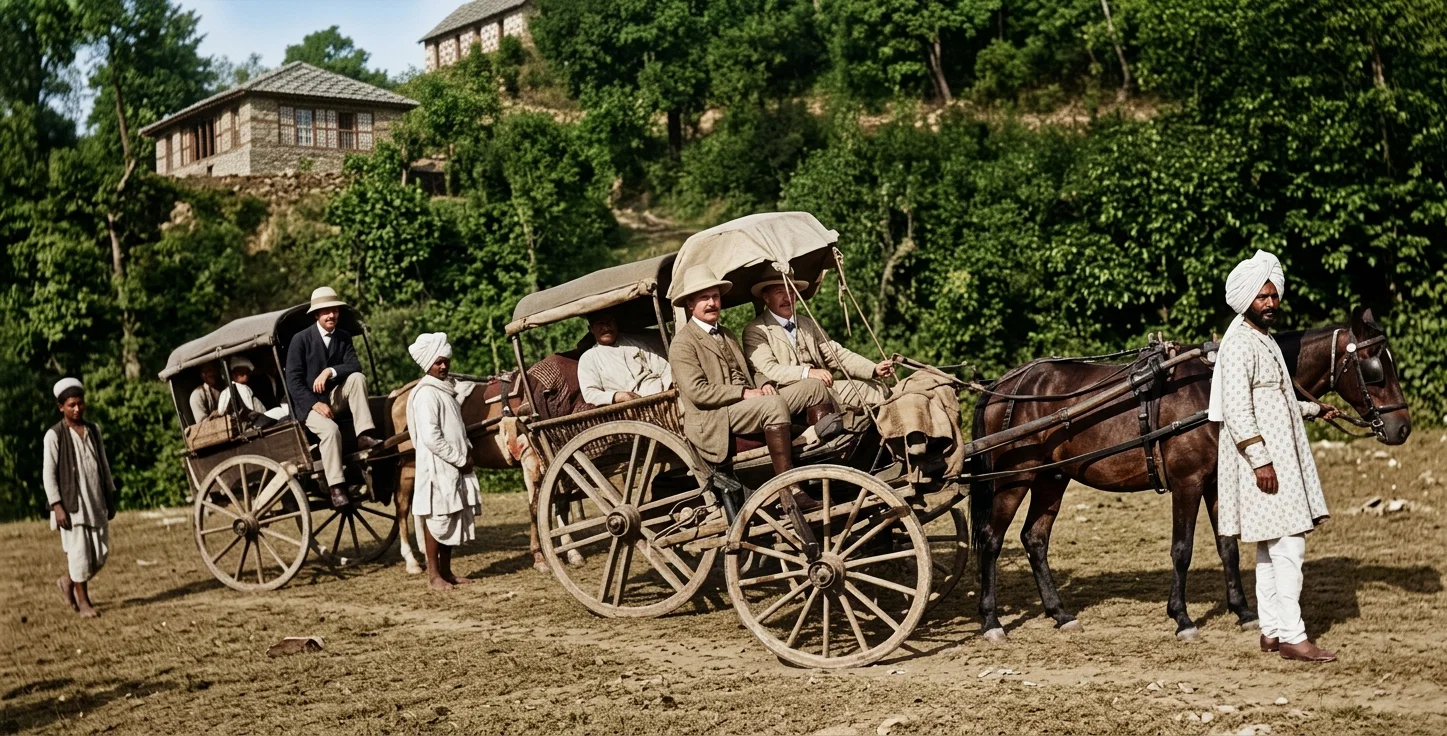
Photo by Dr. H. C. Menkel
PARTY VISITING GARHWAL SCHOOL; BRETHREN W. W. PRESCOTT AND
L. J. BURGESS ON THE CARTS
Photo by Dr. H. C. Menkel PARTY VISITING GARHWAL SCHOOL; BRETHREN W. W. PRESCOTT AND L. J. BURGESS ON THE CARTS
One mountain near by has on its summit a large monument of the madonna, overlooking the city as its patron saint. There are not only many large Catholic churches, but also some fine Protestant buildings here. The Presbyterians have a beautiful school, and the Methodists have a college for girls. Our own growing church in that city testifies that it is good soil for Protestant missions, which truly are needed in this country. When we think of the extent of Chile, with its four millions of people, its handful of workers, and its many openings, we are constrained to say, The fields are indeed white for the harvest, but where are the reapers?