Widowhood in India

6%

Review and Herald Publishing Association · Washington, D. C. · Mar 2, 1911

FromReview and Herald, Vol. 88, No. 9.

Read the full edition

Widowhood in India

EDITH E. BRUCE
One evil begets another; and as a result of the awful practise of child marriage in India, we have an army of twenty-six million widows. The widows of India are equal to one half the population of the German empire. One woman out of every six in India is a widow. In 1901 there were 391,147 widows under the age of fifteen; 115,285 under ten, and 19,487 under five years of age, besides 1,064 baby-widows under twelve months old. Bengal, India's largest province, with an area of 151,185 square miles, has 9,567 widows under five years of age, and 528 under one year. It would take volumes to depict the misery hidden in these figures.
Here, again, we see the contrast between the true and the false religion. With what tender compassion were widows regarded by our Heavenly Father, as he gave definite instruction to the children of Israel in regard to them! “Ye shall not afflict any widow, or fatherless child. If thou afflict them in any wise, and they cry at all unto me, I will surely hear their cry; and my wrath shall wax hot, and I will kill you with the sword; and your wives shall be widows, and your children fatherless.” Ex. 22: 22-24.
All through the Old and the New Testament the widow is looked upon with mercy and pity. Job pleaded his own righteousness by saying, “I caused the widow’s heart to sing for joy.” Job 29: 13. James writes: “Pure religion and undefiled before God and the Father is this, To visit the fatherless and widows in their affliction, and to keep himself unspotted from the world.” James 1: 27.
The Hindu religion brings no hope or comfort to the unfortunate widow. Believing in the transmigration of the soul, and holding woman at such a low standard, the Hindus take it for granted that whatever calamity befalls the son is the result of sin committed by his wife in some former incarnation, though she may, at the time of his death, be a mere babe. Therefore she is abhorred, degraded in person, and reproached with such terms as only the cruelty of ignorance and superstition can utter. She is powerless. Custom, society, and public opinion are against her. If she is yet a child in her father’s house, and remains there, the love and affection of the mother may soften and mollify the evil effects of superstition. But if she is in the father-in-law’s house, her trouble begins at the very hour of the husband’s death. Mingled with the lamentations of the family, are reproaches and even curses for the widow. This attitude toward her does not cease as the first outbreak of grief subsides, but lasts through all her lifetime. Her ornaments, which mean so much to the ignorant, darkened mind of the Hindu woman, are rudely snatched off, never to be worn by her again.
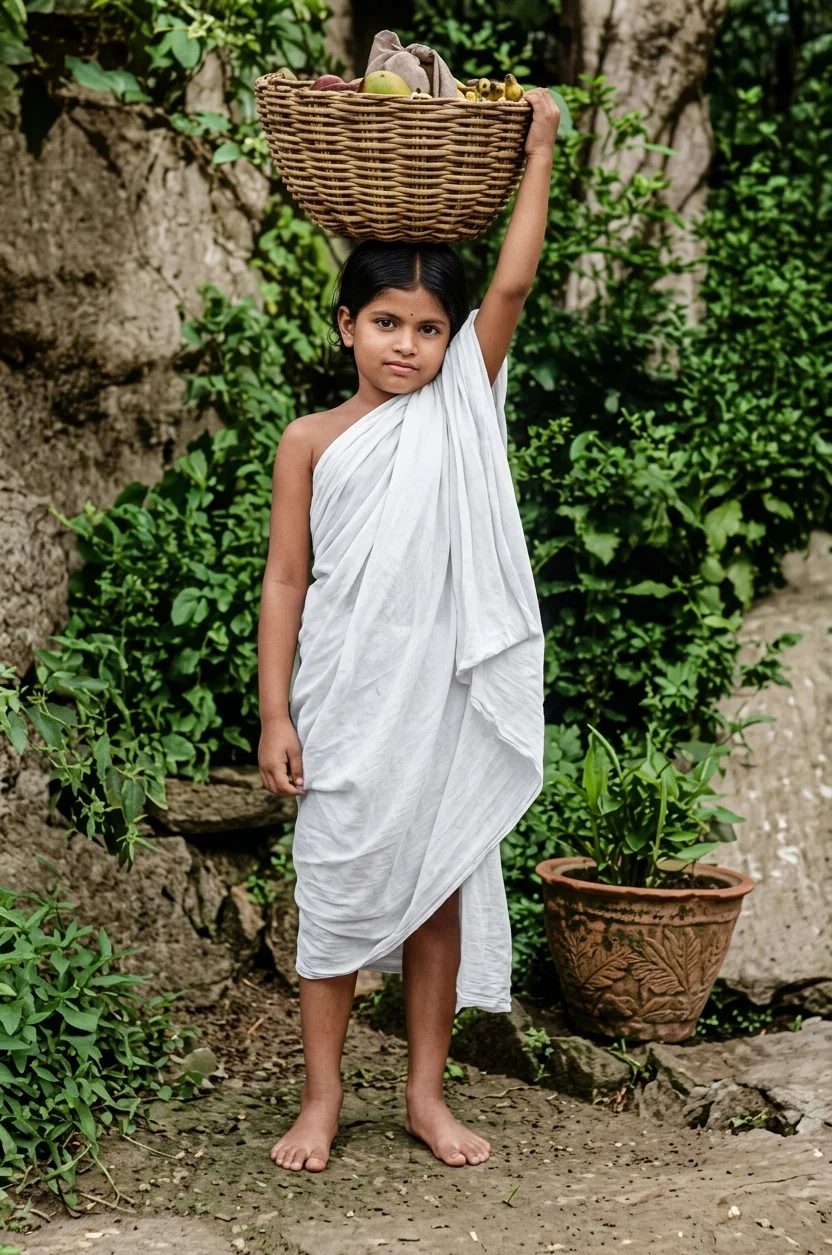
A BENGALI WIDOW, ONLY SIX YEARS OLD
The village barber is called, and in no gentle manner her long hair is shorn from her head, and she must have her head shaved every ten days. On her forehead certain vermilion marks, indications of the glory of the married state, must no more appear. Her pleasant attire is taken away, and replaced by coarse white clothing without border or trimming. She is made a household drudge, despised and scorned by family and neighbors. She must now get up very early in the morning, even before the family servants, to bring water from the well. It is bad luck to meet her on the way. She must not sleep on any easy couch. She must have but one meal a day, and that of the coarsest food; and twice during the month she must make a complete fast of twenty-four hours, not even taking a drink of water.
If there is a wedding or any festivity in the house, she must not be present, lest she bring her own ill-fortune into the lot of others. In all civilized countries there is a law to protect children, feeble-minded persons, and animals; but in India the cruel customs of a heathen religion take an innocent, helpless child, without her consent, yea, without her being old enough even to realize what is being done, and give her in marriage perhaps to a gray-headed man, or perchance to a little boy. Then, if he dies, she must remain his widow for life, subject to all the cruel tortures imaginable, and the law is powerless to help her.
In all cases except those directly connected with life and death, the British government is bound, according to the treaties concluded with the inhabitants of India, not to interfere with the former’s social and religious customs and laws; judicial decisions are given accordingly. The duties of a widow are thus described in the Hindu code of Manu: “At her pleasure let her emaciate her body by living on pure flowers, roots, and fruits; but she must never even mention the name of another man after her husband has died. Until death let her be patient of hardships, self-controlled, and chaste, and strive to fulfil that most excellent duty prescribed for wives who have one husband only.” “In reward of such conduct, a female who controls her thoughts, speech, and action, gains in this life highest renown [?], and in the next world a place near her husband.”
By this code it is plainly seen that there is but one place where the Hindu woman can be independent of her husband, and that is in perdition. The most cruel, repellant custom taught by the Hindu religion was the suttee, whereby a wife could ascend the funeral pyre of her husband, and perish in the flames with his dead body. Though this practise was not universal in India, and not taught by the Vedas, it was greatly encouraged, and history states that many lives were given in this way. In a radius of thirty miles around Calcutta, three hundred women thus offered up their lives within six months. Little girls no more than nine years old, went through this most dreadful torture. It is said that if, when the flames began to rage, they flinched or tried to escape, they were held down with bamboo poles. In many instances several wives were immolated at the same time. At the close of the last century a Kulin Brahman died three miles from Serampore, near Calcutta. He had married more than forty wives, of whom twenty-two died before him. At his obsequies a great fire was prepared, into which the remaining eighteen threw themselves, leaving more than forty children. Happily, the suttee is a thing of the past. By a government decree dated Dec. 4, 1829, it was declared illegal. This, in time, put a stop to it. Cruel as this torture was, the living torture of the widow is such to-day that many would gladly return to this custom, preferring to suffer for a few moments the agonies of death in the flames than to spend a lifetime of misery in the home of the father-in-law. The conditions and feelings of the Hindu widow are vividly portrayed by the following prayer offered by a pupil of a British zenanamissionary, one of the few Hindu women who can read or write, and one who has been a widow from childhood:—“O Lord, hear my prayer! No one has turned an eye on the oppression that we poor women suffer, though with weeping and crying and desire we have turned to all sides, hoping that some one might save us. . . . O Lord, inquire into our case! For ages dark ignorance has brooded over our minds and spirits; we are like prisoners in an old, moldering house, choked and buried in the dust of custom, and we have no strength to get out. All-knowing God, hear our prayer! Forgive our sins and give us power to escape, that we may see something of thy world. O Father, when shall we be set free from this jail? We have not for one day, no, not even in our dreams, seen thy world; to us it is nothing but a name. We see only the four walls of the house. Shall we call them the world, or India? We have been born in this jail, we have died here, and are dying. O Father of the world! hast thou not created us? or hast perchance some other god made us? Dost thou care for men only? Hast thou no thought for women? Why hast thou created us male and female? O Almighty! hast thou not power to make us other than we are, that we, too, might have some share in the comfort of this life? O God, almighty and unapproachable! think upon thy mercy, which is a vast sea, and remember us. Save us, for we can not bear our hard lot; many of us have killed ourselves, and are still killing ourselves. God of mercy, our prayer to thee is this, That the curse may be removed from the women of India. Create in the heart of man some sympathy, that our lives may no longer be passed in vain longing; that, saved by thy mercy, we may taste something of the joys of life.”
The above is a prayer of a high-caste Hindu lady, who has been taught of God in her home by a missionary. She is not allowed beyond her own threshold. While the low-caste widow is compelled to work, perhaps carrying brick and mortar on the street, yet in this she has the advantage of the open air, though her life is spent in drudgery.
We can not imagine the suffering of the widows of India; but as we look upon it, our hearts grow sick, and we are led to ask, What can we do? Our loving Heavenly Father is not unmindful of their cry, and he has said, “Go ye into all the world, and preach the gospel to every creature.” That “every” takes in the twenty-six million widows of India; and the gospel of Jesus Christ alone will bring light and joy into their hearts, dispelling doubt, gloom, and superstition. O for more missionaries to enter these darkened prisons! O for more means to rescue these little ones from cruelty, and place them under the sweet influence of the gospel!
Fathers, mothers, have you already made your greatest sacrifice? Can you spare just a little more to help bring to them blighted lives the message that is so dear to you? Do we really believe Jesus is soon coming? Do we want him to come? There is a mighty work to be done in India before he comes, and many are dying every day without a Saviour.
Let us pray and work and give as never before, that his kingdom may be hastened, and the time come when sin and sorrow shall be no more.
Calcutta.