Child Marriage in India

4%

Review and Herald Publishing Association · Takoma Park Station, Washington, D. C. · Feb 23, 1911

FromReview and Herald, Vol. 88, No. 8.

Read the full edition

Child Marriage in India

EDITH E. BRUCE
“The condition of its women is the truest test of a people’s civilization. Her status is her country’s barometer,” says Dr. J. P. Jones, in “India’s Problem: Krishna or Christ?” If this is true, certainly India falls to a very low mark; for the condition of Indian women is deplorable.
I believe I voice the sentiment of every one who has investigated the conditions of India, with its millions of adherents to the Hindu religion, when I say that the greatest curse that this system of religion has brought upon the homes (?) of the people is child marriage. At the time of the last census, there were 2,273,245 wives under the age of ten; 243,503 under the age of five; and actually 10,507 baby-wives under one year.
Consider this, fathers and mothers! Could you think of giving your own little girl of twelve years, even, to a man thirty or forty? or your eight-year-old darling to a thoughtless, selfish man of twenty-five? The code of Manu says: “A man aged thirty shall marry a maiden of twelve who pleases him, or a man of twenty-four a girl eight years of age.”
But although the code of Manu gives the minimum age of eight years, the orthodox Hindu is taught that the earlier the marriage, the more creditable to the parents and the greater their reward in heaven. It is the popular belief that no woman can have salvation unless she is married; hence the anxiety on the part of the parents to marry their daughters as early as possible. Custom has also made it popular for boys of ten and twelve to marry girls of seven or eight, but it is not such a disgrace for them not to marry young as it is for girls.
There is one class that must betroth their daughters soon after birth. A young Brahman sixteen years of age was reported by a missionary to be in great perplexity and distress. Upon inquiry he said he feared he could not find any one to marry his little baby girl, as he did not have very much money. Often little girls and boys cry at their own wedding, because they have lost sight of their mothers, and are frightened in the din and confusion of the wedding festivities, or perhaps are sleepy and tired.
The giving of little girls in marriage is not because of a lack of love on the part of the parents; for, though unwelcome at birth, they often win the heart of the father, and are petted and adored by him in early childhood. It is said that no mother loves her child more than does a Bengali. It is the cruel caste system, stronger than parental love, that snatches these little ones at such tender age, and carries them into the homes of strangers, there to become the marital property of men perhaps old enough to be their fathers.
I was very much touched by an incident related by Mrs. Ada Lee, a missionary of Calcutta, who has done much commendable work among the Bengalese.
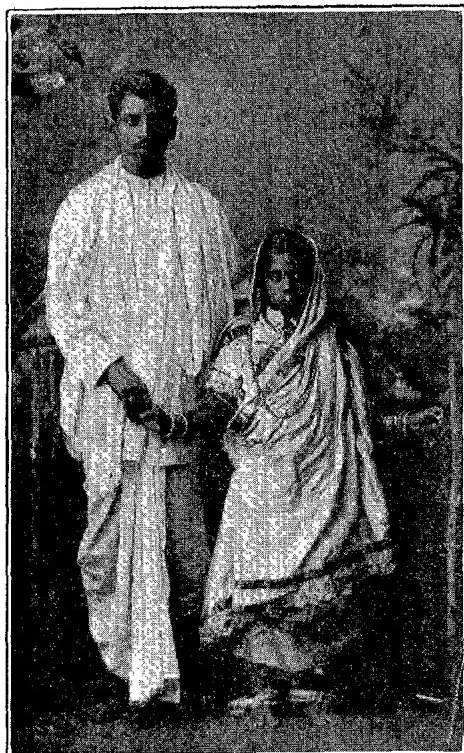
A YOUNG BENGALI MAN WITH HIS LITTLE GIRL-WIFE
While these marriages are the custom in India, yet the picture is a rare one. A missionary had tried for years to get one like the above, without success. The young man is about twenty-five, the girl eight or nine years of age.
It illustrates the condition of many, and shows how the people are held in an iron grasp by a superstitious caste system. She said that one day a middle-aged high-caste Brahman gentleman, of fine, noble appearance, and speaking English fluently, came to her for help. He told her that three of his little daughters had attended one of her day-schools in another part of the city. Now one of these little girls was in serious trouble, and in his extremity he came to her, hoping that in some way she might be able to help him.
At the age of eight he had given this little daughter in marriage to a man who he hoped would make a good husband. After a few months the husband came, and begged to take his child-wife to his own home. The child hated him, and pleaded to be left with her parents—as what child would not? Finally the father succeeded in persuading his son-in-law to leave her with her mother until she was a little older. As the husband returned from time to time, the father pleaded for his child, and so for a while he was able to keep her. But one day the husband came when the father was away, and by force took his poor little frightened bride.
For months the parents knew not where she was. But having learned to read and write, one day she wrote a note to her father, and dropped it from an upper window, whispering to a little girl below to take it to the Bible woman who visited in that neighborhood. In this note she begged her father to come and release her from this awful man. The tortures she had suffered are too terrible to be related. The father sued the man for cruelty, and the child, not being twelve years of age, was given into his hands once more; but now the time had expired, and the husband had brought suit against the man for detaining his lawful wife. In two or three days would be the trial, and the law declared that the child must appear, dead or alive. What could the missionary do? What could the father do? One thing he might do,—break his caste and keep his daughter, but of this he said to Mrs. Lee: “O, yes, I know its evils, and how much we suffer from it, but I am a Brahman, and would be put out of caste if I did not keep our rules, and marry my girls while young; and, you know, we fear each other until we are not able to do that which is right.” And because he feared to do that which he knew to be right, his little innocent, sensitive, delicate child was placed on the altar of Hinduism, there to suffer the rest of her natural life.
The case was tried, and the law gave that brutal man whom they called her husband, this little girl, as they would have given him a horse or a cow. In charge of a police officer she departed for her husband’s home, not in anticipation of being the tenderly cared-for, honored bride, the mistress of the household, but beating her head and shrieking, begging to be shot rather than to be returned to this house, where nothing but cruelty and the worst drudgery awaited her.
This is no sensational story, but an actual fact, and only a sample of what frequently occurs. If we could but look behind the purdah, and behold the more than nine million child-wives,—little girls with all the joy and light of freedom crushed out of their lives,—I am sure that our hearts would be filled with righteous indignation, and in loving sympathy we would cry out, together, “How long, O Lord, holy and true, dost thou not judge?”
Again, from this code which sways so mighty an influence over this people, we quote the following: “Neither by sale nor by repudiation is a wife released from her husband; such we knowto be the law which the Lord of creatures made of old. The ancient sages declare: A bride is given to the family of her husband, and not to the husband alone.”
Ramabai, in her book entitled “The High-Caste Hindu Woman,” says: “The girl now belongs to the husband’s clan; she is not only known by her husband’s name, but in some parts of India the husband’s relatives will not allow her to be called by the name given her by her parents; henceforth she is a kind of impersonal being. She can have no merit or quality of her own.”
The code says: “Whatever be the qualities of the man with whom a woman is united in lawful marriage, such qualities even she assumes, like a river united with the ocean.”
It is not always easy for parents without means to find husbands for their daughters; and rather than suffer the disgrace of having them remain unmarried, they often give a girl of eleven or twelve in marriage to an old man of sixty years. Frequently, fathers give a daughter in marriage to an entire stranger, without knowing or making inquiry concerning the suitor’s character. They take a man’s word for his caste and clan, and submit to him forever the life of their little daughter. After the marriage ceremony, the man takes his bride home, and places her under the care of his mother, where she often takes up the work of the family. If this mother-in-law is a kind-hearted woman, the child fares quite well; but woe to the little one with a hard-hearted mother-in-law to rule over her! She may be subject to the most dreadful tortures; but to whom can she go, or where find refuge? Is she not the lawful property of her husband and his family? and may they not do as they please with her? Law is against her; public opinion is against her; so there is nothing for her to do but to submit. Sometimes she seeks relief in the nearest tank or well, and so ends a life born to misery and woe.
In presenting this subject to an intelligent people, who know anything of the anatomy of the human body, it is needless to dwell upon the physical effects of child-marriage. It is not an uncommon thing to see little girl mothers of eleven or twelve years, or a woman of twenty with a large family of children. It is said that there is one tribe in North India whose women are never able to stand erect. And I have noticed, as I have walked in the streets, that at least three fourths of the women are undersized. Among the wealthy, high-caste women, who are not obliged to work, and are not allowed the freedom of the open-air walks, etc., the opportunity for exercise is very limited. The greatest distance that many of them know is an occasional trip from the father-in-law’s house to the parental home. All this is dwarfing alike to the physical and the moral nature. One of these “shut-ins” said to a missionary, “You are like the birds flying in the air; we, like the ones in a cage.”
Of course it must be understood that I am speaking of the masses—the vast majority—of the Indian people. India has noble people, who have broken the bonds of caste at a mighty sacrifice, and have educated their daughters. One of the brightest and truest women I have ever met, and to whom I am much indebted for information on this subject, is an Indian woman who has creditably qualified herself as a lawyer, and is giving her life to the women and children of Bengal. But such as she are few and far between. Only one per cent of the one hundred forty-four million women of India can either read or write. The East moves slowly; and so the years come and go, and thousands upon thousands of these girls and women, who know not a burden-bearing Saviour, are born, married, and rear children, with no hope of happiness or heaven, save as they worship their good husband. This is their life; they know no other.
O for the time when we shall have consecrated Bible workers to go to these blighted homes, and teach the women of India the story of Jesus and his love! Mothers, as the twilight fades away, and you kiss your darling little girls good-night, and see them tucked away in bed, safe in your loving care and protection, think of these little ones in far-away India, with their hands outstretched for mercy and help. Breathe a prayer that we may know just how to reach them, and that you may know the best way to help us.
Calcutta.