But one foreign worker was added to the staff of the Japan Mission during 1909, Miss Etta Cornish, a nurse and Bible worker. The little force of Japanese laborers shows greater increase. Elder F. W. Field, the superintendent of the mission, writes:—
NEW WORKERS
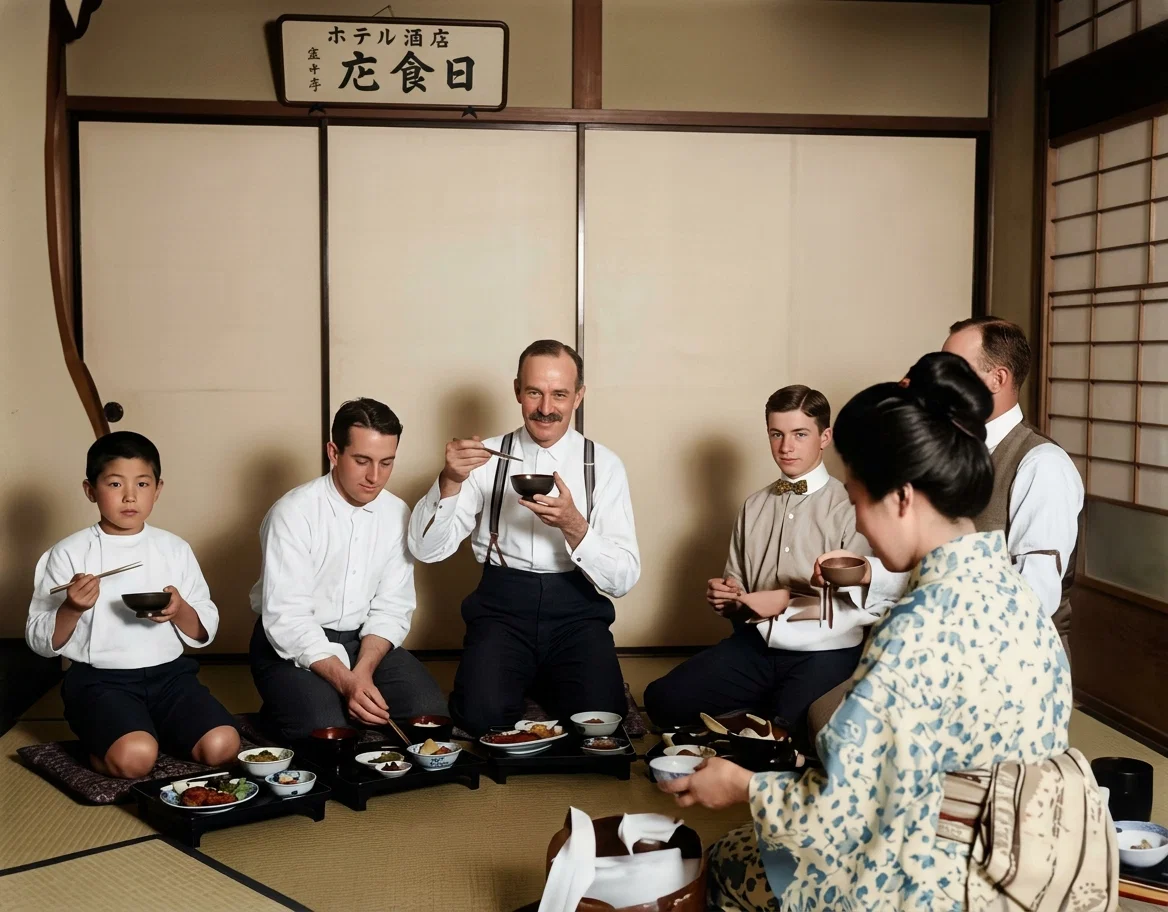
W. D. BURDEN AND FAMILY (JAPAN) TAKING DINNER AT A HOTEL
In the autumn of 1908 we opened our first real training-school for workers, in Tokyo. When the course closed in February, this year (1909), nine or ten new workers went out to devote their time to the spread of the message. In November, 1909, the school for workers was resumed, with about twenty students aiming at a quick preparation for the field. We have few facilities for making a school; but with the blessing of the Lord and the earnest spirit among students and teachers, we expect success.
EVANGELISTIC AND MEDICAL EFFORT
The baptisms for the year numbered forty-nine. Early in the year a new company was brought out at a place not far north of Tokyo. Later others were added, and finally eleven were baptized and organized into a church. During the summer a course of tent-meetings was held at Wakamatsu, and a most encouraging interest was awakened in this city of about forty thousand inhabitants. As a result thus far, eight have been baptized, and twenty more are especially interested. A number have also been added to the churches in Tokyo and Kobe.
In our medical missionary work we have apparently taken a backward step, but not truly so. Our Kobe foreign sanitarium was closed the latter part of February. This was in harmony with the plans for establishing a permanent institution in connection with the center of the work at Tokyo. We have not been able to go ahead very far with these plans for lack of means. But in the meantime the sanitarium workers are enjoying the much-needed opportunity of studying the language. The Eisei-in, our Japanese sanitarium at Kobe, under Dr. Noma, has enjoyed a very prosperous year in every way.
YOUNG PEOPLE’S SOCIETIES
Active young people’s societies at Kobe and Tokyo were reported for the first time in 1909, organized after the return of Elders Field and H. Kuniya from the Washington General Conference. A somewhat novel campaign is reported by the Tokyo society:—
It is a campaign to induce people to leave off the harmful tobacco habit.25
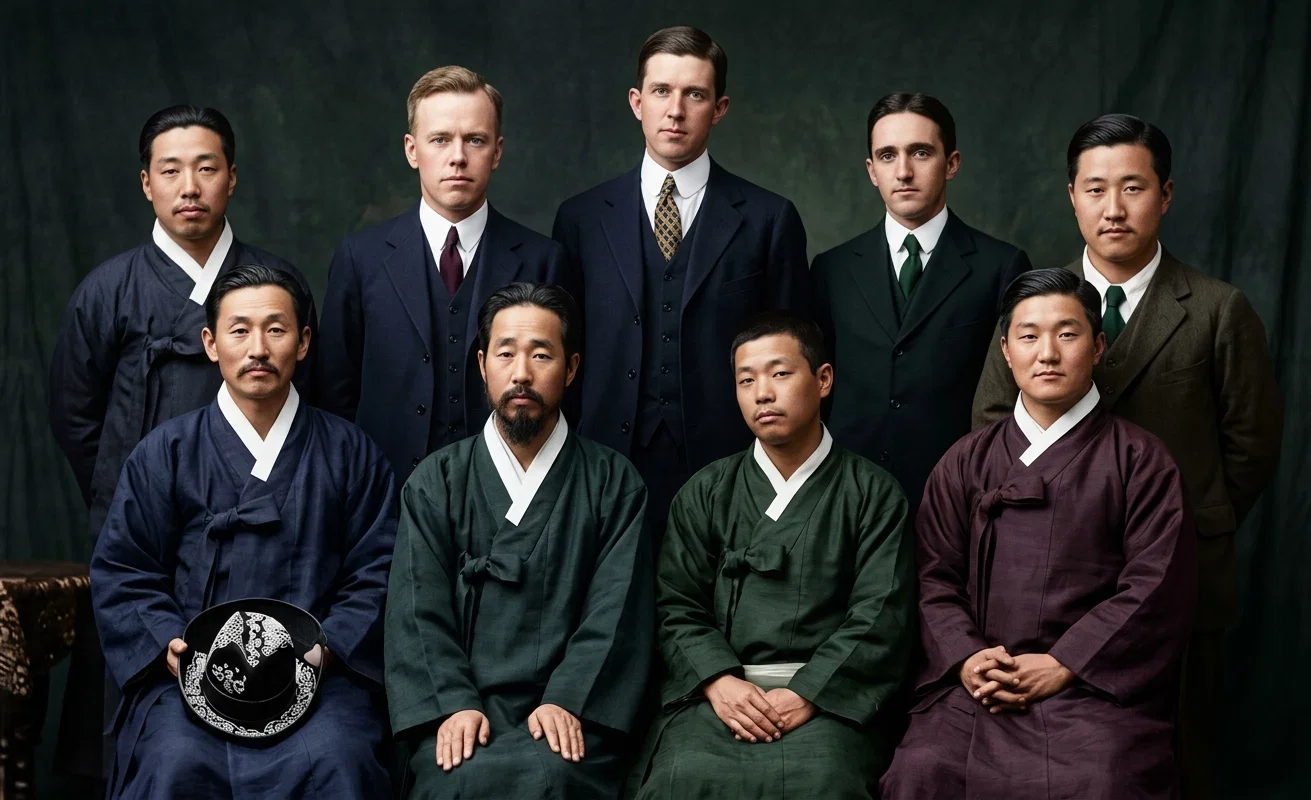
A KOREAN WORKERS GROUP
Back row from left: Kong Ku Myong, C. L. Butterfield (superintendent), H. A. Oberg, R. C. Wangerin, Kim Ku Hyok. Front row: Kim Won, Kim Hyo Sep, Kim Na Chun, Ne Keun Ok.
Passing a house one day, Brother Kuniya saw a man smoking his pipe—a very common sight in Japan. Approaching, he accosted the man about as follows: “If you saw a neighbor’s house on fire, you would raise an alarm, wouldn’t you?” “Certainly I would,” the man replied. Then pleasantly referring to the smoke he saw issuing from the man’s lips, Brother Kuniya said he had stopped to give him warning. Then followed a talk on the evil effects of tobacco, with the result that the man was persuaded to stop the practise; and as a pledge of his sincerity he was asked to surrender his pipe, which he did. This experience encouraged others to undertake the same kind of work. At this writing the society’s collection consists of twelve pipes, six pouches, one tin box containing tobacco, and two packages of cigarettes.
PRINTING THE MESSAGE
A year ago we published a special number of our missionary paper, the Owari No Fukuin (Gospel for the Last Days), and about five thousand copies were used. We expect this year to use twice as many. We have not developed much new literature this year, as the workers in our little printing-office have been kept busy supplying the literature already produced. However, some new work has been begun. Our canvassers are gaining a valuable experience, and we believe that this branch of our work can soon be made self-supporting.