L. R. CONRADI

6%

Review and Herald Publishing Association · Takoma Park Station, Washington, D. C. · Feb 24, 1910

FromReview and Herald, Vol. 87, No. 8.

Read the full edition

L. R. CONRADI

From Russia to Ethiopia

L. R. CONRADI
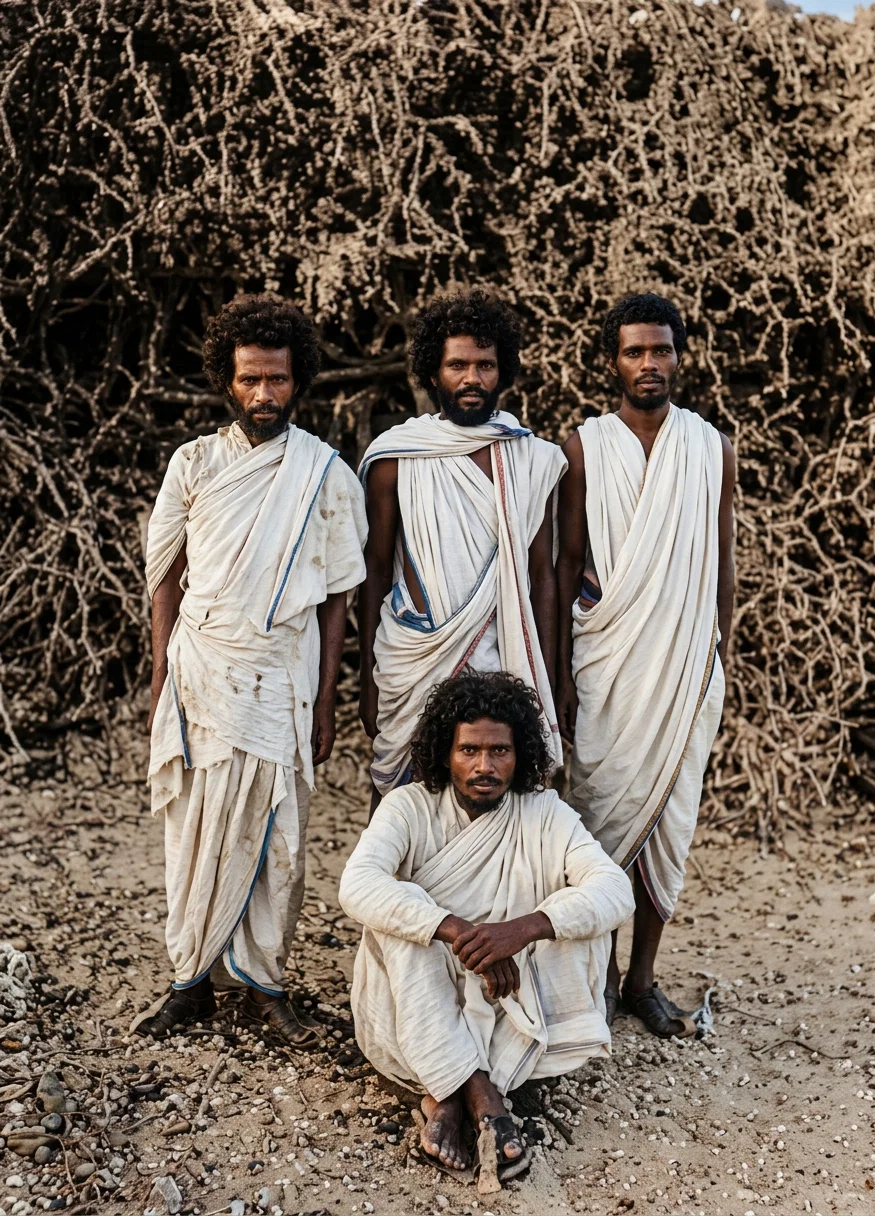
MOHAMMEDANS OF THE COAST
THE day our last meeting in Russia closed, Oct. 31, 1909, Dr. F. W. Vasenius and wife and myself departed on the steamer “Tschischatschow” for Alexandria. Dr. Vahon Pampaian went with us also as far as Constantinople, at which place we did not arrive until Monday evening, for our third-class passengers had to go ashore as we entered the Bosporus, to pass the quarantine. Several brethren called on us in the evening. Next morning we went ashore; and, so different from former days, no official troubled us about passports or anything else. When we reached the house of Elder Z. G. Baharian, we found quite a company gathered awaiting us. Brethren E. Frauchiger, Guy Dail, Baharian, R. S. Greaves from Smyrna, Onik from Nicomedia, F. Scior, and C. Voigt, who had lately arrived from Germany, were present at the council; Dr. Pampaian, and later Elder H. F. Schuberth and Dr. E. Meyer, from Germany, joined us. The presence of a number of new workers seemed to indicate that a new era was dawning upon our work in the Turkish field. While in the past we have gained some foothold and have about two hundred thirty members, yet of late years the progress has been very slow. There have been many reasons for this,—plenty of obstacles, much sickness, and troubles from within and without; but now, in God's providence, the doors have been opened wide. The time has indeed come for broader and more progressive plans.
But while it is necessary to plan well, yet great success in the saving of souls, of whom millions are about us who know nothing of the precious truths God has entrusted to our care, is assured only by earnest, hard work. Accordingly, the council decided that Brethren Frauchiger, Scior, and Baharian should labor for the present among the million people in the great capital itself; Elder Greaves, in Smyrna and Albania; Dr. Pampaian and Elder Buzugherian in southern Asia Minor. Considerable attention was also given to the matter of securing more literature in the Turkish, Greek, and Armenian languages; and as Brother Voigt, who has gained considerable experience in the Hamburg House, has gone to Constantinople to establish not only a branch, but also to look after the circulation of literature, we hope for greater results in this direction.
On the morning of November 4, our steamer pulled out again, Elder Greaves going with us as far as Smyrna, where we called next day on Mrs. Greaves and some Greek Sabbath-keepers. After a short stop at Piraeus, where the presence of several foreign men-of-war was evidence of the insurrection which had recently occurred in the small Greek navy, our steamer arrived at Alexandria, November 8, and by evening we had reached Cairo. As Brethren G. Keough and Awada were conducting a series of meetings at Luxor, we met only Mrs. Keough, and Brother E. Hartmann who had lately come to this field from Germany, and Brother Bezirdjian. While the work has moved slowly in the Turkish field, this is still more the case in the Arabic field, both in Egypt and in Syria. For years we have tried to secure workers who would stick to the field,—become real “apostles” to it, learning to know not only the Arabic language but also the people,—but sickness and a number of other difficulties have defeated our attempts. We now hope that brighter days are also before us here. As there are millions of souls everywhere, and many Europeans as well as natives, there is no reason why earnest efforts should not assure success. But workers are needed who will stick,—persevere,—and have that overcoming faith which, by the power of God and his truth, conquers every obstacle.
Early on the tenth we left Cairo for Suez. One of our Armenian sisters, with her three children, went with us, to join her husband at Port Sudan. After various vexations — necessary accompaniments of Oriental travel — we boarded our steamer “Prince Abbas,” one of the Khedivial line, and at 5 P. M. pulled out into the Red Sea. Quite a change had taken place in the temperature, and the heat became more and more oppressive as we neared the Sudan. On Sabbath, November 13, early, our steamer entered its chief port, Port Sudan, where a fine express-train awaitedthe passengers at the docks, to take them in twenty-four hours, through mountains and desert, to Khartum, Sudan's noted capital. What great changes have been wrought in this region, especially during the last twenty-five years! Up to the nineteenth century, there was no permanent connection between Egypt and the Sudan. About two hundred miles of desert and the Nile cataracts were effective barriers, behind which Ethiopia extended, a land almost unknown. The noted Mohammed Ali broke the spell, however, conquering, between the years 1819-38, the provinces of Dongola, Berber, Kassala, Sennaar, and Kordofan, founding Khartum as its capital. The Turkish sultan conveyed this territory to the viceroy as the “Egyptian Sudan.” Mohammed Ali sent three expeditions to find the sources of the Nile, but not until 1860 could Speke and Grant notify the world, “The Nile is settled.” About the same time Sir S.
Baker created another self-governing province between 2° and 6° north latitude, called the “Equatorial.” To this, in 1874, the province of Darfur was added. But Egyptian rule proved a failure; the twelve hundred seventy miles between Cairo and Khartum, with no proper means of connection, gave too much freedom to the local governors, who so pressed the Sudan with taxes that the Sudanese called the Egyptians “devils covered with men's skins.”
About 1840 a common ship carpenter at Dongola had a son born to him called Mohammed Ahmed. He not only committed the Koran to heart, but passed with success the theological schools at Berber and Khartum, became a wandering monk, and finally settled on an island in the Nile, where many pilgrims flocked to this “saint,” and quite a settlement sprang up. The government summoned him to Khartum, but he refused to go, and withdrew to the mountains. Expedition after expedition was sent there from 1880-83, but all in vain, and the provinces became the spoil of this so-called Mahdi. Khartum itself was threatened, and General Gordon was sent to remove the seat of government. But he chose to remain there; and after a noble defense Khartum became the prey of the Mahdi, January, 1885, and Gordon was killed.
Two months later the Mahdi died, and Calif Abdullah succeeded. He conquered Sennaar and Kassala shortly after, and in 1888, advanced into the very heart of Abyssinia. He now threatened Egypt, but sixteen thousand dervishes perished in the battle of Toski to save their country; however, the Equatorial province became his prey. Meanwhile the English invited the Italians to occupy Eritrea, and their army defeated the dervishes, and took Kassala in 1894. France also advanced to the Upper Nile, and Captain Marchand planted the tricolour at Fashoda, July 10, 1898. To check this advance of France, England, who had built a railway some two hundred twenty miles long, through the desert, sent General Kitchener, with twenty thousand men and much artillery, to take the new capital of the Mahdi, Omdurman. Sept. 1, 1898, the dervishes suffered a dreadful defeat, and by September 19, five English gunboats appeared before Fashoda, and the French flag had to recede from the Nile. But not until 1899 was this Mahdi finally defeated and killed.
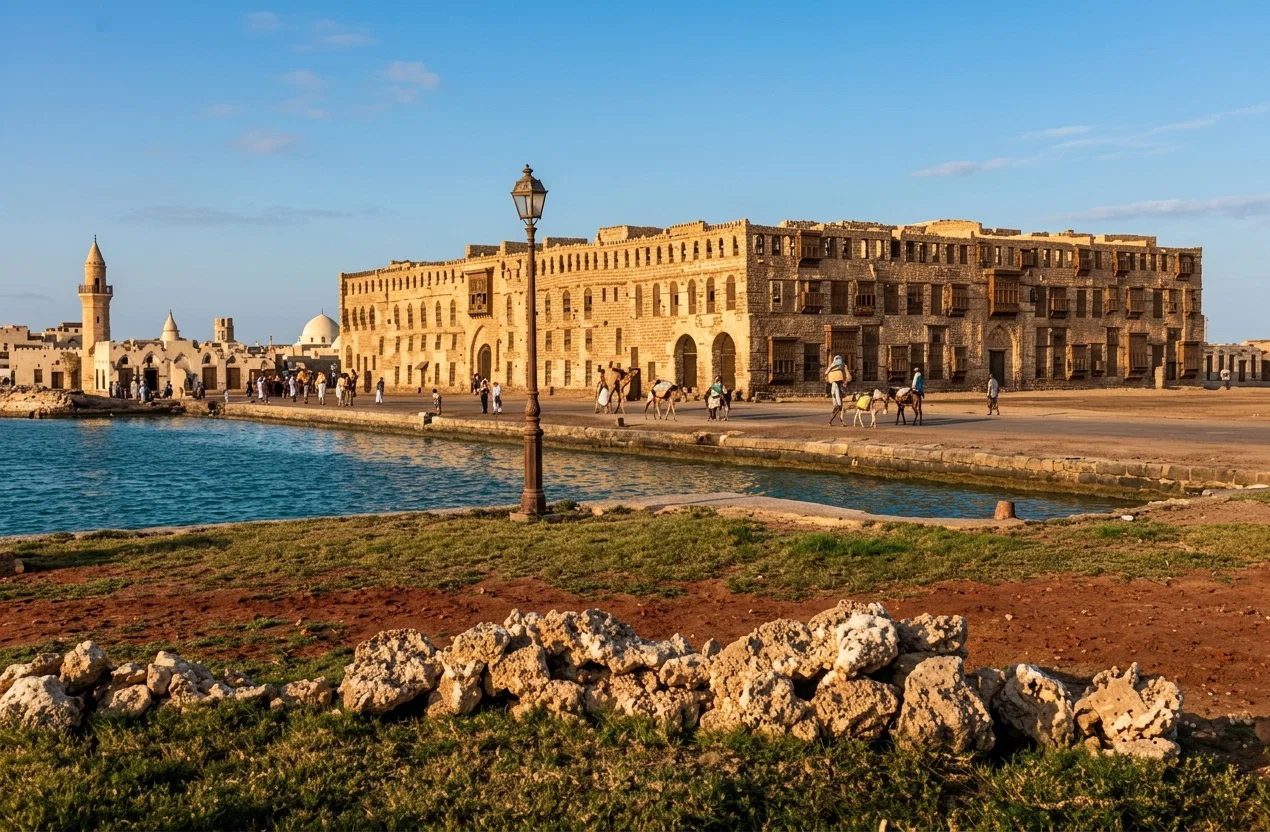
VIEW OF SUAKIN
VIEW OF SUAKIN
England and Egypt now rule over the vast Sudan, the flags of both countries are on all public buildings, but naturally England rules, and Egypt provides most of the men and money. The railway is now being pushed from Khartum up the Nile; steamers ply clear to Gondokoro in Uganda, and all this vast country is opening up to missions. A number of Catholic missionaries, who work in the upper Nile region, went with us. One of them had been laboring here for twenty-one years, in spite of heat and fever. Thus far there are only a few Protestant mission stations in the Sudan. When will Seventh-day Adventist missionaries enter this vast open field? These thoughts filled our minds as a few of us called on Mr. Tommian, and then in his house had a little Sabbath prayer-meeting, the first, undoubtedly, held in the Sudan. There is one Sabbath-keeper here, at least, to witness for the truth.
Port Sudan is a modern town and port, of easy access, with harbor spacious enough to shelter quite a fleet. Sunday morning the freight steamer “Mahalla,” of the same line as ours, entered the port, coming from Jiddah, the entrance port for Mecca. With it came Brother Toppenberg, who had traveled in a German East African liner with our East African missionaries as far as Suez, and left there on November 8. The same afternoon we went to Suakin, the ancient port of the Sudan, connected now also by rail with Port Sudan. The walls and fortifications are still there—evidences of the conflict with the Mahdi, at which time this port played an important part. As the port is small, and the town lies low on an island, and there are sand-banks at the entrance to the harbor, it has cost a great deal of money to create Port Sudan. Here we transferred from our mail-steamer, which ends its journey there, to the “Mahalla,” as ancient a steamer as I have ever traveled on — about sixty years old.
Early November 15, we left Suakin, and on the sixteenth the high mountains of Abyssinia greeted us; by noon our steamer was safely anchored at Massawa, the port of entrance for northern Abyssinia. We were now in the Italian colony of Eritrea. Brother Lindegren had been waiting for us some days, and after patiently toiling to have our goods pass the custom-house, he took us to a lodging-house near the landing. Sixteen days on the Black Sea, the Mediterranean, and the Red Sea had taken us from the great Northern Empire to Ethiopia. We had touched ports in Turkey, Asia Minor, and Greece, traversed the delta of Egypt, been in the Sudan, and now set foot on ancient Ethiopia. Suakin and Massawa are both noted for their pearl fisheries. We had brought pearls of inestimable value—would they be appreciated and accepted?
Hamburg, Germany.