J. S. STEWART

6%

Review and Herald Publishing Association · Takoma Park Station, Washington, D. C. · Nov 11, 1909

FromReview and Herald, Vol. 86, No. 45.

Read the full edition

J. S. STEWART

Fiji

J. S. STEWART

HAVING accompanied Mr. Stewart and Brother Parker and family to the Ra coast at the close of the year, it was my privilege to see something more of native life than is possible at Buresala. Knowing that our people are interested in learning about the customs of the people among whom our workers labor, I will try to give the details as we saw them, and as we have learned of them by inquiring among those around us:—
Usually in a Fijian town New-year's day is a time of great feasting and rejoicing; but this one was uncommonly quiet, as a chief had died. Our host's brother, who lived next door, had been very ill for three weeks, and was much worse the last day of the year. He had no lack of help, but it was plain his end was near. A Fijian almost invariably has a presentment that he is about to die, and his friends generally hasten to dress him in his best clothes ere death draws on.
Early next morning we were awakened by a great wailing next door, and at once concluded that our neighbor was dead. This crying by the women was kept up for hours, then stopped, and three large conch shells were blown almost continuously in a most mournful manner. We were told that if the deceased were not of high rank, the women would have had to cry all day. By means of horns blown by the men, the friends in neighboring towns knew what had happened, and before long arrived to see the burial, and to stay several days with the bereaved wife. The day was spent mostly in preparing food, receiving and presenting mats, etc. Late in the afternoon it was our privilege to see our host present mats and whales' teeth to the wife and friends who had cared for the deceased.
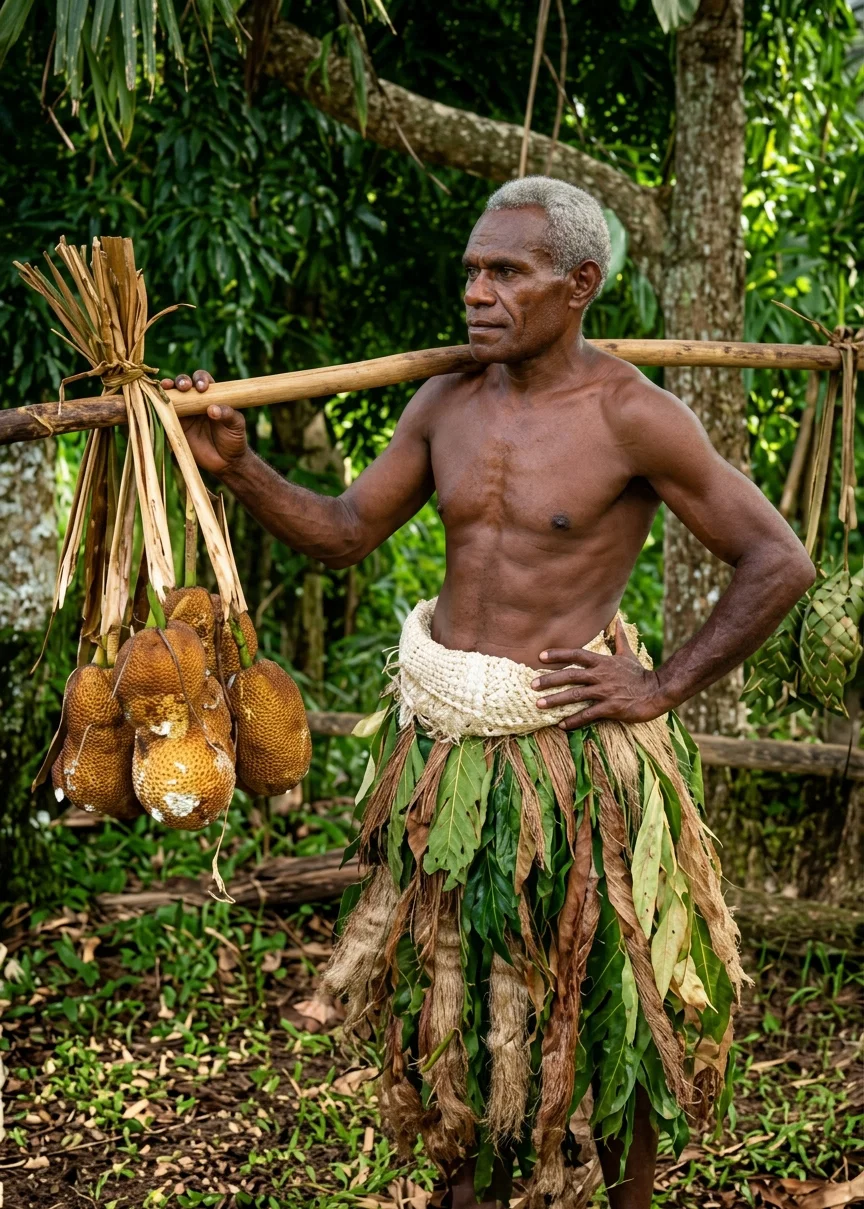
A FRUIT VENDER IN FIJI
Here a whale's tooth is highly prized, as by presenting it anywhere a person can ask for and get almost anything he wants. On inquiring the meaning of this presentation we were told it was similar to our giving money to friends in need.
It seemed as if the whole town followed with the weeping wife to the grave, almost every one bringing a stone for the top of the grave.
Half-way through the ceremony, conducted by a native Wesleyan teacher, twelve or more mats were spread over the grave; on the top of these the body, already wrapped in about six mats, was placed, and at the close of the service lowered into its last resting-place. It did not take long to fold down the mats and fill in the earth. All sadness then seemed to be forgotten as the friends and relatives repaired to the feast prepared in honor of the dead.
Four days later another feast, in which the whole town took part, and which continued far into the night, was probably an outlet for the gaiety that had been repressed on the previous occasion. Later on another big feast will be made: then the relatives will be free to go back to their own houses. All this time they have, while consoling the bereaved, been living in her house and been fed at her expense. The wife is expected to stay quietly about her house for one hundred days.
It seems that these burial customs differ among the various tribes. The blowing of the conch shells is a special custom of this tribe: some persons here said that they had never heard it before.
The days of the wife's mourning differ according to rank, and love for the departed; about ten days may be sufficient for the common people. These things convince us that the power of custom is strong here in Fiji, but we can say that the truth is stronger still, and will triumph in the end.
During our stay at Namarai we were privileged to meet with our people from several small companies near. They came together for New-year, and for a small council. We believe the time was profitably spent, and all felt refreshed for the work before them. The women seemed especially grateful for the meetings held for them.
The work seems to be onward. Our school here has a brighter prospect before it, and we trust that it may be a blessing to many of our young people. We have much to make us rejoice, but we also see much to make us realize the greatness of the work before us.
Buresala, Ovalau.