HARRY ARMSTRONG

6%

Review and Herald Publishing Association · Washington, D. C. · Aug 11, 1904

FromReview and Herald, Vol. 81, No. 32.

Read the full edition

HARRY ARMSTRONG

Ceylon

HARRY ARMSTRONG
A LITTLE over one month ago we left Calcutta, and sailed out of the “sacred” river into the Bay of Bengal. We did not leave India because the work there was finished, for notwithstanding all that is being done by our faithful brethren and sisters, its needs are multiplying day by day. India is a stricken land, and its need can never be written in words. No artist can ever picture the dire distress of its people and the loneliness of soul felt by those who are still held in the chains of darkness and superstition. Nothing will ever answer this need, except the love, fellowship, and brotherhood of the Lord’s Christ in his people. We need one hundred young, loyal-hearted Seventh-day Adventists, those who are burdened for the truths for this time, to dedicate their lives to the service of God, and come over and help us.
CINGALESE WOMAN
CINGALESE WOMAN
Considerable work has been done both in India and in Burma, but Ceylon has been an unentered field. For this reason we sailed toward the island, entering its capital, Colombo, that by the grace of God the standard of present truth might be lifted up, and a memorial established for the Lord and his truth.
Ceylon is a beautiful island, and because of its beauty and fruitfulness it is called the “Eden of the East.” Many poets have sung its praises, and many hearts have been inspired to worship by its beauty and loveliness. O. W. Holmes says:— “When Ceylon sweeps thee with her perfumed breeze, Through the warm billows of the east- ern seas.”
Because of its location, being an island in the Indian Ocean, it nearly always enjoys the cooling breezes of the “eastern seas;” and being a land of spices and perfumery, these sea breezes are soon changed into the “spicy breezes” of which we love to sing.
“What though the spicy breezes Blow soft o’er Ceylon’s isle; Though every prospect pleases, And only man is vile: In vain with lavish kindness The gifts of God are strown; The heathen, in his blindness, Bows down to wood and stone.”
Although it is the premier crown colony of the British empire, Ceylon is not very large. In comparative size it is about equal to Belgium and Holland, about three fourths the size of Ireland, one eighth the size of France, or three eighths the size of the State of Missouri. Its extreme length from north to south is 270 miles, and greatest width 137 miles. Its total area is 25,481 square miles, and the population is 3,629,986.
Perhaps there is no other island that yields such a wealth of treasure. In its gem pits are to be found a liberal supply of many precious stones, such as the sapphire, chrysoberyl, ruby, cat’s-eye, aquamarine, topaz, garnet, and cinnamon stone. Also in the Gulf of Manar, choicest pearls are sought and found at regular intervals, known as the “pearl fisheries.”
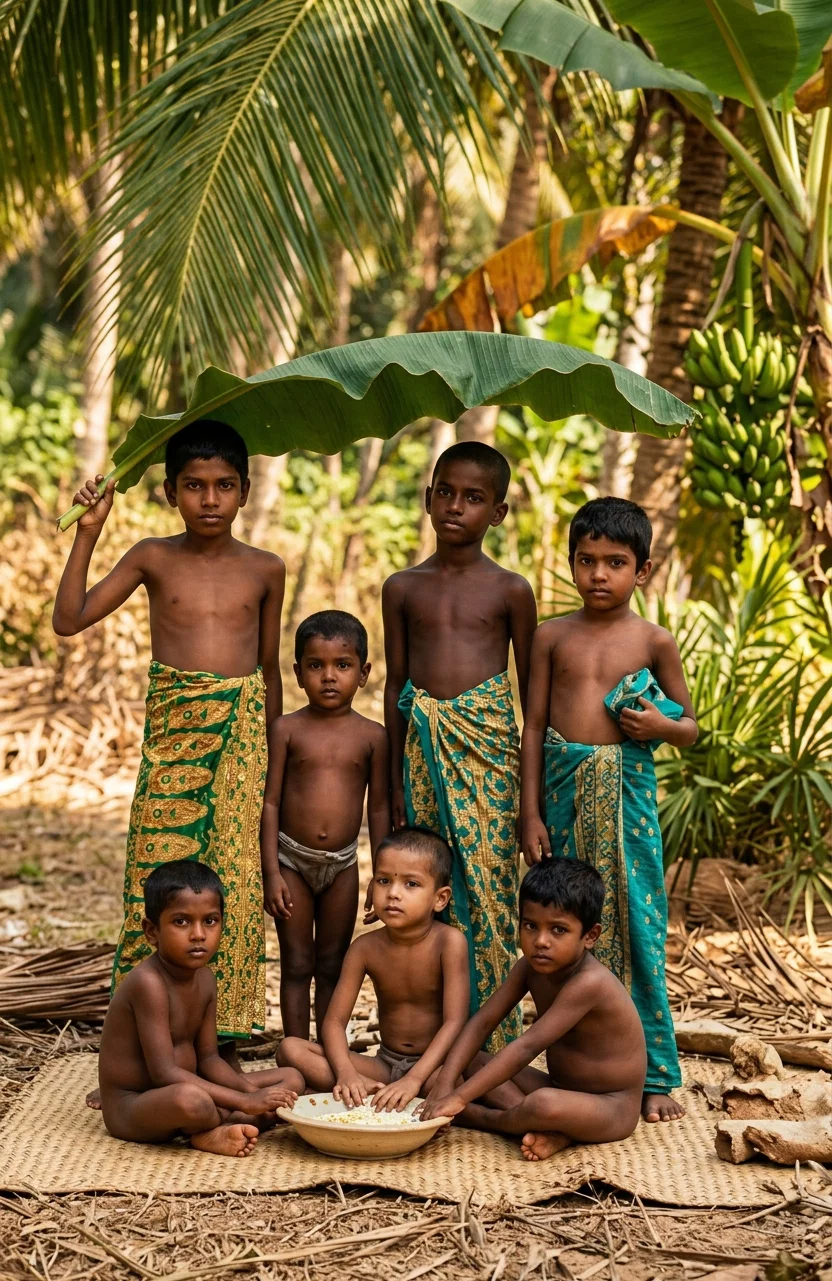
GROUP OF CINGALESE CHILDREN
The island is also rich in vegetation. The chief vegetable products are cocoanuts, rice, tea, cinnamon, tobacco, and rubber; and among valuable timbers, ebony, satinwood, and calamander may be mentioned. Ceylon is also famous for its elephants, from whose tusks ivory is procured. There are other large wild animals which live in the jungles, such as the bear, leopard, buffalo, deer, and wild boar.
Colombo is the capital of Ceylon, and in this place we have decided to open up the work. Its harbor is visited by ships of all nations, and is in itself a good field for missionary operations. The harbor is protected by a breakwater, and an accompanying picture shows a common sight during the “monsoon” season. The monsoon has burst with all its fury since we came here, and much distress, attended with loss of life, has been caused by the floods. Railway lines and bridges have been swept away, and many of the poorer classes have been made homeless.
The people of Ceylon are called “Cingales.” The greater portion of them are Buddhists; the rest are “Christians,” mostly Roman Catholics. We believe there is a great work to be done here among this people. They are, as all heathen are, “very religious,” but they are still worshiping “an unknown god.” We have come to declare the true God unto them by presenting the third angel’s message as a final appeal for all to “fear God, and give glory to him; for the hour of his judgment is come: and worship him that made heaven, and earth, and the sea, and the fountains of waters.” Our hearts are of good courage; for we believe the Lord will establish the work of our hands in raising up a memorial to the third angel’s message and the coming of his kingdom.
Colombo, Ceylon.