In Egypt and Syria

5%

Review and Herald Publishing Association · Washington, D. C. · Jul 21, 1904

FromReview and Herald, Vol. 81, No. 29.

Read the full edition

In Egypt and Syria

L. R. CONRADI
As the route to German East Africa passes Suez, we decided to so arrange our journey that I could spend a few weeks with our workers in Egypt and Syria, and then meet the missionaries for German East Africa at Port Said. Accordingly, Brother Dail and I left Hamburg, February 16.
We reached Alexandria on the morning of the twenty-second. Elder Wakeham, and one of the Armenian brethren living there met us. We had an interesting meeting that night, and next morning took the train for Cairo. Elder Wakeham seems in good health, and since we have closed out the hygienic restaurant, he has his whole time for the gospel work. Mrs. Wakeham is in Keneh, Upper Egypt, with her children, and they are getting hold of the Arabic quite rapidly, as they live among the people and are doing some educational work for them. Dr. Keichline has opened a small office in Cairo, where he is fast winning friends among the Mohammedans, especially among the student classes, for whom he feels a special burden.
Quite recently some converts have been baptized in Egypt, and others are about ready to take the step. The prospects for our work are brightening in this dark land.
The twenty-fourth, Brethren Wakeham Dail, and I went to Port Said, en route to Jaffa. Brother Hoerner, accompanied by others of our friends, met us at the boat there. It was remarkable that ours was the first steamer from the South that had landed in Jaffa for about six weeks, and more than that, the day before, the sea had been so stormy that boats arriving from the north were not able to land. Jaffa is one of the most unhandy and dangerous seaports with which we are acquainted.
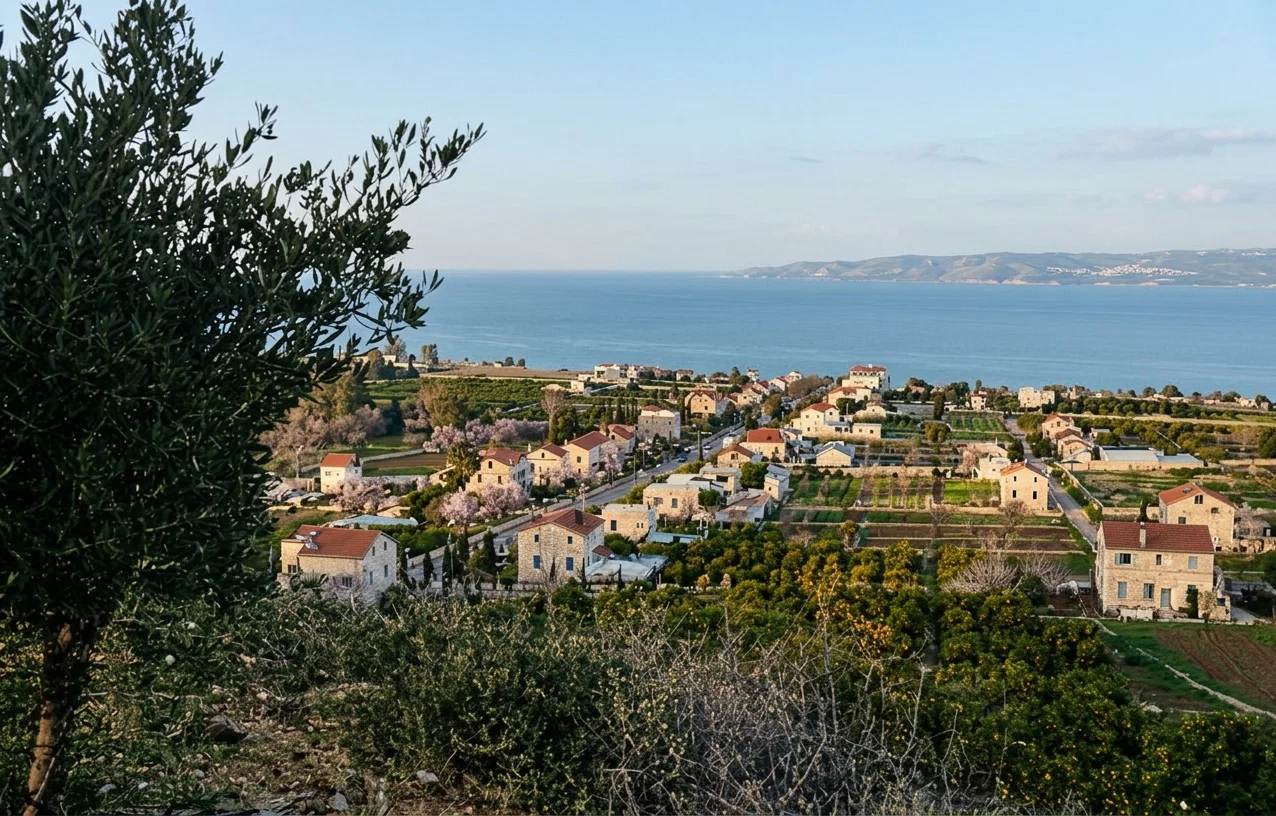
GERMAN TEMPLE COLONY, MT. CARMEL
Friday we took a drive into the country to visit several institutions, and to get facts helpful to us in our work. Pleasing, indeed, was it to us who had so lately been among the snowy hills of the North, to see the immense orange groves, laden with their burden of fruit, or the almond-trees, in full bloom. We went to Ramleh, and from there visited a farm secured by the German Orphanage in Jerusalem, and then we visited Rishon, one of the leading Jewish colonies in the land of the Philistines. I was surprised while traveling through the length and breadth of Palestine to find at least thirty of these thriving colonies. The Jews have purchased large tracts of land here; a good deal of this is devoted to grape culture, and at Rishon, there is probably one of the largest wine cellars in the world.
Upon returning to Jaffa, we found that Brother and Sister Jespersson, of Jerusalem, as well as Brother and Sister Krum, and Brother Zarub, of Beirut, had arrived.
Sabbath evening we had meeting in the German Temple Colony, near Jaffa.
During the last thirty years several thousand Germans, mostly from Wurtemberg, have founded many flourishing colonies in Palestine. Their idea was to build up spiritually a temple body, by having a number of people settle here. In fact, this movement was to some extent an outgrowth of the 1844 movement—another offshoot; but as the colonists have become prosperous in worldly things, not a few have lost their old fervor. However, when I spoke of our message in their hearing, and of the providence of God in the first angel's message, one gentleman, sitting near by, responded by hearty “amens,” and in greeting me, he shook hands very cordially, and said: “Yes, that was our bright hope, and I am still glad to hear about it.”
Sabbath was a beautiful day. Seventeen of us were assembled. This is the largest number of our people that were ever together in the Holy Land. In the afternoon it was my privilege to baptize three converts under the billows of the Great Sea. They have come to a knowledge of the message through the work of our mission in Jaffa, and will all go to Friedensau to further prepare themselves for usefulness in the Syrian Mission.
Returning to the home of Brother Hoerner, we celebrated the ordinances of the Lord's house; this was a solemn occasion.
Sunday forenoon we fully organized the Jerusalem-Jaffa Seventh-day Adventist church, ordaining Brother Jespersson as elder, and Brother Hoerner, as deacon. We hope the day may soon come when we shall have a churchin each of these places, but we are thankful that at least so much has already been accomplished in this field. We are glad to report that the two medical missions in Jaffa and Jerusalem have been favored of God financially, and are paying their rent and other expenses, besides bearing half of the wages of the leading workers employed in them. And, best of all, a few have been brought to a saving knowledge of the truth through the influence of our laborers here.
As there were some questions with reference to the future of these institutions, as to whether they should remain in their present locations, or be removed to some other place, as Haifa, or Beirut, or to another part of Palestine, we determined to take a trip through the country, visiting a number of places together, and at the same time hold as many council meetings as the circumstances might admit. We mapped out our course, intending to go to Haifa at the foot of Carmel, visit Nazareth, the Sea of Galilee, and from Tiberias return via Samaria to Jerusalem. We hoped to get through in six days.
As we had beautiful weather, we were able to crowd ourselves together in one wagon, drawn by three horses, and Sunday afternoon at five o'clock we set out from Jaffa, going north through the Plain of Sharon. As spring had already begun (it was the twenty-eighth of February), the plain was covered with a rich carpet of flowers. Many trees were in bloom; the fig-tree was just shooting forth its fruit and leaves. We drove the entire night, stopping only to water and feed the horses. Our route lay a little to the east of the site of ancient Cæsarea, mentioned in Acts 21:8. At present there are only a few of the ruins left, and these are fast disappearing, as they are used for building stone, and for limestone. We also passed through quite a large Jewish colony called Zammarin. From here we turned to the sea, near the town of Tantura; this is the ancient Dor, whose inhabitants the Jews did not drive out when they took possession of the land. See Judges 1:27. At Athlit we saw large ruins of the old castle of the pilgrims, in use during the crusades. It is the last fortress which fell into the hands of the Mohammedans in 1291 A. D. About half-past five in the evening, we came up to Carmel. We rounded the promontory, and passed the thriving German colony just as we entered Haifa. In the city we met the German consul, who is very favorable to our work. He asked that we climb Carmel by moonlight, and spend the night in the health home he had erected there. Carmel is quite a range of mountains, something like twenty miles long. It is here about one thousand feet high, but its highest point lies some eighteen miles inland, where the ‘top of Carmel,’ is one thousand eight hundred feet high. Here it is that Elijah had his wonderful experience with the prophets of Baal. The butt of Carmel is beautifully covered with green, and its sides and top contain a number of vineyards and olive-trees. Isa. 35:2. There are many natural caves on this mount of God. One has a wonderful view from this mountain chain. Next morning at breakfast, the German consul was present, and he read to us the experiences he had in planting the institutions on the summit of that hill, showing how the providence of God had gone before them.
In 1870, the first houses of that German colony had been built, and even then the founder thought that some day they must have a kind of health home on the top of the hill. One great difficulty then stood in their way—the French monks held the lower part of the mountain, and had established quite a convent there. They sought in every way to make it appear that the Germans were trying to get possession of this place only that they might later on conquer the whole country. When, in 1880, they tried to get possession of some property, these monks, learning of it, built a wall across the Roman road which led up to Carmel. In 1881 some Germans were gathering wood, and a monk, with eight of his servants, thinking they were laying out a road by which they might get up to Carmel, beat them terribly, so that one of the men suffered two months from its effects. The Turks and the Germans finally united to contest with the monks their right to barricade this public road; and, according to the customs of the country, the two parties, Jan. 29, 1885, ascended the mountain to demolish a part of the wall. This brought about quite an agitation among the people. The German and French governments had to interpose, and a long court trial was the consequence. In April, 1885, the expenses of this trial had already reached three hundred and fifty dollars. Not knowing what would be the outcome, Consul Keller, for so is he called, was one day meditating upon the matter when there passed by him a bier carried by four mules, and followed by three mule drivers and a European lady. “Then it seemed that something said to me,” said the Consul, “that I should go to the hotel, for God had something for me. But I did not go until I was called there. I was informed that the lady who had just arrived, had lost her husband on the road between Nazareth and Haifa. I did all I could to help this distressed woman with the burial, and also tried to comfort her. All the German colonists sympathized with her in her great bereavement. The lady desired in some way to reward us for the kindness shown her; but I would accept nothing. However, I told my wife that if the lady should again say anything, I would surely relate to her our plans for the health institution we wished to build on Carmel. She did speak to me again, and then I told her of our project, and said it would cost us at least five thousand dollars. The lady answered, ‘All right; I will give you that amount.’ When she said it, I hardly dared to believe it. But she said, ‘You better write seven thousand dollars, because you will need it.’ The trial continued until 1887, and even Bismarck intervened in the matter.”
Finally the papal authorities in Rome asked the monks to make peace with the Germans. Oct. 18, 1887, the rights for which the Germans had been contending in court were awarded to them, but the trial alone had cost five thousand dollars. By the time the road to the summit of the hill had been finished, the rest of the money donated had been spent. All they could do was to put up a few wooden buildings. But in 1890, they decided to erect a stone building, as the lady promised them still more help. However, they found that even after the permanent building was begun, the Turkish government was opposed to the move, and sent up Turkish soldiers to destroy the work; yet, in spite of all these things, they finally succeeded in completing the structure. The present building cost twelve thousand dollars. There are olive groves and vineyards around the home, and there is also now a hotel in the same neighborhood.
Staying over night with us in the home, was a noted bank director, of Berlin. He is a prominent man in the State Department of Religion. He led in the morning worship. I had a good opportunity to speak with him about our work, and of the opening providence of God in German East Africa. He seemed very much interested.
(To be concluded)