I HAVE long felt that the needs of the African field are not realized by our brethren, and I do not wonder at this; for they have known but little about the great work there is to be done here before the message closes. At present we have five small missions started in Africa, and some of these are scarcely in running order, hence able to accomplish but very little. The facts are that we have scarcely made a beginning, even in South Africa, and the millions of Africa are still beyond, and nothing is being done to give them the last warning message .
Thank God, he has sent godly men into these fields who are giving the Bible to the people, and preparing the way before us.
We are constantly saying, “There shall be delay no longer.” I firmly believe that the time has come for the last message to go to the world with power; but one question constantly arises in my mind, and that is, Are we going forward with the message? I wonder why it is that more people do not have a burden to work for souls and to enter these benighted fields. O how very few seem to think that God wants them to take up this work! Even here in Africa, where men speak the language and know the native and his needs, very few can be found who will labor for the souls of the people who are in such great blindness. May the Lord awaken his people.
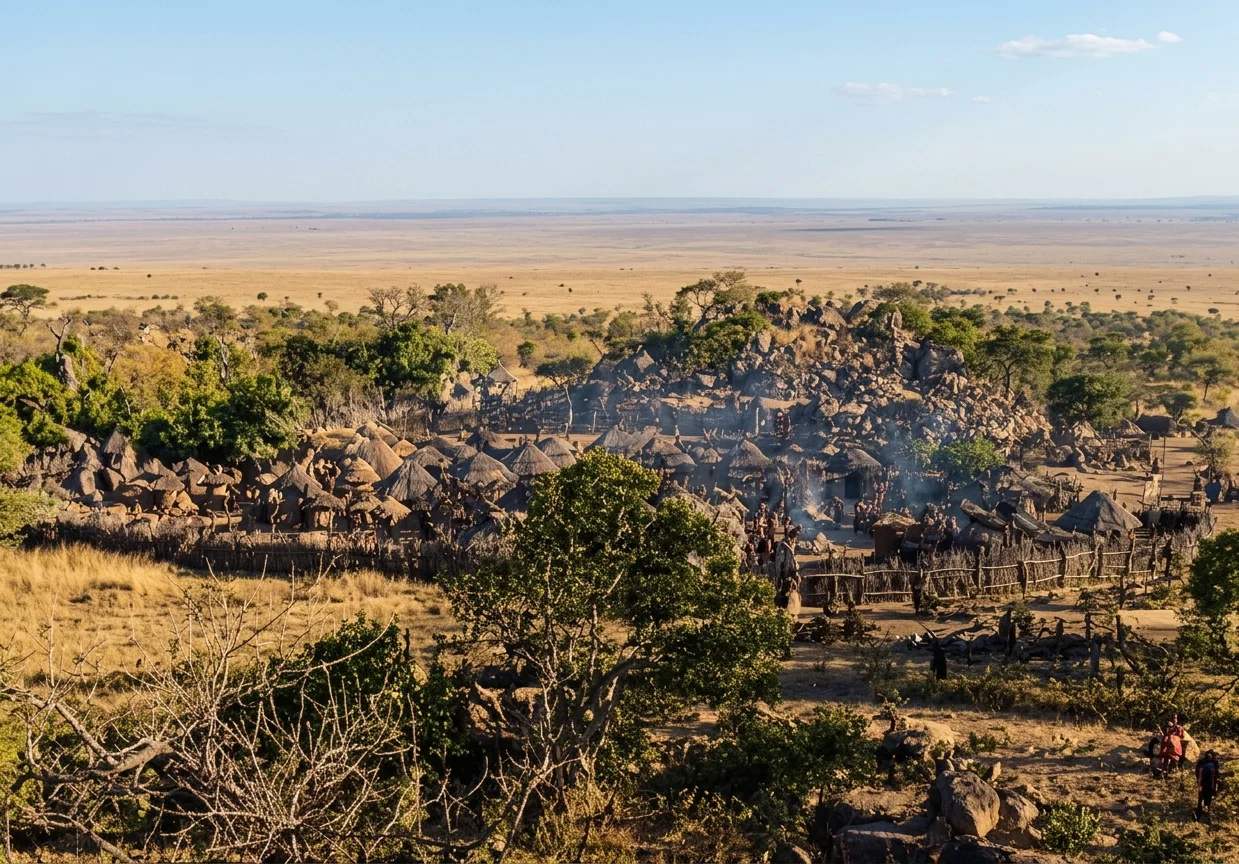
A NATIVE KRAAL IN MATABELELAND
Let us consider the needs that are staring us in the face to-day. It is nearly fourteen hundred miles to the mission farm from Cape Town. There is absolutely nothing being done for the natives between here and there. Bechuanaland has stood with open doors, inviting us to enter, ever since we began work in Matabeleland, but it remains untouched. It was in this country that Dr. Livingstone began his work for Africa. Khama’s country is a portion of this section, and we have talked of entering it, but it remains untouched. The Transvaal and Orange River Colonies have their thousands of natives, for whom we have never lifted our finger. Natal and Zululand teem with natives who are partly civilized and Christianized, for whom we have done nothing.
But let us come a little nearer home. The Kaffir tribe, or more properly the Amaxosa people, are found in this colony, especially in the eastern portion. Perhaps there are no natives in South Africa who are better educated and have had more done for them, but we have not yet begun work among them. The country in which they live is healthful, and is largely settled by white people, hence almost every convenience may be had. The land is generally good. Fruit and vegetables of all kinds may be grown. Other denominations have opened missions among this people, and have educated natives whom they have sent into the interior to labor for their own people, the white missionary visiting them only in the winter season, when there is but little danger of the fever. In this way they have saved the lives of their men of experience, and the work has advanced equally as fast.
But I want to bring you to Cape Town, and see what a field we have at the very doors of our work. Go where you will, it is hard to find a more healthful spot, and one that offers more advantages and comforts than Cape Town. There is a location in one of the suburbs of this city where there are thousands of natives living. These men are those who perform the work in the city and at the docks. Labor has brought these people right to our doors, where we can work for them and have every comfort, but nothing has been done. How long are we to pass by on the other side, and leave these people in darkness?
We have some things for which to thank the Lord. One of our brethren here gave us two lots of land in Johannesburg, which are to be sold, and the proceeds devoted to the native work. These are worth about four hundred pounds. We should enter Kaffraria and open a mission, and this will require at least five hundred pounds. Brother Moko, an educated native, is now working for his people, and would be good help to a man who might take up this work. These are healthy fields, where work can be done, and at the same time the benefits of civilization may be enjoyed. I ask, Is it not time that we begin work in this field?
The hearts of all are sad at the news of the death of Pastor Watson, our missionary to Nyassaland. Once more the banner has dropped from the hands of a brave Christian man, and now who is the one to pick it up and bear it onward? The message must go, and God has the men to bear it. Because a warrior drops in the field, the work of God will not stop. The burden rests upon some heart that will take up the work and go forward till the Father sees that his work is finished. He may as well drop in Africa as in any other part of the world.
Shall we as a people rally around our standard, “The commandments of God and the faith of Jesus,” and bear it onward to every land? Shall we by word and deed say, “There shall be delay no longer”? Shall we give our lives and our all to the promulgation of this message? I know it will triumph gloriously, and there will be a people who will go through to victory with it. From the14shores of Africa, God will have a people whom he will gather into the kingdom, to join in the song of redeeming love. There will be a people to whom he will say, Well done, good and faithful servants, because they have been faithful to him. May the Lord awaken his people and arouse them to act while the day lasts; for soon the time will come when no man can work.