The WORLD'S PULSE

5%

Pacific Press Publishing Association · Mountain View, California, U. S. A. · Sep 9, 1930

FromSigns of the Times, Vol. 57, No. 35.

Read the full edition

The WORLD'S PULSE

Silk produced in the world last year weighed 100,000,000 pounds.
The most densely populated tract of land in the world is the island of Java, with a population of 690 to a square mile.
The cancer menace is on the increase; in 1920 it stood twentieth on the list of mortal diseases in registered areas. By 1929 it had risen to second place.
Thirty-one thousand Americans were killed and more than one million injured by automobiles in the United States in 1929, fatalities having increased eight and two-thirds per cent over 1928.
The province of Szechwan, in China, with a population of sixty million people, has only twenty-seven motion-picture theaters, while Arabia, with five million persons in the peninsula, has only one.
A report from the Ministry of Commerce and Labor of Nanking, China, says that volunteer instructors from the Kuomintang societies are teaching the coolies in the principal cities to read and write. Perhaps China will have an educated labor class after all.
There are now over 35,000,000 motor vehicles in the world, for at the end of last year, according to facts and figures of the automobile industry just issued by the National Automobile Chamber of Commerce, there were 34,876,837. Of this number, 26,501,443, or 76 per cent, were in the United States. This country has the greatest number in proportion to its population,—one to every four and a half persons, while the world average is one to fifty-four and a half persons. Ethiopia may be considered the least motorized country, for its population to one motor vehicle is 17,781.
A recent editorial note remarks that no matter how the stock market may soar and crash, the savings bank deposits in the United States climb steadily. In New York City, for instance, on July 1 savings banks held $3,527,403,120 on deposit, an increase of $180,186,934 in six months. It states further that “it might be well if more persons realized that prosperity not only begins in the savings bank, but generally continues there, if it gets half a chance.” Why not continue just a step further and assure the public that the safest of all investments are in heavenly stocks and bonds, and the safest bank in which to make their deposits is the Bank of Heaven. Maybe the philosopher was right who sagely remarked that “the main reason why so many people are afraid to lay up treasures in heaven is because they are afraid that they will never see them again.” What do you think about it?
A striking statement recently appeared to the effect that 75 per cent of the motion-picture houses in the United States will have fixtures for talkies by the end of 1930. The present attendance at the movies of 115,000,000 people a week has been doubled in the last two and a half years since the appearance of sound pictures.
Blasting and riveting, considered the two loudest noises in the New York bedlam, are nearly 100,000,000 times as intense as the smallest sound that can be detected by the human ear.
Contrary to the general idea that accidents occur oftener in large shops, recent statistics reveal that the frequency rate of accidents is 25 per cent higher in small industrial plants in New York than in those having more than one hundred employees.
Ever since airplanes came to be an important factor in transportation, precocious minds wondered whether the day would ever come when one-way traffic would be required in the lanes of the air. That day has arrived at last. A recent news item declares that one-way traffic in the air has now been introduced by the Air Ministry of London, similar as in certain London street centers for motor traffic. The object is to minimize the risk of collision between airplanes flying between the several airports near London.
<|FIGURE|>
The regions around these airports have been defined as “restricted areas,” around which pilots must fly by the shortest route when leaving. On reaching the edge of another restricted area, the pilot must then fly anticlockwise round it, and similarly turn into the airport of destination from the edge of the area.
Airplanes were recently used to scatter literature, in weight almost half a ton, on the provinces of Florence and Pistoia, Italy. This flood of literature, totaling 350,000 pieces, was for the purpose of urging Italian farmers to increased efforts in the production of wheat. The airplanes traveled approximately 1,309 kilometers [818 miles] in doing this work.
New York has the largest single supply of radium in the world. The state has just purchased an additional $297,000 worth besides accessory equipment.
Caustic remarks are sometimes overheard proceeding from school children who seem to think that traveling to school four or five miles every day is an imposition. Distance, however, does not seem to dampen the ardor to secure an education among the children of the Flinders and Portsea districts, Victoria, Australia, who attend the nearest high school—at Frankston, twenty-eight miles from Melbourne. Some of these young aspirants travel seventy-five miles a day. Special busses subsidized by the Education Department, run from Flinders and Portsea to Frankston, the children paying a small amount a week for the service. In a year, pupils living in the more remote districts cover up to fourteen thousand miles in their journeying to and from school. A number of other children travel more than ten miles on bicycles to the school each day.
Here is a clipping from the Christian Science Monitor, which will doubtless set many to thinking: “Chicago—‘I promise myself that for a period of one week; when discussing business conditions . . . I will emphasize the facts that are favorable and encouraging, rather than those which incite to pessimism.’ This is the pledge of the One-Week Club, started by the American Lumberman, a trade journal, to awaken people to an appreciation of the basic soundness of American business. Although the ‘club’ asks for no enrollment, responses commending the plan have poured in upon the editorial office of the American Lumberman since the publication of the announcement on the front page of the journal May 24. By July 19, from 25,000 to 30,000 reprints of the editorial had been mailed out in response to requests, according to Elmer Hole, editor. The original circulated to about 14,000 subscribers.’
Sounds like a very ideal pledge, doesn’t it? Not only that, but we are sure that it has already benefited many. However, a plan like that should not end there. If a little is good, more will be better. Why not apply the same optimism to all conversation regardless of its nature? Whereas we know that such a Utopian plan could not be carried out to a full consummation, on the other hand, we are positive that in subjects of religion, as well as in all other matters of family, social, political, and national life, there would be such a decided improvement that in a short while newspaper men would have to be hunting other sources than gossip, political scandal, or what-have-you to appease the mental cravings of the reading public.
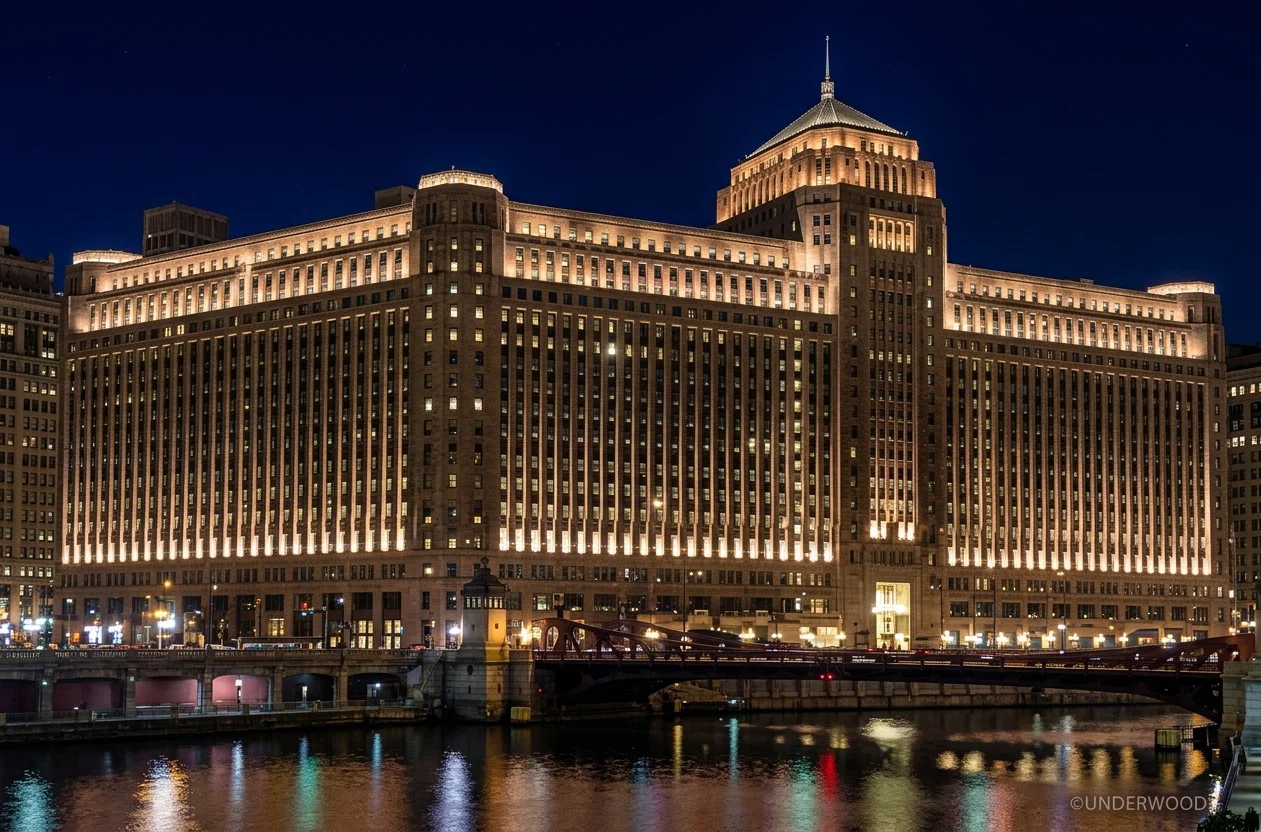
A temple of business at night. The world's largest building, the Merchandise Mart, is an added beauty to Chicago's already famous night views. If temples of religion were as highly regarded, the nation would soon be on the upward mend.