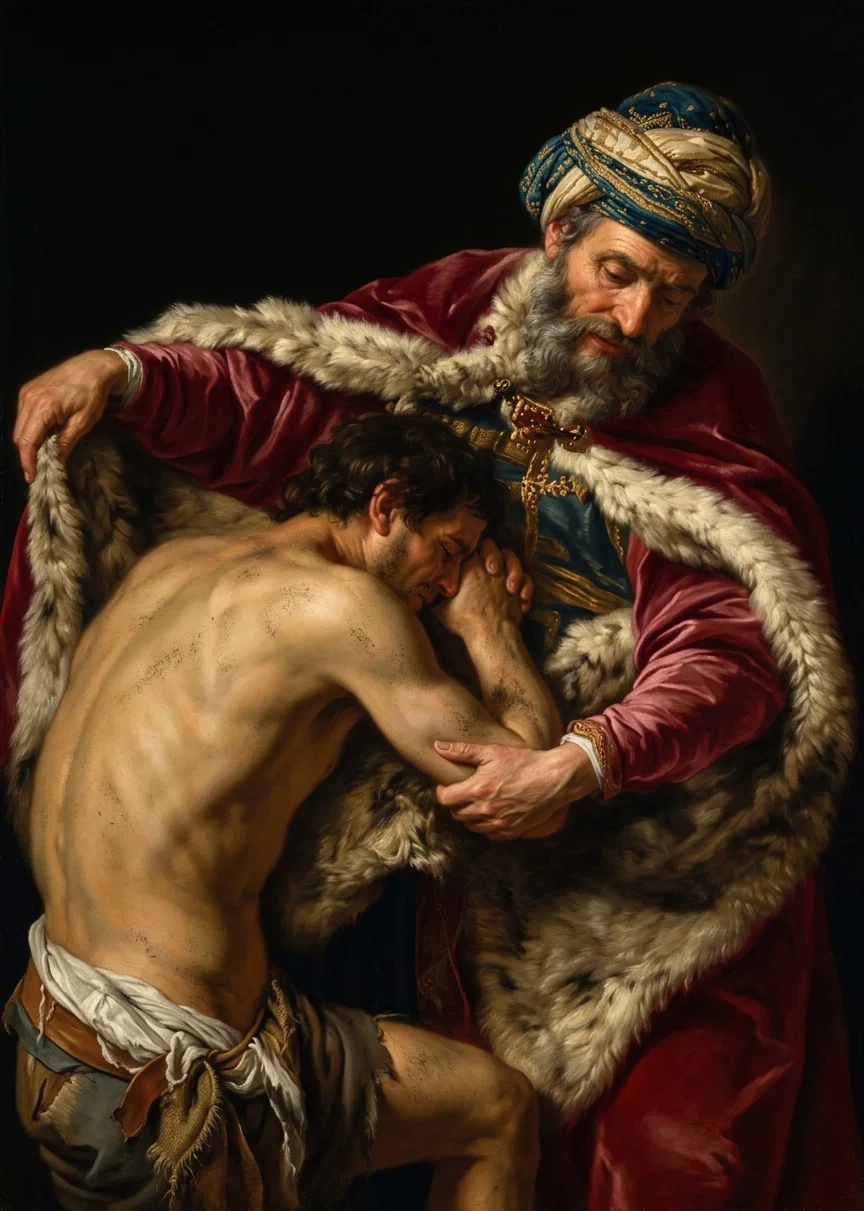
The prodigal son never imagined that his father could have such an intense love for him. Our heavenly Father is waiting with open arms; anxious to welcome us back home.
CARDINAL MANNING and Henry George were talking together, and the cardinal said, “I love men because Jesus loved them.” Mr. George replied, “And I love Jesus because He loved men.” The cardinal’s remark was almost apostolic. “In the face of Christ we ought, and in the grace of Christ we will.” That motive will be pure enough for missions to live in; it will also be large enough for missions to move in. Other motives are pure and large, but only one is redemptive. Other religions contain beautiful precepts, superb literature, but only one contains the power of God unto salvation.
How glad we ought to be for God’s unfailing pledge, “Herein is love,” that “God sent His Son”! Through Him God speaks to us; through Him we speak to God. Christ came because this pledge was true. He lives, and it is forever true. We owe Him more than our thanks; we owe Him our lives. Shall we not, then, do something for Him?
This pledge can easily be compared to a safe; let us say, “Break open the safe, and discover the will.” The story is told of a certain young man in America who was the son of a wealthy Christian man. He had become wayward in his habits, and, finally, quarreling with his father because he had been refused all the money he demanded, he had left home in anger and given himself up to a reckless life. For a long time he continued an abandoned wanderer. Becoming at one time very poor and being brought to the verge of desperation, he determined to break into his father’s house in the absence of the family, thinking that since he well knew where the valuables were kept, he could find means to relieve his necessity. “My father owes me a living,” he said to himself, “and I will have it.” He succeeded in effecting an entrance into the house and the safe, and amid the stillness of the house, began his search. Coming upon some valuable papers, he found his father’s will. With curious eye, he began reading that will. To his utter astonishment he found his name among the heirs and a large bequest set against it. At first he could hardly credit his eyes. The father with whom he had quarreled, against whom he had cherished such bitterness,—could it be possible that he had retained his name in his will, and was yet intending to give him his portion with the rest? “Can it be,” he said to himself, “that my father loves me in spite of all my hatred and bitterness toward him?” And such was the effect of these thoughts that they were the means of bringing him to repentance and reconciliation with his father.
How little that young man thought his father loved him! Has not that thought come to you? Has not your idea about God been along that trend of thought? Perhaps you have tried to shut God out of your life, but after breaking open the safe, you discovered the will that “God so loved the world, that He gave His only-begotten Son, that whosoever believeth in Him should not perish, but have everlasting life.” What a wonderful discovery! “He that heareth My word, and believeth on Him that sent Me, hath everlasting life.”
Yes, peace is found and can be found by all. Not alone by repenting, not by reforming, not by feeling, not by preaching, but by hearing and believing God’s message,—by simply seeing, realizing, and believing what Christ has done for you.
Beloved, if Christ so loved us, what then can we do? What then ought we to do, and what then are we going to do? We have a great opportunity. Yes, opportunity knocks at our door every day, and I fear that we miss a great many grand opportunities because we are not ready for them.
“They do me wrong who say I come no more
When once I knock and fail to find you in,
For every day I stand outside your door,
And bid you wake, and rise to fight and win.
Though deep in mire, wring not your hands
and weep;
I lend my arm to all who say, “I can;”
No shame-faced outcast ever sank so deep,
But he might rise and be again a man.”
—Malone.
Opportunity is power. What we ought to do, we can do; and when God opens a door before His people, it is His command that they should enter. The great doors of the world are not often swung wide open. There are indeed many ways by which we can improve our opportunities. One day when James Brainerd Taylor, then a young man, was out driving, he stopped at a watering trough. Another young man was watering at the same trough. Taylor said: “I hope you love the Lord. If you do not, I want to commend Him to you as your best Friend.” The strangers went their ways. The young man was converted, entered the ministry, and went to Africa as a missionary. Many times he wished that he knew who the man was that spoke to him at the watering trough, but he never did until some one sent a box of books to him in Africa. Opening one of the books at the title page, he saw a portrait, and exclaimed, “Oh, that is the man! That is the man who preached to me at the watering trough.” It was the portrait of Brainerd Taylor.
Perhaps if we only speak an encouraging word to some one, it will help him along on life’s way. Faithful Christians, those who are the real children of God, are reminded by Paul in his letter to the Philippians that they shine as lights in the world, holding forth the word of life. Not all lights are of the same magnitude, but the nature is always the same. Even as the lighthouse sends forth its rays, so ought we to send forth our rays. The great purpose of preaching is to perfect Christian character. We Christians have the keys to God’s plans, to God’s house, to God’s home, but we are carrying them around in our pockets and do not use them, or we try them only on the front door when we should try them on the other doors as well.
Again I repeat, Beloved, if Christ so loved us, then what ought we to do? Obedience is the first test of love. Jesus has said, “Go ye therefore, and make disciples of all the nations, baptizing them into the name of the Father and of the Son and of the Holy Spirit: teaching them to observe all things whatsoever I have commanded you: and lo, I am with you always, even unto the end of the world.” This commission contains a promise that we all want to claim, but we have no right to the promise unless the command also is accepted and followed. The two questions that the most powerful men are ever asking themselves are these: “What needs to be done in the world? and how can I best help to do it?” The following stanzas are a good answer for each one of us to give:
“Take my feet, and let them be
Swift and beautiful for Thee;
Take my voice and let me sing
Always, only, for my King.
“Take my lips and let them be
Filled with messages for Thee;
Take my silver and my gold,—
Not a mite would I withhold.”
(Continued on page 10)Four
Your Father’s Will
(Continued from page 3)
The great commission had given the early church its marching orders: “Go ye into all the world.” It was to a world task that the first gospel missionaries set themselves when—
“Out from the doomed Jerusalem, in the days
of long ago,
By two and two they sallied forth to the
lands of sun or snow.”
Most of them were schooled only in that wondrous school of three years and a half of association with Christ; but they bore a message of life and power that humbled the pride of all the gathered learning of the ages. “All power is given unto Me, in heaven and in earth,” Christ had said in the preface to the great commission. “Go ye therefore, and teach all nations.” With joy these believers told the message of hope to all.
The miracle of missions is a miracle of a changed life. It is the everyday experiences incidental to the upspringing of a new life. The story of missions is full of the marvels of God’s overruling providences and transforming grace. This is the message that the everlasting gospel of Christ’s redeeming love and grace and power is to proclaim to all mankind in this last time. We are to follow Jesus, who left us an example that we might follow His steps. There is much left for us to do.
A gentleman once said to Dr. Skinner, who was asking aid for foreign missions, “I don’t believe in foreign missions. I want what I give to benefit my neighbors.”
“Who are your neighbors?”
“Why, those around me.”
“Do you mean those whose land joins yours?”
“Yes.”
“Well,” said Dr. Skinner, “How much land do you own?”
“Five hundred acres.”
“How far down do you own it?”
“Why, I never thought of that before. I suppose halfway through.”
“Exactly, and I want this money for the Chinese men whose land joins yours at the bottom.”
To a believer in Christ all men are neighbors.
The motive that constrained men and women to go out as missionaries at the beginning will be sufficient to continue the missionary enterprise in the desire to share our Saviour, the only Saviour, with a world that absolutely needs Him.
“Beloved, if God so loved us,” what then are we doing?
“Who’ll go? who’ll go whate’er the cost?
Who’ll go? who’ll go to save the lost?”
“I go, I go, whate’er the cost;
I go, I go to save the lost.”