W. A. BARLOW

6%

Review and Herald Publishing Association · Takoma Park Station, Washington, D. C. · Jan 9, 1908

FromReview and Herald, Vol. 85, No. 2.

Read the full edition

W. A. BARLOW

Santalia and the Santals—No. 6

W. A. BARLOW

Costume

The costume worn by the women is the sari, a piece of cotton cloth about a yard wide, and, if she can afford it, six yards long, wrapped around the waist like a skirt, thrown over one shoulder, brought under the opposite armpit, and fastened at the side. The men, when at work, wear only a waist-cloth, but when visiting friends or going to market, they wear a cloth thrown over the shoulders like a plaid. The women are very fond of brass ornaments, worn on the fingers, wrists, arms, neck, ankles, and toes, and usually wear flowers in their hair, which is well smeared with oil. It is not at all uncommon for a Santal girl on a gala or mela day to wear ornaments weighing altogether more than fourteen pounds.

The Occupation of the Santals

The occupation of the Santals is almost exclusively agriculture. The work in which they excel is that of reclaiming jungle land. Selecting some remote spot in the jungle, where no one but themselves could live, they begin to clear the forest, plowing among the stones, and eking out their scanty living by hunting and gathering wild berries. Once his land has become arable and worth cultivating, the Santal is apt to fall into the clutches of the wily Hindu money lender who advances him money, say at the rate of three hundred per cent, and then seizes his land in payment; or the rent, which was at first nominal, is increased by the landlord. The Santal, often too ignorant to see through the wiles of the money lender, and too poor to fight against his landlord in court, flits by moonlight to some still more remote region, to begin the laborious process over again, reclaiming land for the benefit of the landlord, tilling fields to fatten the money lender. There is always at least one family of blacksmiths in a good-sized Santal village, who make agricultural implements and arrowheads out of the country iron, often receiving as payment the weight of the tool in rice or some other grain. They are not Santals, but Kols or Kamars. The latter were nominally Hindus, one of the “semi-Hinduized aboriginal” tribes, but in many cases they have lived among the Santals for many generations, and speak the language as their own.

Education

It may be inferred, from what has already been said, that education, in the usual sense of the term, is at a low ebb among the Santals. Their instincts and ambitions are not literary.
“Iron jointed, supple-sinew’d, they shall drive, and they shall run, Catch the wild goat by the hair, and hurl their lances in the sun; Whistle back the parrot’s call, and leap the rainbows of the brooks, Not with blinded eyesight poring over miserable books.”
That still represents the Santal’s idea of juvenile happiness. In the census returns they hold a high place among the illiterates. Out of every 1,000 males 994, out of every 1,000 females 1,000, were returned as unable to read or write in 1901. Apart from Christianity, they are in this respect making very little progress. Although they have no desire to keep abreast of the march of civilization, numerically they more than hold their own. During the ten years from 1891 to 1901 they increased by twenty-four and one-half per cent, while the increase in the entire population of Bengal was only four per cent for the same period. Although they are mingling more than they formerly did with other people, and are inclined to imitate the social and religious customs of the Hindus, neither the race nor the language show any signs of dying out. Both, in fact, appear to be exceptionally virile.
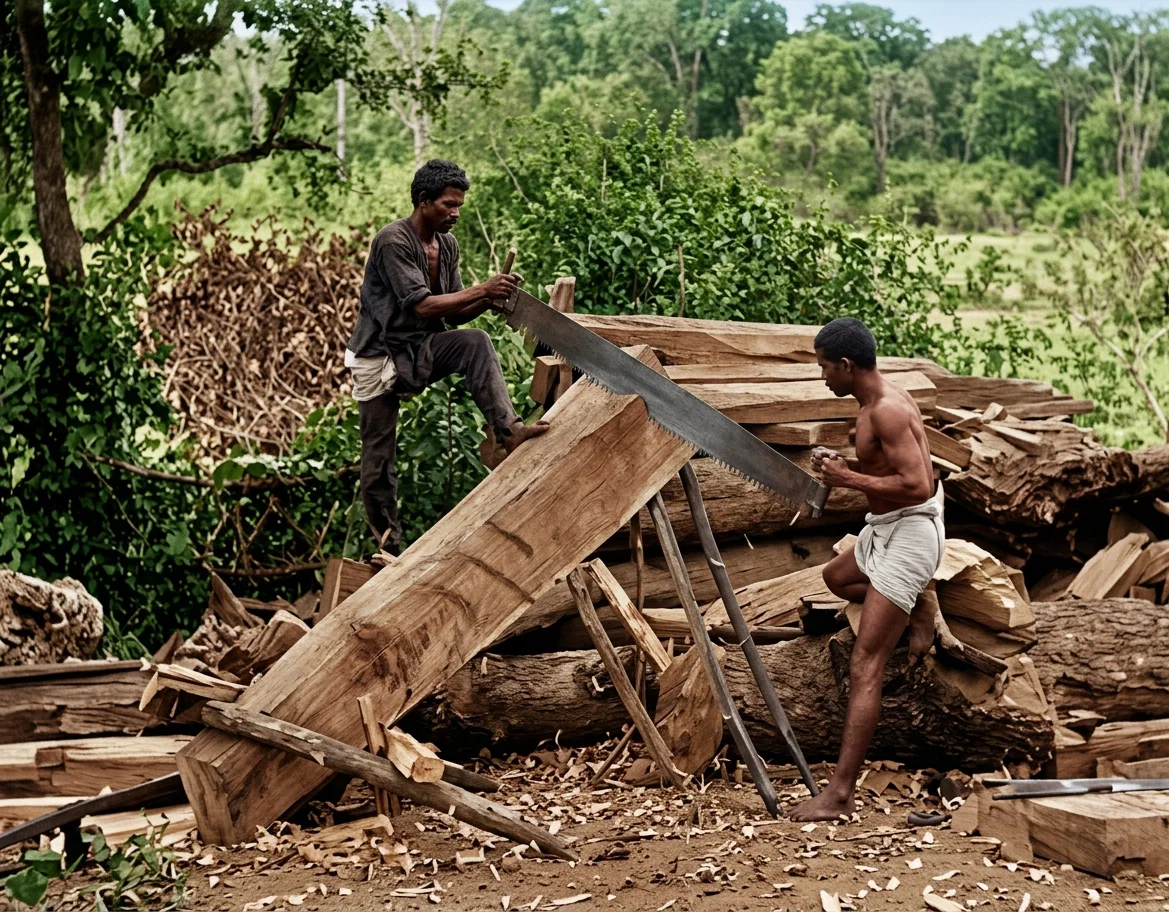
NATIVES OF INDIA SAWING LUMBER

‘The Santal Rebellion’

The most important event in the recent history of the Santals, an event which brought them into prominence and attracted the attention of the government of India to them, was the rebellion in 1855, two years before the great mutiny. Exasperated beyond the limits of endurance by the exactions of the Hindu money lenders, and alarmed by threats of imprisonment for debt, they rose in a body, twenty thousand strong, armed with their ancestral weapons, bows and arrows, determined to march to Calcutta to lay their grievances before the governor-general. They were badly advised, and at the instigation of two hot-headed leaders, Kanhu and Sido, whose names are still held in remembrance, they began to massacre Hindus indiscriminately, right and left, and a few Europeans also were slain. Troops were marched against them from Calcutta. Had a single official who could talk with them in their own tongue been sent instead, many lives and much money would have been saved; but probably there was no European in India in those days who could speak Santali. White-headed Santals still tell us of the deplorable bloodshed which followed. The Santals knew nothing of the rules of civilized warfare; called upon to surrender, they had not the slightest idea of what was meant. Places are still pointed out where they fought the unequal fight with their backs to the wall till not a man was left. They compelled the admiration of their foes. “They were,” wrote an officer who fought with them, “the most truthful set of men I ever met; brave to infatuation. A lieutenant of mine had once to shoot down seventy-five men before their drums ceased, and the party fell back.” Their wrongs, however, were then fully inquired into, and within a certain tract of country they were placed under special legislative protection. Among the older generation of Santals everything still dates from the hul, as they call the rebellion. The nearest approximation a very old man can give to his age is to tell you how many children he had at the time. In many respects it marked the beginning of a new epoch in the history of the Santals.
“From her night shall China wake; Afric’s sons their chains shall break; Egypt, where Thy people trod, shall adore and praise our God. India’s groves of palm so fair shall resound with praise and prayer; Ceylon’s isle with joy shall sing, ‘Glory be to Christ our King!’”
Simultala, India.