An Overland Trip in Brazil

8%

Seventh-day Adventist Publishing Association · Battle Creek, Mich. · Dec 30, 1902

FromReview and Herald, Vol. 79, No. 52.

Read the full edition

An Overland Trip in Brazil

MRS. LULA V. C. GREGORY
We have come overland, on muleback, to Rio Grande do Sul, from Brusque, where the conference was held. In fair weather this is a twelve days' ride. But we came over the road in the rainy season, and stopped at intervals to visit brethren by the way, and so were a little more than five weeks on the trip.
Our way at first lay over the mountains. This was necessarily slow and tedious, and sometimes lonely. At some places we traveled for hours through mountain trails just high enough and wide enough for one mule to pass, and then we were continually dodging the new growths which were trying to fill up the openings. One cannot appreciate a tropical jungle without seeing it. It is so full of great trees and roots and lesser trees and vines and bushes and brush, that when a road is forced through, there is a solid wall on either side, and it takes only a few weeks for a road to close up, unless it is constantly traveled.
Being the rainy season, we were not so troubled with snakes, although we killed three. At one time, as we skirted a hill, we heard the monkeys yell very close to us; but they kept themselves so well hidden in the trees that we did not see them. We frequently heard them at a distance. We also saw hundreds of wild turkeys, geese, and ducks, and ten or twelve very small species of ostrich, besides many other wild birds.
In the second half of our journey we spent three days on the seashore. Here progress was more rapid; for the sand, washed every day by the waves, made a firm, even road. During this part of the trip the Lord gave us good weather, so we were able to sleep out of doors every night but two—and part of the time this was a necessity, for there were no houses near.
Sabbath we stayed at the house of a Catholic Brazilian. He was at once interested to know why we were resting that day, as he had heard of Sabbath keepers before. After a Bible reading and some talk, he and his family said they would keep the Sabbath. On the advice of the doctor, he also promised to give up tobacco, to which all in Brazil are much addicted, and he did abstain during the remainder of our stay there. We left him tracts and a Bible, and have since sent him some papers. He promised to give the truth to his neighbors, so we know not what the end may be. He said that one man had already talked with him on the subject. This is in a part of the country where none of our people live, and where there has been neither canvasser nor preacher.
The people seem to be hungry for truth; but for many the cross to live aright is too heavy, and they cannot take it up. Others receive it gladly. We can but sound the message. May God help us to sound it faithfully.
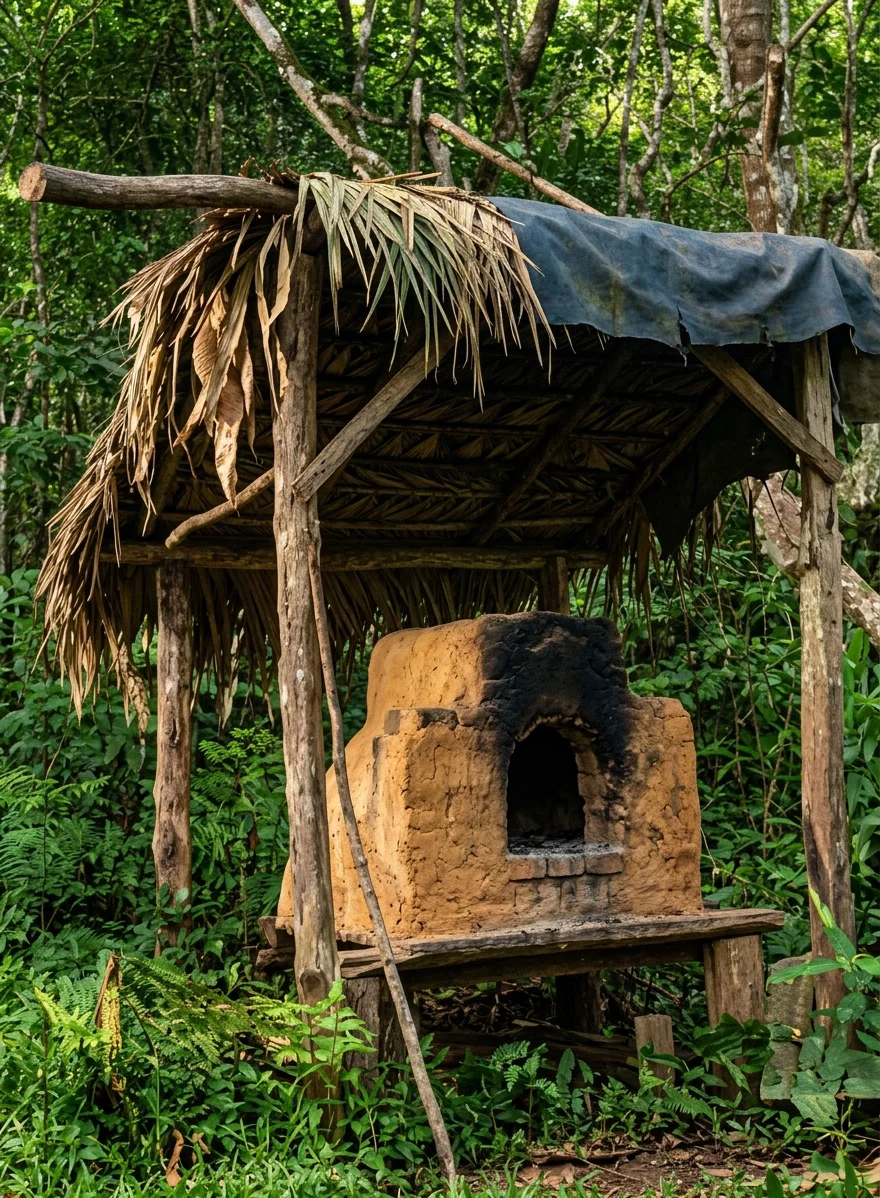
A PRIMITIVE OVEN
A PRIMITIVE OVEN
The picture shows the bake-oven. It is made of brick and mud. Others are of mud and stones. The process of baking consists of building a big fire inside the oven, allowing this to burn down to red-hot coals, then raking these out and putting in the bread, stopping up both chimney and door. The brick and block used for this purpose may be seen in the picture, also the pole with a hoe-like attachment for raking out the coals.
The majority of the farmers' wives have no baking tins, but use large leaves, putting a huge piece of dough in the center of each one. For putting the bread in and taking it out, they have a spade-shaped stick, fastened to a pole. In all the southern part of Brazil, bread is baked in this manner. Even in the city, where some have stoves, the people never seem to think of using them. The roof of both house and oven is thatched with the leaves of a tree that grows here very abundantly.
The Lord is blessing the work and the workers here, and we feel sure that he will also use the medical work to his glory. Our prayer every day is that the Lord will keep us where he can use us. We thank him for the privilege of a part in his work. We are of good courage Although things seem to move slowly, we have learned some lessons of patience and trust.