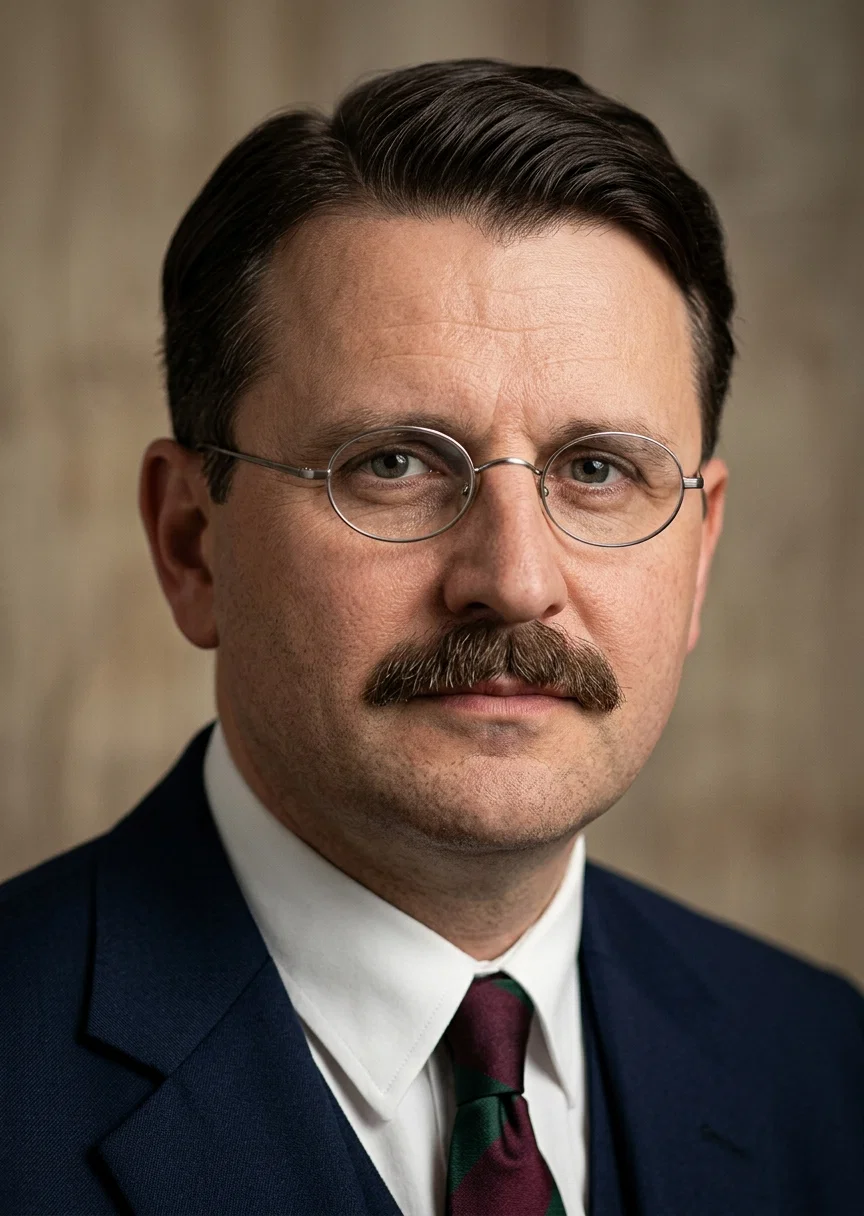
A few weeks ago several hundred bishops representing the Established Church of Great Britain and the independent Episcopal Churches of the Colonies and Dominions, as well as representatives from the United States, met in a great church council in London. We are giving our readers a close-up of that epochal conclave through the eyes of who was present at the sessions, and who had the unusual privilege of an interview with the Archbishop of Canterbury, the head of the Anglican communion.
Arthur S. Maxwell
Our London Correspondent
NO ONE can look with indifference upon the recent great gathering of bishops of the Church of England at Lambeth Palace. It marks another epoch in the life of a great Christian body. From it will emanate influences that will profoundly affect the thought of our time and the lives of millions of our fellow men throughout the entire world.
This conference, convened at Lambeth Palace, the ancient manor where for seven centuries the Archbishops of Canterbury have made their home, is the seventh in a series dating back to 1867. Others were held in 1878, 1888, 1897, 1908, and 1920.
INCREASE IN SIZE AND USEFULNESS
As the years have passed, the Conferences have increased both in size and in usefulness. With the expansion of the church’s activities and the multiplying of dioceses the number of bishops attending has increased. Whereas in 1867 the number was only 76, out of a possible 144, this year 310 gathered at Lambeth out of a total of 400 bishops. They came from the ends of the earth. Twelve traveled from India, 15 from South Africa, 24 from Canada, 9 from the West Indies, 22 from Australia, 6 from New Zealand, 6 from Japan, 9 from China, and 64 from the United States. On this occasion, for the first time, a native Chinese bishop (the Right Reverend P. L. Tsen) was present, also a Japanese bishop, the Bishop of Tokyo (Dr. Matsui), an Indian bishop, the Bishop of Dornakal (Dr. Azariah), and an African bishop (Dr. Howells), Assistant Bishop on the Niger.
It is of no small importance that the Protestant Episcopal Church of America, though legally separate entirely from the Anglican communion, still recognizes its historic derivation from the older body, and continues to send its bishops as honored members of the Conference.
This year, also, important delegations have been received and welcomed from the Eastern Orthodox Church—including representatives from Jerusalem, Antioch, Alexandria, and Thyateira, and the churches of Greece, Cyprus, Bulgaria, Poland, and Armenia—together with Archbishop Kenninck of Utrecht (Old Catholics), the Bishop of Lund (the Church of Sweden), and prominent leaders of the Church of Scotland and of the English Free Churches.
All these delegations attended chiefly to discuss the thorny problem of reunion. Whatever the result, it was certainly no small triumph to bring such a heterogeneous company together.
NOT A LEGISLATIVE BODY
It should be pointed out that the Lambeth Conference is not a legislative body. It is not the Vatican Council of the Anglican Church. It may act in an advisory capacity, but the various sections of the church are absolutely free to receive or reject its counsel. The resolutions passed have no legislative force whatever. They bind no one. For this reason many think that the Conference is futile. To-day, however, counsel is more efficacious than edicts, and universal benefit of some kind must surely accrue from the prolonged, prayerful study of modern problems by the leaders of a great Christian body. The considered opinion of three hundred bishops is of no small importance, and the church and the world should be better for their labors.
THE AGENDA
The agenda chosen for this year’s conference revealed both courage and vision. Those who prepared it certainly did not omit the difficult subjects.
“The Faith and Witness of the Church in This Generation” was the noble title chosen to head the long list of subjects. This main theme was considered under six headings:
The Christian Doctrine of God.
The Life and Witness of the Christian Community.
The Unity of the Church.
The Anglican Communion.
The Ministry.
Youth and Its Vocation.
Things ancient and modern were curiously commingled at the opening ceremony of the great Conference in Canterbury Cathedral. The Archbishop sat in the historic patriarchal chair of Augustine, but his voice was carried to the assembly by Marconi loud speakers.
Impressed with the solemnity of the occasion and the responsibility of leadership, the Primate delivered an address memorable for its breadth of vision and its deep spiritual insight.
After speaking words of welcome to the delegates, he proceeded at once courageously to envision the day when “the Church of England” throughout the world would resolve itself into a community of free, self-governing churches. Even the missionary dioceses now directly responsible to the See of Canterbury are, he pointed out, fast developing their own local organizations which must soon lead to new autonomous churches like those of the United States, Canada, Australia, New Zealand, South America, the West Indies, and India.
WORLD NEEDS
Referring to the 1920 Conference, the Primate reminded his audience of the opening words of the late Archbishop Davidson when he impressed upon those present that they were “set at this unparalleled time in a bewildered world to do their part in repairing the vastest cataclysm which the human race has known.” Then, with solemn emphasis, he showed how conditions are but little different to-day. *“Brothers,” he said, “the world of our generation is still bewildered and restless. The wounds of war are not yet healed.Page NineNew difficulties and perplexities—industrial, social, political—beset almost every nation. The need of a spiritual fellowship is more clamant than ever.”*
How shall this need be met? To some extent at least, thought the archbishop, by unifying the church. He saw signs that this desirable objective was slowly being achieved.
Then, having dwelt briefly on the main points of the Conference agenda, he proceeded to make a closing appeal which, we do not hesitate to say, deserves the reverent consideration of every Christian believer. No matter what one’s denominational affiliation may be, none can resist such a message as this. However much one may be led at times to find fault with the church for its failures or apostasies, here, surely, is sincerity beyond question. It is deep calling unto deep. It strikes at once through all artificial barriers straight to the innermost heart.
THE DOCTRINE OF GOD
‘Suffer me as I close,’ said Archbishop Lang, ‘to say a word about the first, the deepest, the greatest, of all subjects to which we are bidden to give our thoughts—the doctrine of God.
‘We have to speak to our own generation. Yet after all, in every generation, in every part of the world, and for every race there is one supreme purpose of all human life. It is that it should find its way to God. If this purpose is to be fulfilled, it is not enough that men should know that He is; they must know in some measure what He is. The main reason why at this and at every time the ways along which men seek God are so devious and disappointing, lead so often away from Him rather than toward Him, is that men set out with imperfect, unworthy conceptions of Him. Materialism, beyond doubt the greatest menace of our time, flourishes on these partial, antiquated, unworthy conceptions. It cannot be combated till they are corrected.
DEEPER CONCEPTION NEEDED
‘Thus it has been borne in upon many of us that while we have been discussing, never more busily than in this questioning generation, the proofs of God, the purposes of God, the laws of God, the kingdom of God, we have been apt, so to say, to take the doctrine of God Himself for granted. We have not put God Himself before our eyes in His eternal nature as infinite wisdom, power, beauty, goodness. We have not rethought our conception of Him in the light of fresh revelations which He has been giving of Himself in nature, in the spirit of man, in new apprehensions of the significance of Christ.
‘This lack of a true and rich doctrine of God, evoking alike awe and praise and trust, makes religious life either cold or sentimental, makes our teaching so often meager and partial, makes our worship so mechanical, or else turns it into channels unworthy of the glory and majesty of God, above all makes ecclesiastical controversy so barren and unlovely. We have to recover for ourselves, for our clergy, for our people, for our generation, a deeper, richer conception of God. Deeper—yes, and more simple also. We have need to recover the profound simplicity of that conception of God which filled the soul of Jesus, which through Him brought new life and hope and strength into a weary world. A scholar has recently described that old world into which He came—its exhaustion, its loss of nerve, its want of faith, its manifold disillusionment. Is it not a picture of our world also? It is for the Christian community to renew, to reinterpret, Jesus’ own fresh, invigorating conception of God as One real and near and sure, One in whom for life and death men can absolutely trust.’