North Brazil Mission

8%

Review and Herald Publishing Association · Takoma Park Station, Washington, D.C. · Nov 7, 1907

FromReview and Herald, Vol. 84, No. 45.

Read the full edition

North Brazil Mission

F. W. SPIES
After the organization of the Rio Grande do Sul Conference, the Santa Cathrina and Paraná Conference, and the setting apart of the province of São Paulo as a mission field, there still remained sixteen of Brazil’s provinces, which constitute the North Brazil Mission. Of these, four are inland, and twelve are coast provinces. And the coast line, from the most southern point of the Rio de Janeiro province to the most northern extremity of Pará, the province farthest north, covers about twenty-six hundred miles. In this field, and mostly along the coast, we have a population of seventeen million. The territory extends from twenty-three degrees south latitude to five degrees north latitude; and while it all lies in the tropics, cool and bracing climates are found on the high table-lands, three thousand and more feet above the sea-level.
In almost all these provinces the forests abound in many valuable varieties of wood, which form an important article of commerce. Also, great quantities of india-rubber are extracted from the india-rubber tree, and this is one of the chief industries of some sections of the north.
The country is also rich in minerals. Gold, lead, iron, zinc, copper, sulphur, saltpeter, and salt are found in abundance, also diamonds and other precious stones. Agriculture is, as a rule, carried on in rather a primitive manner. The articles generally raised are cacao, coffee, cotton, vanilla, tobacco, sugar-cane, rice, corn, legumes, sweet potatoes, and mandioca. Oranges and bananas are the principal fruits, although there are many other varieties. Cattle raising is carried on more or less extensively in all provinces, and carne seca (meat salted, and then sun-dried) forms one of the chief articles of interstate commerce.
The physical features of Brazil present many beautiful and picturesque sights. But as a rule the means of communication are very poor, which causes the work of the missionary to advance slowly, and to be very laborious. In many provinces almost the only manner of travel is by muleback; and even this at times and in many places is accompanied with dangers and hardships. I have known of travelers having to wait two weeks for a swollen stream to subside, in order to continue their journey; and not having within reach any food, they ate rawhide, to keep from starving.
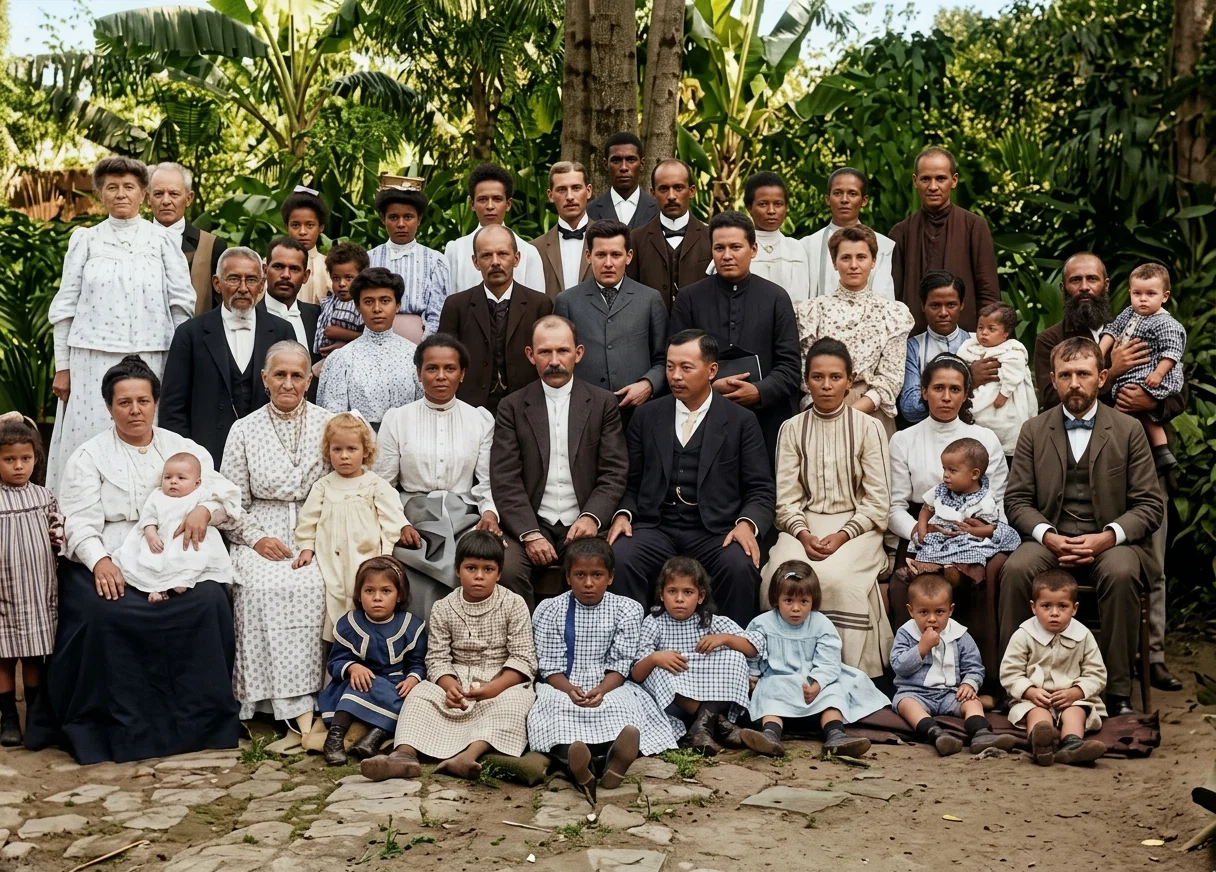
THE MEMBERS OF THE RIO CHURCH
The dominant religion is the Roman Catholic. As is generally the case where this religion has held sway for centuries, ignorance, superstition, and vice abound. The lives of many priests are so dissolute that they have almost become a byword. The result is that the marriage relation is regarded in a very loose manner by the people. Often for trivial reasons married couples separate, each one taking another consort, and thus sin and misery multiply. To find people living in concubinage is a very common thing.
Yet into this land of darkness and sin the third angel’s message—the message that is to go to every kindred, nation, and tongue, to prepare a people for the Lord’s coming—has found its way. Still, as we think of only one minister in a field of seventeen million souls, scattered over such a vast territory, with such poor facilities for getting around among them, we are reminded of the saying that South America is the “neglected continent,” and can but earnestly pray to the Lord of the harvest that he will send more workers to help gather the grain for the heavenly garner; for we see that the work is growing more and more difficult as the years go by; and while men wait and sleep, the enemy is sowing tares that will soon bear a bountiful harvest, and bring about the conditions of Noah’s day.
But we have a beginning in this field. Here in Rio we have a church of about thirty members, while, all told, perhaps another twenty-five are keeping the Sabbath. In Espirito Santo we have threeorganized churches and a number of scattered members, about one hundred thirty in all. In Mucury, the northern part of Minas Geraes, we have a church of forty members. Aside from this, in Bahia there are some observing the Sabbath and calling for baptism. I shall go to this place as soon as possible.
About two weeks ago a letter from a Brazilian in his seventy-fifth year, who is a student of the truth, brings an invitation to visit the province of Sergipe. To-day a letter brings intelligence that a young man, a native, who is in the employ of a missionary society, and is working in another part of the large province of Minas Geraes, is studying the truth, and has already accepted part of it. May this prove to be an instrument chosen of the Lord to assist in this last great closing work of the gospel.
The picture of the Rio church found on the preceding page was taken a few months ago. Two thirds of its members are natives. While we toil on, trusting in Israel’s God for victory, we are encouraged to know that loyal hearts are daily remembering us at the throne of grace. May the glad day hasten when, the battle ended, Immanuel, our Prince, shall lead his hosts in through the pearly portals of the New Jerusalem to enter into the rest there provided for them.
Rio de Janeiro.