4 *Mighty Movement—A Strong Purpose

5%

Review and Herald Publishing Association · Takoma Park Station, Washington, D. C. · Aug 15, 1907

FromReview and Herald, Vol. 84, No. 33.

Read the full edition

4 Mighty Movement—A Strong Purpose

The second and last mass-meeting of the American Federation of Catholic Societies was held in Tomlinson Hall, Indianapolis, Tuesday evening, July 16, at 8 P. M.
The chief features of the evening were the address of Rev. J. T. Roch, of Nebraska, on “Making History,” and the address of Rt. Rev. Jas. A. McFaul, Bishop of Trenton, on “Federation.” Both men were forceful speakers, and the audience being almost wholly Catholic, the meeting was certainly an enthusiastic one.
The address of the first speaker was devoted largely to a setting forth of the weakness of the Catholic Church in America upon the point of daily and weekly papers. He deplored the fact that there were so few purely Catholic dailies in this country in proportion to the number of Catholics; and set before the convention the necessity of immediately remedying that condition. He declared emphatically that “the church [Catholic] can have no influence, no power, until it has a press that is powerful and influential.” He hoped the time would speedily come when in this country there would be as many Catholic dailies in proportion to the population as there now are in Germany. In that country there are one hundred and thirty Catholic dailies; in this country only twelve.
He laid the blame for Catholic weakness in this particular upon the Catholic laity, because they do not make it a point to advertise in Catholic papers and patronize those who do. By general patronage of those who advertise in Catholic papers, he would make Catholic papers of greater value to the advertiser, and so strengthen them financially and increase their power and influence.
Concerning the situation in Germany and the reason for the strong Catholic press of that country, he said: “The Center [Catholic] Party insist upon this, that those who call themselves representative Catholics must subscribe for Catholic papers, and that Catholics who have a business to advertise shall advertise it in the Catholic papers.” This, in principle, amounts to a systematic boycott carried on by a church for her political advantage.
They who know the conditions in this country as regards the public press and its domination by the Catholic power, can but wonder what more that body could desire. A few years ago there came to San Francisco, Cal., one whodesired to deliver a lecture upon Catholicism. Only one paper published that lecturer’s advertisement, and that paper published the following morning a profuse editorial apology for having inserted the advertisement. With a daily press thus practically subsidized, and operated without expense or burden to that church, we can but wonder what more even the Catholic Church could desire in the matter of a Catholic press in this country. Nevertheless, with all the power that the Catholic Church wields in this regard, that power is counted as nothing by the Catholic clergy in comparison to the power they intend to wield when they have the powerful and influential press for which they are now working. It is evident from the plans laid that it is not “the power of the Spirit” they are seeking, but political power, the power to compel men to yield to their demands in those things that they consider to be for the benefit of the church.
The address of Bishop McFaul on Federation dealt with the importance of a united Catholic body in this country. Though the Catholic Church in America considers itself fortunate in being in a country of light and liberty, she is still far from satisfied, and there are many things of a temporal nature she desires which she knows the majority are not willing to grant. The right of the majority to rule, even in civil affairs, she is not content to recognize, however, and because she wants a thing, she will have it, majority or no majority.
Referring to “false accusations” made against Catholic federation by its enemies, the speaker said:—
This shows the necessity of Catholics taking hold of the secular and religious press of the country. We shall never exert our due influence in America if we do not support and employ the press in the work of spreading the light of religion and the true solution of the great problems which are confronting our age. And the forming of public opinion by the press and by Catholic congresses, such as this national convention of federation, can not be accomplished, unless we have the stalwart Catholics of every nationality banded together in behalf of the social, civil, and religious interests of Catholics.
The bishop announced the motto of the Federation to be, “In union there is strength;” and it is the purpose of the Federation to use the strength accumulated by the union of numbers to compel the rest of the country to accede to their demands. This setting forth of their purposes, and this trusting in the arms of flesh to force compliance with their wishes, this confederacy of human forces to crush opposition, brought to the writer’s mind the scripture:—
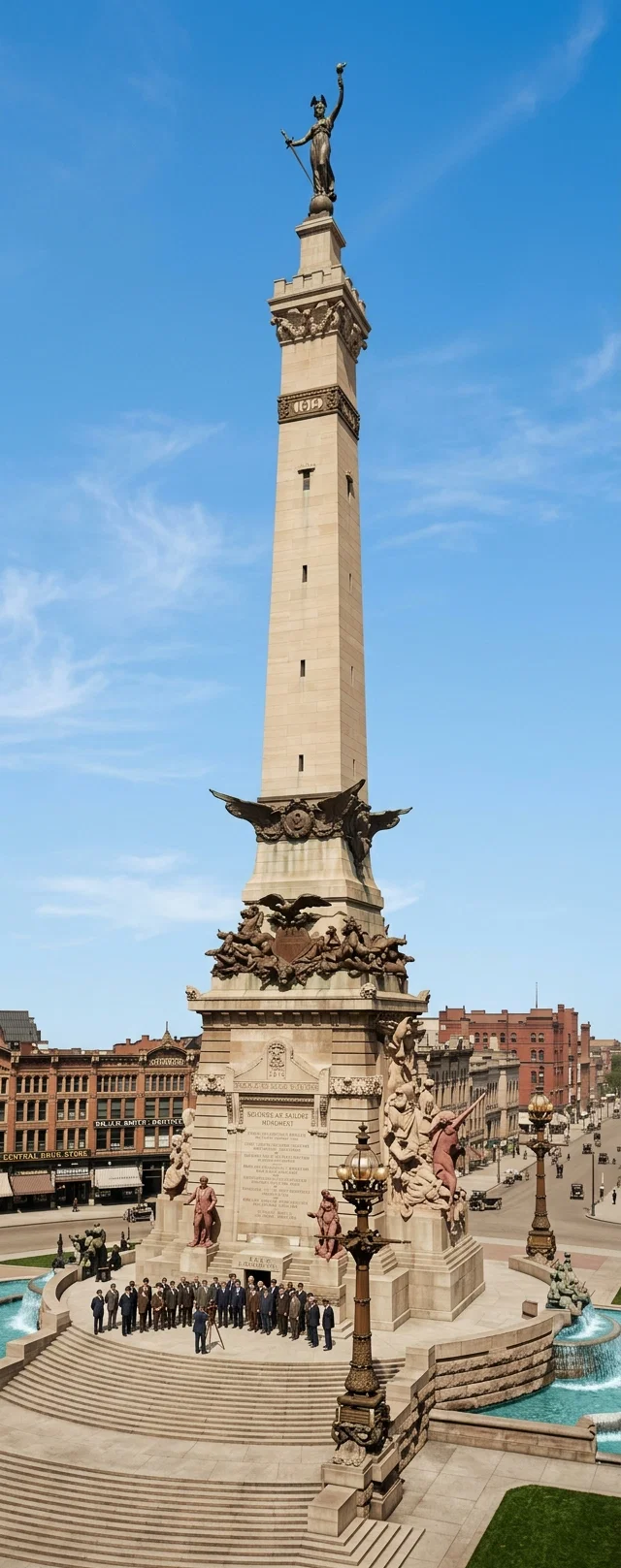
INDIANAPOLIS WAR MONUMENT, WHERE FEDERATION DELEGATES WERE PHOTOGRAPHED
“Associate yourselves, O ye people, and ye shall be broken in pieces; and give ear, all ye of far countries: gird yourselves, and ye shall be broken in pieces; gird yourselves, and ye shall be broken in pieces. Take counsel together, and it shall come to naught; speak the word, and it shall not stand: for God is with us. For the Lord spake thus to me with a strong hand, and instructed me that I should not walk in the way of this people, saying, Say ye not, A confederacy, to all them to whom this people shall say, A confederacy; neither fear ye their fear, nor be afraid. Sanctify the Lord of hosts himself; and let him be your fear, and let him be your dread.” Isa. 8:9-13.
This speaker also highly lauded the work of the German Catholics in using the strength of numbers to force from unwilling politicians compliance with their demands. Upon this point he said:—
They, in their combined strength, established a press that made the fatherland ring with the injustice of Bismarck, with the wrongs done liberty of conscience by the Kulturkampf; and behold, although the “iron chancellor” had loudly proclaimed, “I will never go to Canossa,” every one knows he was glad to make peace with Catholics. Before his death the lightning from heaven struck him.
It is this same “lightning from heaven” that the American Federation of Catholic Societies purpose to employ in this country against all who refuse their demands and object to taking a trip to “Canossa.” The power of the American Federation of Catholic Societies to accomplish such results was seen recently in the matter of the treatment of the friars in the Philippines. The flood of gold poured into the lap of that order by this government was the result of the stand taken by the Federation against the first expressed purpose of this nation, according to the statement of the archbishop. He said, “We gave notice to our enemies that there was no power beneath the flag that could expel the friars. You know the result. Our government listened to the voice of federation, and the friars received a reasonable compensation for their lands. What we have done thus far has attracted the attention of other countries, and similar bodies have been formed in Australia, Italy, and notably in England, where the bishops to a man have raised the banner of union on the identical lines of the American Federation.”
One of the chief lines of activity to be taken up by this Federation in the immediate future is the revision and transformation of the school system of this country. The demand for such a work occupied a prominent place in the annual report of the national secretary. It also occupied a prominent place in the address of Bishop McFaul. Their proposition is that the state pay for the secular instruction given in their parochialschools. This they declare to be one of their rights; and as the Federation is created to secure and protect their rights, it will use the combined power of its nearly two million members to force a recognition of those rights.
Their reason for expecting compliance with this demand lies in what they have already accomplished, notably in estopping the United States Senate when it purposed to interfere in the Kongo matter. Woe betide the unwitting politician who dares to oppose the designs of that church in this matter. The Federation will see to it that he “goes to Canossa,” or goes no more to the legislature.
That it is just such work as this that the Federation has cut out for itself was shown by a declaration made by the bishop. He said some feared that if their organization kept on, it might get into politics and then politics might get into their religion. He saw no danger of their getting into politics, and declared that, “If the politicians meddle with our religion, we’ll tend to them.” This declaration brought a storm of applause. It indicated also that the organization’s promoters do not consider they have anything to fear from recalcitrant politicians. In fact, the address closed with the declaration that it was the purpose of the American Federation of Catholic Societies to “make America the youngest and fairest daughter of the holy Catholic Church.”
At the last business meeting of the Federation the election of officers took place, resulting in the re-election of the officers who have served for the past year, and the election of three additional vice-presidents.
C. M. S.