In Africa

10%

Review and Herald Publishing Association · Takoma Park Station, Washington, D. C. · Jul 4, 1907

FromReview and Herald, Vol. 84, No. 27.

Read the full edition

In Africa

We are nearing the Indian Ocean at Beira, East Africa. For eight weeks we have been at our Somabulo Mission, in Matabeleland. It was a pleasure to teach the boys and girls in the school there, while waiting for the favorable season to enter Nyassaland.
Elder Armitage has carried on the work of the Somabulo Mission for six years, with little help except that of his wife. When one sees the many things to be done from early morning till late in the night, it is not surprising that no one man is able to endure the strain without much sickness in such a fever-stricken climate. I am pleased that he has now been provided with a teacher for the school. This additional help has always been needed. Elder Armitage will now be able to give attention to other important matters. Several boys who have been in training a number of years should now be taken out by him, and located at favorable points where schools are needed. The boys are willing to go, and I believe they will do good work in teaching their people. The question arises in many minds: Do these missions pay; are they a success? I wish every brother and sister who doubts their success could spend a month with the fifty boys and girls rescued from heathen darkness by the Somabulo Mission. You would find them civil, honest, clean, steady, hard-working, Christian boys and girls. The mission has a wide influence for good among both whites and natives. It is a success, and worthy of your support.
The native teachers, two of whom are now out in native villages, have a good knowledge of the Bible and the pillars of our faith. They can speak and read English, which enables them to read the truth from our books and papers. Thus they may constantly grow stronger in the truth themselves, and better communicate the message to their own race. If properly managed by our missionaries, the English language in the hands of these native teachers may become a great force for spreading the message in Africa. The foreigner can never reach the native heart as can his brother native.
Through God's care and blessing we are still in excellent health. There is probably no deadlier malarial district than the seven hundred miles of country from Bulawayo to Beira; also the coast and rivers from Beira to Nyassaland.
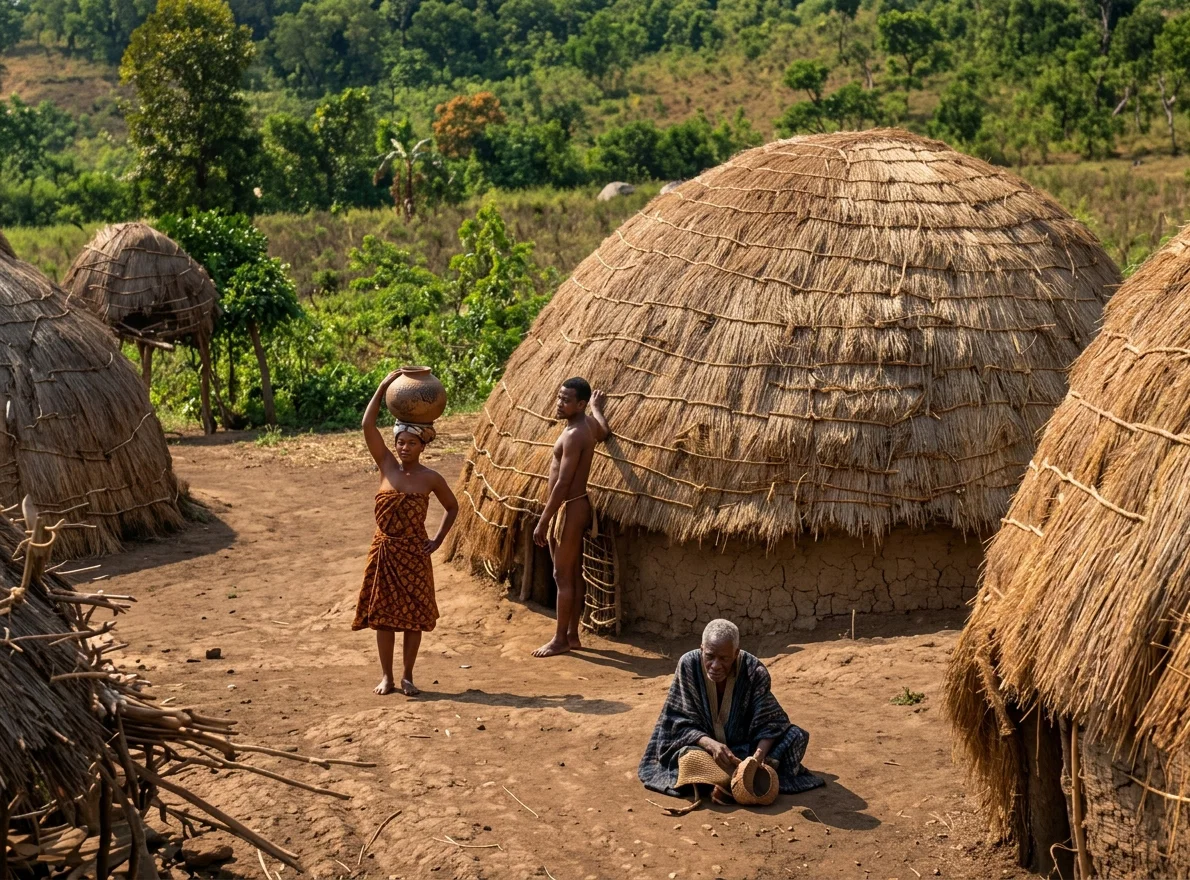
KAFIR HUT, SOUTH AFRICA
We have taken the advice of our South African brethren to wait until May to pass through this district. Being the dry, cool season, the climate is less dangerous.
I should say that I was not permitted to leave Rhodesia without a taste of the very common eye disease of the country. This is the first affliction my eyes have ever suffered. It is not serious, however, I believe. With a few days' care all will be well again.
This port of Beira is hot compared with the beautiful highlands of Rhodesia. But our steamship is waiting in the bay, so we do not have to spend even a night in Beira. This place is over two thousand miles northeast from Cape Town, and is the chief port of Portuguese East Africa. We go by boat to Chinde, at the mouth of the Zambezi River. It requires only nine hours for this trip on the Indian Ocean. From Chinde a river boat takes us to Chiromo, on the Shire River, and from there we go fifty miles to our Plainfield Mission, by native carriers. We hope to reach the mission in ten days. We appreciate very much the kindly interest that our friends at home have taken in us and the Nyassa Mission. We shall try to write fully of the work in Nyassaland after arriving.
JOEL C. ROGERS.