The Great Peace Congress

4%

Review and Herald Publishing Association · Takoma Park Station, Washington, D. C. · May 2, 1907

FromReview and Herald, Vol. 84, No. 18.

Read the full edition

The Great Peace Congress

K. C. RUSSELL
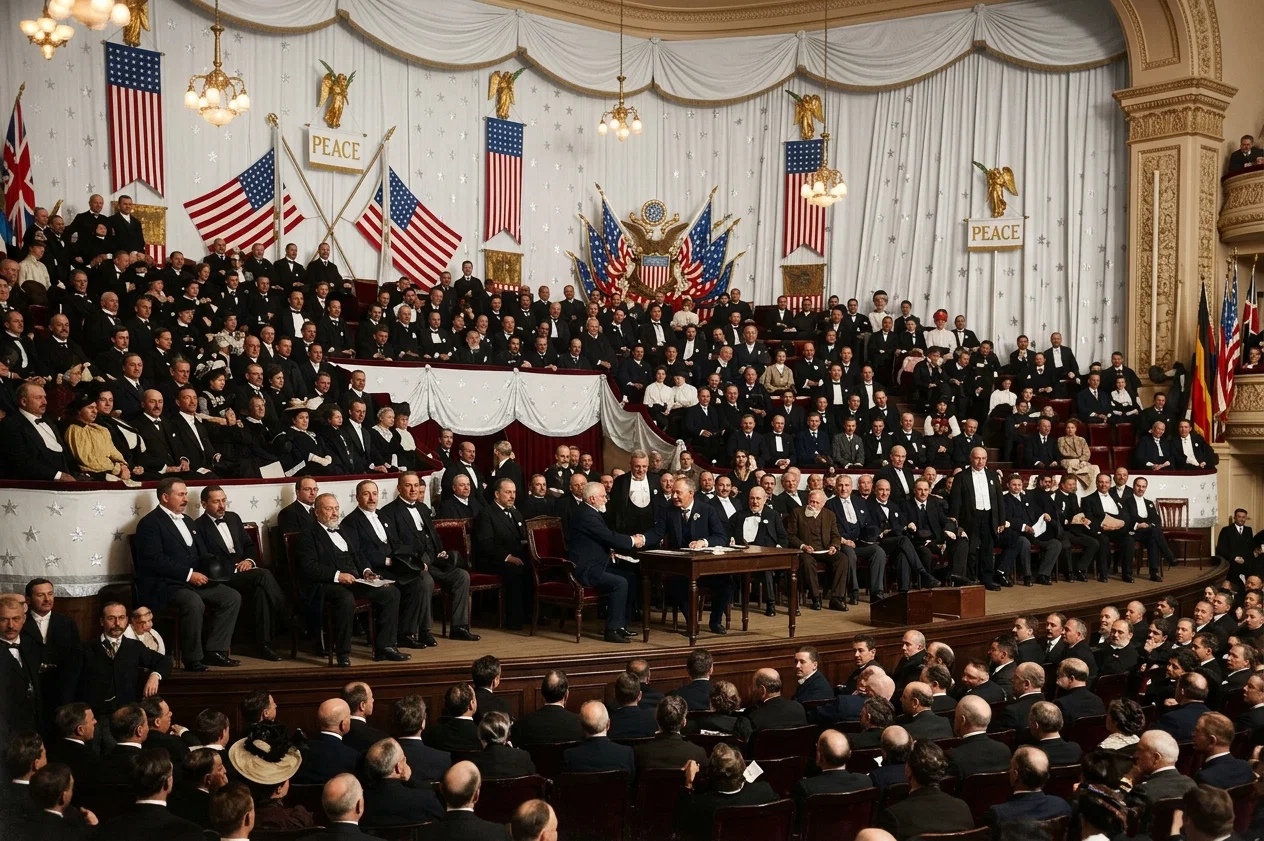
One of the greatest events of the century has been the occasion of the First National Arbitration and Peace Congress, which was held in the celebrated Carnegie Hall, New York City, April 14-17. The great and magnificent auditorium was filled to overflowing to the topmost galleries, at nearly all of the services.
The interior of the hall presented a most striking and imposing spectacle, especially to one who can read in this movement a significant sign of the times. The platform was so elaborately decorated as to give the appearance of a typical epoch of eternal peace; silver stars sprinkled on a broad hanging of white, and the eagles and arrows of the American shield were carefully screened by a symbol of brotherhood. A golden angel, bearing in one hand a palm leaf, supplanted the usual war eagle or pike-head on the staffs; broad bands of white, inscribed with the golden word “Peace,” depended from the feet of the gilt angel. Above the main galleries was a groundwork of white, surmounted by the flags of every nation under the sun.
To one who is familiar with the prophetic outline concerning what the people and nations will be saying and doing in the last days, this Peace Congress presented a most solemn and impressive fulfilment.
The prophet Isaiah said, under the inspiration of the Spirit, “Many people shall go and say, Come ye, and let us go up to the mountain of the Lord, . . . and he shall judge among the nations, . . . and they shall beat their swords into plowshares, and their spears into pruning-hooks: nation shall not lift up sword against nation, neither shall they learn war any more.” And the prophet Micah predicted that the nations would be saying the same thing at this very time. What a signal fulfilment of these prophecies before our very eyes! Let it be noted that they were saying these things.
There were thousands of people present saying these things by their enthusiastic applause of those who were saying these things by word of mouth; and there were also the delegates, representing the different nations of earth, who, as the prophet declared, were saying there shall be war no more.
The prophecy which stands in marked contrast to these texts already quoted teaches that the Lord says, “Prepare war, . . . beat your plowshares into swords, and your pruning-hooks into spears.” Joel 3:9, 10.
As evidence of the fulfilment of these words, one needs only to behold the great nations of earth, with their mightystanding armies and their powerful navies, which are annually increasing in strength and magnitude. Since the last Hague Conference, in 1899, it is estimated that the aggregate annual increase of money expended in preparation for war has reached the alarming sum of fifty million dollars.
To render the scene more impressive, one need but turn the eyes toward the platform and the boxes in the galleries, where sat delegates who represented the great nations of earth, and who had come to join in the cry of “peace and safety.”
Among the distinguished personages who were in attendance at the opening session, were Andrew Carnegie, the president of the Congress; Rabbi Emil G. Hirsch, D. D.; Bishop Henry C. Potter; Monsignor Lavelle; Dr. Frederick Lynch; George Foster Peabody; Booker T. Washington; Dr. Charles E. Jefferson; and many others. Archbishop Farley of the Roman Catholic Church, of Washington, D. C., was unable to be present, but was represented by Monsignor Lavelle, who read an address that was prepared by the archbishop.
Stereograph copyright 1907 by Underwood & Underwood, N. Y.
The key-note of all the addresses of the first session, was that of arbitration and conciliation, rather than any argument for disarmament or actual cessation of war. From the archbishop’s address we quote the following:—
“The holy see is still the working head of the great Catholic body, over two hundred and fifty-six millions of souls; and its moral authority was never greater. All these countless millions would surely welcome the recognition of the holy see as a factor in international arbitration.
“It stands forth universally venerated as a divine representative committed to the works and the interests of peace by the nature and history of its office, at the head of a great working system of international religious administration which permits it to reach rapidly and efficiently the minds and the hearts of the whole peoples and races.
“I am not prepared to say just how the holy see might again take its place as a factor in the work of universal peace, or how the Christian world shall resurrect a tribunal that was once its pride and honor.
“I think I can safely say that if the holy see were no longer excluded from this noble and eminently religious enterprise, the thirteen or more millions of American Catholics would at once take a livelier interest in the movement for the abolition of war. It would appear to them as more than a Utopian scheme—as something practicable and, in a large measure, attainable.”
The address plainly indicated the great ambition of Rome to play an important part in the coming Hague Conference. There can be no misunderstanding as to that desire on the part of Rome. This is not strange, however, to those who understand the policy of Rome. The papacy has long sought to be the arbiter of nations, and to pose as the prince of peace. No opportunity is ever lost by her, if she can thus gain prestige and power to extend her authority.
It will be noted that one of the arguments produced by the archbishop why the holy see should be represented at The Hague Court, is because of the great numbers of Catholics in the world. It is evident that the argument will carry weight with those upon whom the responsibilities rest of selecting the personnel of this august court. In such a position the pope of Rome would be able to speak with unbounded authority when international disputes might arise in countries where the Catholics are numerically large. When difficulties are settled thus, the pope would be heralded as the prince of peace. The appointment of a representative of the greatest ecclesiastical organization in the world would inevitably and logically lead to the settling of ecclesiastical differences which might arise, as well as to arbitrate troubles between nations.
The congress strongly advocated the establishing of a world supreme court at The Hague. The power vested in such a court would sustain the same relation to the world that the Supreme Court of this country does to the United States. While the National Arbitration and Peace Congress does not speak officially, yet it is its purpose to create a world-wide sentiment that will carry tremendous weight in accomplishing the object to be obtained at the coming Hague Court.
It is a worthy and commendable thing to desire and seek peace, in every proper and legitimate way. But the thing that God does not approve of is the cry of universal “peace and safety,” when the Bible plainly declares that a condition of things directly opposite will exist. The Lord plainly teaches that at the very time this great cry of peace is being heralded, there will be “perilous times.” “Evil men and seducers shall wax worse and worse;” “the devil is come down unto you, having great wrath, because he knoweth that he hath but a short time;” “there shall be a time of trouble, such as never was,” and other similar expressions are used to describe the condition that will exist.
The sentiment pervading the recent Peace Congress was voiced in the following words by Mayor McClellan, of Greater New York: “I am one of those who believe that the world was better yesterday than it was the day before; is better to-day than it was yesterday, and, with God’s blessing, will be better to-morrow than it is to-day.”
Multitudes will be deceived by these things, in thinking that the roseate condition which is so universally taught to-day, is sure to be realized; but, as the result, destruction will overtake them; for the Lord declares that “when they shall say, Peace and safety; then sudden destruction cometh upon them, . . . and they shall not escape.” 1 Thess. 5:3.
The only enduring peace is that which comes to the individual soul, in Jesus Christ, the mighty Prince of peace.