C. D. AC MOODY

5%

Review and Herald Publishing Association · Takoma Park Station, Washington, D. C. · May 2, 1907

FromReview and Herald, Vol. 84, No. 18.

Read the full edition

C. D. AC MOODY

Turkey

C. D. AC MOODY

The writer has now been in Turkey three months. Turkey is a country in which the nations of the world are especially interested. Constantinople, its capital, stands as a great divide between the obscure and distant East and the enlightened, expansive West. Here is where Oriental and Occidental life meet. No place stands as so impressive a landmark of political and ecclesiastical struggles. It has been the objective point of the world's greatest generals. Nature has endowed it with surroundings which make it a natural stronghold.
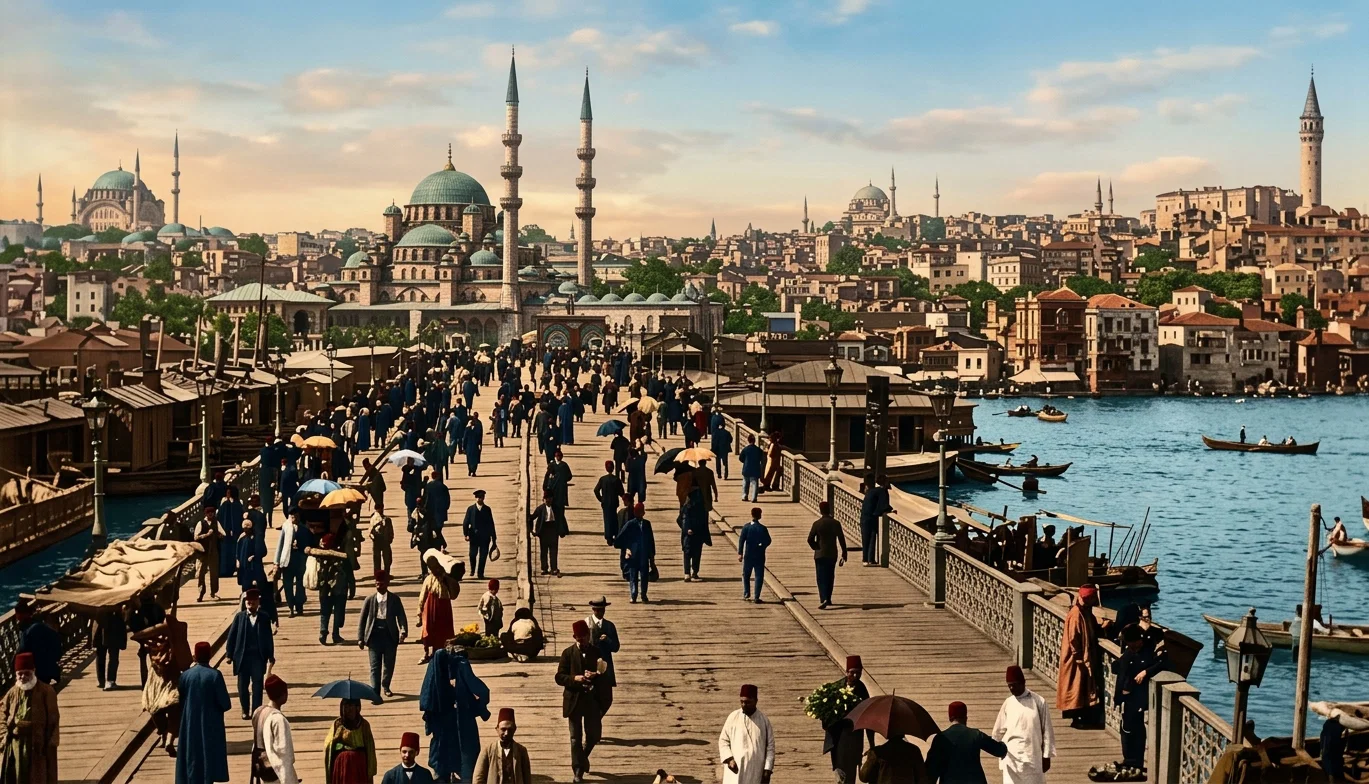
The accompanying illustration is that of the main bridge across the mouth of the “Golden Horn,”—a projection from the Bosporus,—with part of the Turkish, or Stambül section of Constantinople—the site of the ancient city of Byzantium. Probably in no place in the world is there a greater number of nationalities represented, and a greater variety of costumes seen at any and all times than on this pontoon bridge. Constantinople is classed as one of the most picturesque cities in the world. Her many Mohammedan mosques, with their massive domes and spiral minarets looming up before the eye, present a most fascinating view. But a great contrast is presented to all this when her dirty, narrow streets are traversed, most of which are but little better than alleys. On either side of the Bosporus loom up mountains whose tops and sides are strewn with ruins of the past. These are interspersed with modern villages and suburbs of Constantinople. Along the shores, mostly on the European side, the summer homes of many Europeans are located; also the summer residences of the principal foreign ambassadors.
While the nations in their race for supremacy are focussing much attention upon the Ottoman field in the interests of empire, there is an organization on earth which is, or to say the least should be, vastly more interested in the things relating to Turkey's present and future. That organization is the church of God that bears to the world the message of the second advent of the Messiah. We are proclaiming this advent message to the world solely upon the authority of God's prophetic word. And the last earthly power depicted in prophecy is that power of which it is said, ‘He shall come to his end, and none shall help him.’ The nation over which floats the crescent banner of the sultan is that power. Not only do Seventh-day Adventists believe in the early departure of the Turkish authority from Constantinople, but some of the Mohammedans themselves look for this. Everything shows that these final acts in earth's drama will soon take place.
A thing worthy of notice in this connection was brought to the attention of the writer upon a recent trip into the edge of Asia Minor. Within the past few months quite a company of people from the Transcaucasian district between the Black and Caspian Seas have come to Ismidt,—old Nicomedia,—bringing with them all they possess. Some of them have considerable wealth. When asked if they were going to settle in Ismidt, they replied that they would settle nowhere at present permanently. They stated that they had come to be prepared to go with their leader when he leaves Constantinople to go to Jerusalem. As they are faithful adherents to the Mohammedan faith, the sultan of Turkey is their spiritual head. In fact, it is quite generally believed by many Mussulmans that the seat of government is to go to the south country soon.
In the February number of the Contemporary Review, Mr. Edwin Pears, in an article entitled “Macedonia and the Neutralization of Constantinople,” speaks in the following peremptory terms regarding the relation of Turkey to the powers of Europe:—
MAIN BRIDGE ACROSS THE GOLDEN HORN, CONSTANTINOPLE
“Once it is understood that England has a definite policy in Constantinople, of which neutralization forms an essential part, I should anticipate that all the Western powers, and sooner or later Turkey and Russia themselves, would recognize its reasonableness. The time is rapidly approaching, whether a conference be called shortly or not, when Europe will be compelled to assist in making new arrangements for Turkey.”
In view of all these things, it is high time we were availing ourselves of every opportunity and resource to impart to the millions of Mohammedans this last message of salvation. We of all people have something to impart. I shall not speak of the many obstacles to be encountered in pursuing aggressive work in this country. I shall speak only briefly of personal experiences in the field since coming here, of the evidences of God's leading, and of some of the great needs here.
The strongest constituency of our people in the Turkish Mission is in the edge of Asia Minor within a radius of ninety miles of Constantinople. After passing through customs and Turkish passport “red tape,” the first company I visited was our church at Bardizag. This is the largest church in all the mission field. Bardizag is located across the bay (which is an arm of the Sea of Marmora) from Ismidt. Ismidt is upon the site of the old Nicomedia, which was the first Roman capital in the East.
I found that the dear believers in this place had for some time been anxiously waiting for some one to come to them. The way I was welcomed by them can be appreciated only by those who have gone on a similar mission to isolated companies in the mission fields. I found them for the most part strong in the faith. About two hours' journey on horseback from this place, at Ouajük, is another company of believers whom I visited later. Being reasonably near together, these two companies are under one church organization, having a total membership of seventy. It is likely that in a very short time they will be divided, and each have its own organization. Bardizag is an Armenian village of ten thousand inhabitants. All these people live within the limits of the space required for a village of that many hundred in America.
The trip from Bardizag to Ouajük, with my interpreter, was made on horseback over the rough mountain path; for there is not a wagon road leading to the latter village from any direction. This seems all the more strange when we find that the village has a population of three or four thousand. We carried with us on a packhorse sufficient charcoal for fuel to last us ten days, as there was none to be had at Ouajük. Be assured it was a new experience for the writer, who, with the other laborers in the home land, has been used to steam railroads, or at least a carriage of some description. It was extremely novel and interesting however. Two of the brethren accompanied us to look after the horses and luggage.
This was a very profitable trip. All had many questions to ask, and each seemed anxious to know the truth. We were with them over two Sabbaths. The second Sabbath communion service was held, and all expressed a desire for reconsecration to God. It is touching to see these poor believers, some of whom have to labor hard all day for four or five piastres (sixteen or twenty cents), contribute of their means as best they can for the furtherance of the gospel message, which they love.
My first experience in conducting a communion service in this country was at Ada Bazar. This is located on the railroad about twenty-five or thirty miles east of Ismidt. At this place there is a good little company of believers, which, with several families from a neighboring village, numbers twenty-one. On Friday the brethren from this latter village came to Ada Bazar, and all remained together over Sabbath and Sunday. Sabbath two meetings were held, besides the communion service. But what a strange communion service it was to me! About me the sisters were seated on rugsthrown upon the floor, while most of the brethren were on a kind of settee which is a permanent fixture in the houses of most villagers, and which extends across two sides of the room.
It was a blessed occasion to all of us. With great reverence these dear people ate of the bread and drank from the cup upon which we had asked the Saviour's blessing. They were much encouraged, and were determined to press forward. At all the places visited many an hour has been spent after the evening study answering their eager questions; sometimes till late into the night.
For nearly three weeks I have been in Constantinople. A blow has come to the work here in the death of Dr. A. W. George, who established our medical work in this city, and who also had the burden of looking after the field work in Asia Minor. He is another standard-bearer fallen. We feel keenly the loss. At present there is no one to pick up his branch of the work and carry it forward. We are seeking God earnestly for light and help at this time, and that he will open the way that means and the proper person may be supplied to take up the work of the one who has fallen at the post of duty.
Here in a field with a population equal to that of the five Lake States comprising the Lake Union Conference, with South Dakota added, there are but seven workers, including the writer. And this is only one of the three divisions of the Levant field. Beyond Turkey stretches Persia, whose borders have not been crossed. Though I have not been long enough in this field to write intelligently of work in detail, enough has been seen and experienced to make me believe that the recent move on the part of the Mission Board to make a special effort for the whole Levant field has not come too soon. A few days ago a letter was received from a city in Armenia, southwest of the Transcaucasus, pleading for some one to come to them. They report some to be baptized, and an interest among the people. This field is ripening for the final harvest.
There is a great work to be done for the people who speak the language of the Koran—Arabic—and the languages akin to it—the Turkish and Persian. I do not believe I am speaking untimely in urging upon some of our bright young people the idea of preparing for work in these fields. May the present move result in a speedy opening up of all parts of the vast territory now within the pale of Mohammedanism. Within these confines the early church had its beginning. And so surely in this territory earth's history shall close, and that, when this gospel of the kingdom shall have been preached in all the world for a witness unto all nations. Let no man turn his back or lay down his armor, till the victory is won, and the last page of earth's history is completed.
Constantinople.