Alto Parana Mission

7%

Review and Herald Publishing Association · Takoma Park Station, Washington, D. C. · Apr 18, 1907

FromReview and Herald, Vol. 84, No. 16.

Read the full edition

Alto Parana Mission

J. W. WESTPHAL
This mission embraces the republic of Paraguay and the territory of Missiones in Argentina. The former has a population of nearly six hundred thousand, exclusive of the Indians, whose number is variously estimated at fifty thousand to one hundred thousand. Missiones has a population of about thirty thousand.
This territory was once the stronghold of Jesuit missionary work in South America, whence the name given to Missiones. At one time it also embraced a portion of Brazil. But the missionaries were gradually driven back by the Brazil slave-hunters, and the Indians taken from the mission stations and captured in the forests were taken to Rio de Janeiro and other slave markets, to be sold. At that time the population of Missiones was one hundred and thirty thousand.
Scattered over Missiones and a part of Paraguay are the ruins of these mission stations. They were composed of a church building, fronting upon a large square or enclosure, which was surrounded by large buildings and courts, in the latter of which the Indians were housed, and, until resigned, were kept from escaping. All was generally built of large rock, and comprised a veritable fortress against the attacks of the savages and slave-hunters. The rougher work was all done by the Indians, who were practically the slaves of the Jesuits. The Indians were taught the various trades, but especially the Catholic religion. By ingenious devices, moving images of saints were made to demonstrate their power, and inspire faith in the heart of the red man, and what could not be done honestly or by deceit, was accomplished by force.
One of the chief and best-preserved ruins is in San Ignacio, on the Parana River, a little above Posados. The church is about eighty by two hundred and forty feet. The walls are six feet in thickness. In the front is still to be seen the image of San Ignacio, hewn in bas-relief on stone. Within the walls are now large orange trees. In the center of the square, in front, is a small cemetery. The enclosure and buildings, as well as the forest about, are filled with orange trees, and the people come from far and near to gather the fruit.
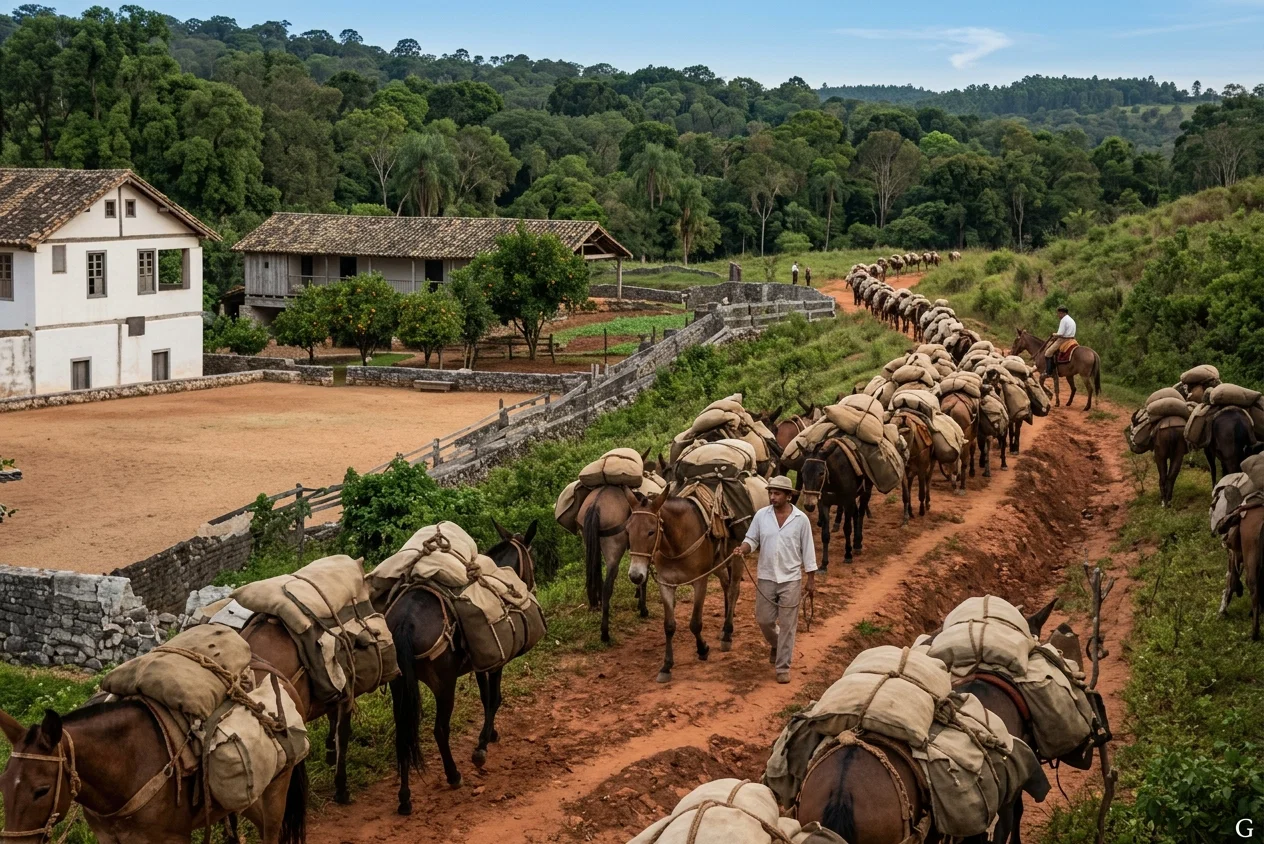
MULE PACK TRAIN IN PARAGUAY
When Spain in 1767 banished the Jesuit order, their missionary efforts in her territory ceased. The dreams of Jesuit greatness and power came to an end. The domesticated Indians still lingered about the stations, making their homes within their abandoned walls, until about 1815, when the stations were laid in ruins by the Portuguese.
It is in this former stronghold of the Jesuits that the third angel's message has made some of its most signal triumphs. In the course of three years, about one hundred and fifty Seventh-day Adventists have been raised up, while there are still others keeping the Sabbath. Throughout the whole region more or less is known of the truth, and urgent calls still come for help. During our recent meeting, two were baptized, and three united with the churches.
Paraguay and Missiones have a distinct race of their own, developed from the early Spanish settlers and the Guarini Indians, and, in Missiones also, the Brazilians. While the official language is Spanish, the language of the people is Guarini. There are thousands who can not understand Spanish, and still more who can not speak it. The Guarini language is itself a mixture of the Spanish and the Guarini of the Indians, so that they are not understood by the Spanish, and but little more by the Indian. Except a translation of parts of the Bible, they have no literature. Few can read in any language. The Bible is unknown, except as the agents of the Bible societies have scattered it. Nominally all are Catholic. Superstition occupies the place of faith everywhere.
Owing to a train of circumstances, religious and social, the moral temperature is lower than in any other country in South America. Ever since the war with Brazil, Uruguay, and Argentina more than thirty years ago, when nearly all the men of military age were killed, the female majority has steadily been maintained. Marriage has largely fallen into disuse. The cigar is found in the mouths of men, women, and children alike. These conditions make Paraguay a difficult field for successful work. In every way the people are enslaved, and the conscience seared. As far as I could learn, Protestant churches generally have succeeded less in establishing themselves than in other South American countries. It is still virgin soil for gospel work.
Including the laborers, there are now thirteen baptized Sabbath-keepers in Paraguay, and six or eight others are keeping the Sabbath. It was my privilege to visit them recently, and I found them firm, and rejoicing in the Lord. They are very scattered, but their isolation does not affect their ardor. I believe all those baptized are faithful in giving to the Lord his own.
My trip which was made through Missiones and Paraguay, as far as Gonzales, in company with Elder Ernst, the superintendent of the mission, was interrupted for a week by the sickness of Elder Ernst. After a three-days' tedious ride on horseback, being tired and warm, he took a cold bath, from which pneumonia resulted. Thanks to the knowledge the Lord has given us of simple treatments, after a week's nursing, I could leave him on the road to recovery. I concluded my visit in company with Brother Ignacio Kalbermatten, the only other laborer in that field. Remember the work and workers in this difficult field, in your prayers.
Diamante, Entre Rios, Argentina.