EN ROUTE from Erfurt, in the West German field, to Elbing, where we were to have the Prussian Conference, I spent January 14-16 in Friedensau, where I found the brethren busy closing up their annual accounts. There were a number of important matters to be considered. I was glad to find eleven young people who were finishing their course of study in the school, ready to go into the field in January. The places made vacant by their departure, will be more than filled by the new students who will be immediately admitted. The fields in the German union are anxiously waiting for all the workers we turn out, be they nurses or Bible workers. I found the brethren closing in the building of the Old People’s Home.
In Berlin I met Brother Guy Dail, and we went on to Elbing, a city of about fifty-three thousand inhabitants. The Prussian Conference here was held January 16-20. This conference contains the two provinces of Eastern and Western Prussia, with a population of about three million seven hundred thousand— mostly Protestants. One hundred and sixty-nine were added during the year, bringing their membership up to seven hundred and thirty-eight. A number of companies were received, and among them was a good strong Polish church of more than twenty members. There was a fair representation of our people in various parts of the field. Elders Erzberger and Schilling assisted in the meeting. Sabbath was especially a good day. Brother F. Prieser, a promising young man who had done good work, and Brother G. Domnik, our Polish laborer, were both ordained to the gospel ministry, and the Lord witnessed by his presence.
Although the people in this field earn smaller wages than in almost any other part of Germany, yet we are glad to say that their tithe increased, and this conference, also, was able to give five thousand marks toward the Old People’s Home. They also gave liberally toward the material fund and the work in East Africa. Four were baptized at this meeting. Elder G. Obländer was again unanimously elected president of the conference. As we have over one hundred Polish brethren in this field, it was decided that we now get out the Sabbath-school lessons in that language, using the German types. This work will be done at Friedensau. This is the first step toward the publication of another regular journal.
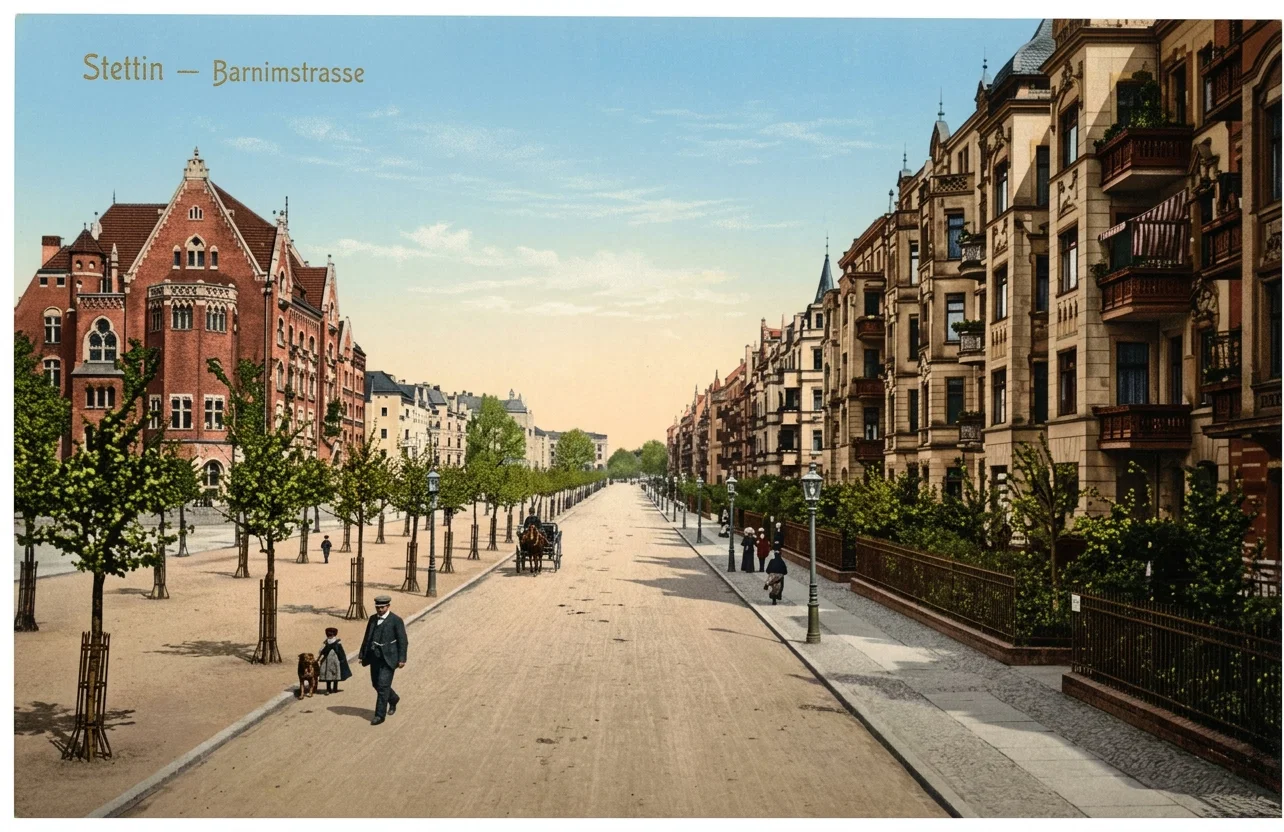
STETTIN, GERMANY
State College chapel at the left, in which two of our meetings were held.
During the meeting it was bitterly cold, as a cold wave had struck the Continent, such as has not visited us for the past twenty years, reaching down to Constantinople and Italy; but in spite of this we had most excellent meetings; and especially was the parting sermon Sunday night blessed of God, and many seemed deeply impressed by the Holy Spirit with regard to the importance of the truth God has given us for this time.
An experience of one of our sisters on her return home by train will illustrate the effect of the conference: She found a lady in the apartment who was speaking to others about the good meetings she had been attending in Elbing, where she “had heard things she had never heard before.” In the conversation that followed, our sister found that this lady had been visiting in the city, and happened into one of our meetings, and had been so favorably impressed that she was telling the good news to others—thus actually doing missionary work. There is indeed a power with this truth that is greater than we realize.
From Elbing we went to Stettin, a city containing about two hundred and twenty-five thousand inhabitants, and noted especially for its ship-building industry. The East German Conference had its regular session here, January 23-27. They had secured a fine hall in the city, capable of holding about five hundred hearers. We were pleased to find more than two hundred of our own people present.
The East German Conference has the largest membership of any conference in the German union. Last year was one of great growth, as the report shows three hundred and fifty-nine additions, and a membership of fourteen hundred and thirteen, and a tithe of about sixteen thousand five hundred dollars. In Stettin itself we now have a church of eighty-two members.
At this meeting we had the help of Elders Erzberger, Obländer, and Schilling, and Dr. Planer, one of our brethren from Dresden, who delivered several interesting talks on health. Although our meetings were held at election time, and the agitation among the people ran high, and although the emperor’s birthday occurred at the time, with its festivities, still we were pleased to see good audiences. On two evenings it was impossible for us to keep our regularly engaged hall, so we had to arrange for another place, and the Lord wonderfully opened the way for us to secure the beautiful hall in the State college located in Stettin, the authorities granting us the free use of the hall, and charging us only for light and service. This college chapel was indeed a beautiful one, with fine paintings and a nice pipe-organ; but best of all, the chapel was well filled with16attentive hearers.
Twelve were baptized at this meeting. Several others offered themselves for baptism, but they will be baptized in Berlin.
The church at Charlottenburg, a suburb of Berlin, with sixty-five members, and several other companies, were taken into the conference. On Sabbath we ordained several local elders and deacons. Brother Prillwitz, a licentiate who had for several years been local elder of the Berlin church and later had done successful field work, and was a member of the conference committee, was set apart to the gospel ministry. Since that time, he has been called to take charge of the Austrian Mission.
The East German Conference gladly voted two thousand four hundred dollars for the Old People’s Home, and contributed liberally to missions, and to the “material fund” for the German “Ministry of Healing.” Brother E. Frauchiger was again unanimously chosen president of the conference.
Although the Silesian Conference, with nearly four hundred members, has now been separated from the East German Conference, yet in eastern Germany there are still about one thousand members, over four hundred of whom are in the city of Greater Berlin. From now on, this conference includes the provinces of Brandenburg and Pomerania, and the kingdom of Saxony, with a population of about eleven and one-half millions.
This closed the round of annual meetings in Germany,—seven in all,—and we have every reason to be thankful to God for the union that existed throughout all these conferences, and for the good attendance of our own people and of those from without.