L. R. CONRADI

4%

Review and Herald Publishing Association · Takoma Park Station, Washington, D. C. · Dec 13, 1906

FromReview and Herald, Vol. 83, No. 50.

Read the full edition

L. R. CONRADI

Abyssinia

L. R. CONRADI

Abyssinia has probably come into the foreground as much as any of the strange, virgin lands, during the last few years. It has recently been the object of a number of extraordinary political missions, for not only the great nations of Europe, but even the United States of America, tried to come into contact with the people, and gain admission for their commerce. In the early part of the present year, Dr. Rosen was sent by the German government to wait upon Emperor Menelek, and also to travel all through that country.
Abyssinia has about one hundred and fifty thousand square miles, and contains a population of about four and one-half millions. The vaguely defined dominions of Menelek stretch from near the equator to the fifteenth degree north latitude, or as far as from Cairo to Khartum, or from Hamburg to Madrid.
The word Abyssinia is derived from the Arabic Habash; the inhabitants call themselves Ithiopavians, or Ethiopians.
On account of its high mountains, the region now included under the name Abyssinia, has been very properly called the African Switzerland. The average height of the plateau is about nine thousand feet above sea-level, everywhere intersected by deep ravines, and dominated by lofty snow-capped peaks. The desert stretches from the Red Sea to the base of the mountains, which rise very abruptly to the region of eternal snow, and slope gradually to the west. The climate is temperate, in the main, but of course in the ravines it is hot, as in the basin of the Dead Sea, while on the heights it is cold. The people are chiefly engaged in agriculture, stock raising, and hunting. The hides of the cattle are especially valuable. The land is fertile. They have no less than sixteen different kinds of barley, and twenty kinds of wheat and maize. There are plenty of legumes, and cotton, and coffee, which even grows wild in the primeval forest. Malaria is unknown.
The Abyssinians are skilled only in working in leather and metals; and their other industries are carried on in the home. Although their country is rich in mines, yet they have not done anything to develop them.

Religious Life of the People

What naturally interests us most is the religious life of the people. The Abyssinians form a part of the Coptic Church, and they are under the Patriarch of Alexandria. In their traditions they say that the queen of Sheba came from their country; while there is no proof of this, yet we do know that Christianity took root in that land some time in the fourth century, and since that time, in view of its isolated condition, has been preserved there. Their translation of the Scriptures into the Ethiopic dates from the fourth century. Upon this book rests whatever power Abyssinia had in its best days.
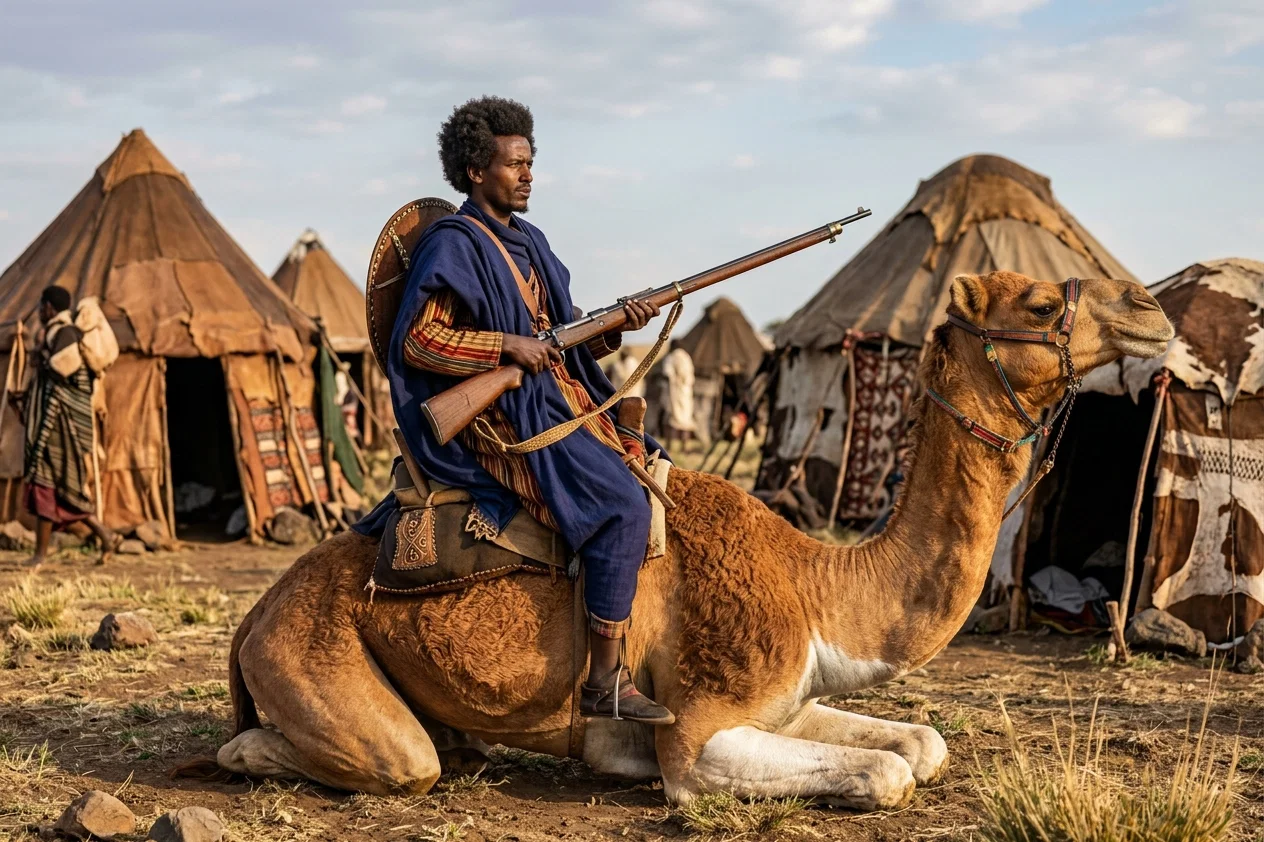
Personally, I made the acquaintance of some Abyssinians en route from Beirut to Jerusalem; they were on a pilgrimage to the holy land, but on account of quarantine, had been carried to Beirut, as there is no quarantine station at Jaffa. They are a tall, slender, well-built people. As to intelligence, they are surely above the negro population.
AN ABYSSINIAN SOLDIER
Their church at Jerusalem is not very far from our medical mission in that city. Their church buildings are round structures, with cupolas on top; and they have services here Friday evening, Sabbath, and Sunday. At the present time they observe the Sabbath, and practise circumcision. They also own a part of the court room in the Church of the Holy Sepulcher at Jerusalem; but their quarters are very poor, if compared with the richly furnished apartments of the Coptic Monastery.
While the Abyssinians were able to withstand the encroachments of the Mohammedans, and even seemed lost to the world for a while, yet they were rediscovered in 1490 by Portuguese naval officers. The Portuguese tried hard to get the country into their hands, and thousands of people were killed. The Jesuits were finally expelled. They made another attempt in 1621, and a third effort in 1750.

Protestant Missions

In 1830 the Church Missionary Society sent out Messrs. Gobat and Kugler to this field; other missionaries followed. The Jesuitical cloud again appeared, and in consequence, all the missionaries were expelled from the country in 1838. But the missionaries remained on the border of Abyssinia, until 1859, when they again returned to the capital; they were imprisoned, and remained in confinement for a number of years — until 1868, when they were freed by the English military force.
In 1868 the Swedish Evangelical National Society began work at Massawa, in what was then Abyssinian territory, but what has since been converted into the Italian Colony of Eritrea. This colony contains about thirty thousand square miles of territory, and about three hundred thousand inhabitants. It lies along the Red Sea shore. The Swedes now have five stations, occupied by eighteen missionaries, and thirteen native helpers. They have a printing house, and schools, and about three hundred communicants.
It is a cheering fact that not only do the Abyssinians have the old version of the fourth century, but the Scriptures are translated and issued by the British and Foreign Bible Society in the languages of the people to-day. The Amheric edition was issued in 1875; in 1899 the Galla Bible left the Basel press; the Society has also reprinted the Ethiopic New Testament. The New Testament is printed in the Tigre, as well as in the Tikrinya language. Not only has the blessed Word been printed in these various tongues and dialects, but it is being circulated.
The following was received by the British and Foreign Bible Society in the summer of 1901:—
“The conquering Lion of the tribe of Juda, Menelek the Second, Emperor of Ethiopia by the will of God.
“Peace and health from God to the Honorable Mr. Alfred Cooper.
“The two copies of the New Testament, which were sent from the Society by the hand of the Englishman, were duly received, and I tender my best thanks for them. If you send a quantity of these books to Adis Abeba by a person, bearer of a letter from you, they will be received with pleasure, and Iwill see that they are distributed, and that a good price is paid for them.
“Written at Adis Abeba on the twenty-third day of Tonba, 1893 [1901 A. D.].”
We might remark that besides the Abyssinians, who belong to the state church, are the Zalans, a nomadic people who consider themselves Israelites, but who should be described as Christians. And there are also quite a number of Jews and Mohammedans.
The French also have territory in this region, as they have acquired possessions in Somaliland, with about two hundred thousand inhabitants. There is now in process of construction a railway from Jibuti to Harar. A little farther to the south and east is British Somaliland. On the western side of Abyssinia is the Sudan. As we have already a Coptic ordained minister in Egypt, we could surely do something from that side. Thus we see a great territory is open to us for missionary work all around Abyssinia, among probably two million people. Quite a number of Abyssinians live and conduct business outside of Abyssinia proper.
We are thankful to know that our brethren in Scandinavia have now definitely decided to dedicate their First-day offerings toward opening up the work in this interesting field. During the recent local conferences, about one hundred dollars was contributed as First-day offerings toward the enterprise. The German field has also received about five hundred dollars as gifts for this enterprise, so a small beginning has been made. We have felt that if our Scandinavian brethren in America could see the importance of this work, they might also be glad to contribute liberally toward it. We ought to have at least two or three thousand dollars to begin with, and then a constant income after the mission has been opened. Who will feel it a privilege to help us in this work?