The Swedish Annual Meeting

5%

Review and Herald Publishing Association · Takoma Park Station, Washington, D. C. · Aug 16, 1906

FromReview and Herald, Vol. 83, No. 33.

Read the full edition

The Swedish Annual Meeting

GUY DAIL
June 19-24 the twenty-fifth annual meeting of the Swedish Conference was held in the prosperous city of Vesteras, a comfortably and neatly built town of about sixteen thousand inhabitants, a great many of whom are engaged as workmen in the electrical manufacturing works here.
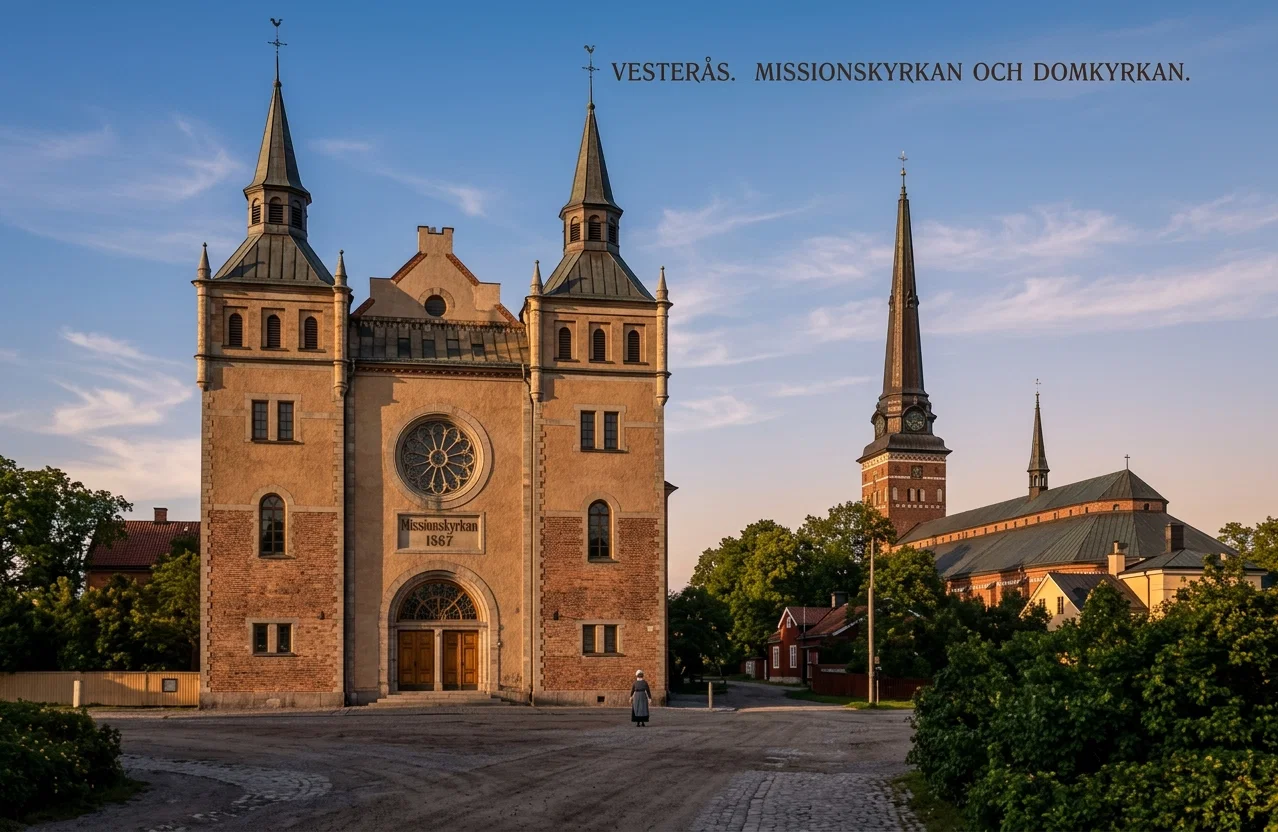
MISSION AND STATE CHURCH, VESTERAS, SWEDEN
Several weeks previously, a tent had been pitched in the city, and a regular course of lectures had been in progress, so that there was a good outside interest already developed, and the citizens of the town helped to form a part of the evening congregation.
Twelve of the thirty churches sent twenty-seven regularly accredited delegates; but a number of other brethren were accepted as delegates by vote of the conference. About one hundred and fifty of our people were on the ground. We have no church at Vesteras, so we think this a fair representation.
Outside help was rendered by Elders L. R. Conradi, P. A. Hansen, Fred Anderson, and F. R. Oberg. One of the subjects most strongly presented was the need of unity in the work of God. This led to greater devotion and consecration on the part of the delegates. Sabbath was indeed a day of blessing; for some gave themselves to God for the first time, backsliders were reclaimed, and nearly all rededicated themselves to the Lord's service. Seven were baptized.
Two new churches were received into the conference, one at Solvesborg (fourteen members), and the other at Karlshamn (seventeen members). In round numbers, eighty were added during the year, raising the membership from eight hundred and one to eight hundred and twenty-seven. A number emigrated to America; indeed, since the conference was organized, about three hundred members have left this field for America, so that this cause alone helps to cut down the net increase.
We heard several good experiences at this meeting, especially with reference to the circulation of the printed page. One man in southern Sweden, where we have the hardest field on account of the prejudice against us, bought a copy of “Prophecies of Jesus,” and read it through fifteen times, and then began to keep the Sabbath, with his wife. Another instance: One of our colporteurs was canvassing, and had the privilege of making his headquarters in the city mission house. In a short time the pastor became angry at him, because he was succeeding so well in his work. He was compelled to leave the mission house, but then the elder of the church said to him: “Drive up to my house, and stay there until you have delivered your books.” In four months this brother took orders for three thousand kroners' worth of books—the best record yet made in Sweden by any of our canvassers. Five or six years ago this brother stammered so much that it was thought by many it would be impossible for him to work as a colporteur. However, so long as he speaks with prospectus or Bible in hand, he does not stammer, but talks well, and is one of our most successful salesmen. God helps him.
Yet one more case: A few days previously to our meeting, the Inland Mission minister had warned all his people against “Christ's Object Lessons;” but the Free Missionary thought that was going a little too far, for he had formerlybought and read “Steps to Christ,” and thought it a good book. So he went from house to house, reading selections from that book, and asking, “Do you see anything wrong with that book? The other book will be just like it, you may be sure.” His influence helped us very much.
We might refer to some of the things that are taking place in Sweden itself. There has been formed a confederation of churches, whose purpose is to secure the enactment of more stringent Sunday laws; this is perhaps the strongest religious movement in the popular churches of Sweden to-day. Aside from it, we might mention the tendency among the educated classes of the state church toward “higher criticism;” there are also some learned men in the free churches who appear to be infected with the “new thought;” but on the other hand, there are some strong men belonging to the free churches that oppose this “higher criticism.” Spiritualism and Romanism are gaining some ground, and the Millenial Dawn party is growing.
But to return once more to the conference proper: The delegates heartily indorsed the re-establishment of the Scandinavian Union school; the dedication of the First-day offerings to the Abyssinian Mission; and the sending of Ole Nelson to begin work in the Swedish part of the Northlands Mission this fall, to be kept on the Swedish pay-roll until Jan. 1, 1907, when that mission will be formally separated from conference territory. Brother S. F. Svensson was invited to remain, and labor in the conference. It was recommended that a minister should not finish a course of lectures until he had presented the leading principles of the third angel's message, and attempted to get the people to take their stand; that the gospel worker should not be satisfied with simply preaching the word, but that he do thorough house-to-house visiting in the homes of the people; that all be faithful in the payment of their tithes and offerings; and that greater zeal be manifested in the Sabbath-school and missionary departments of the cause.
The health work carried on in Nyhyttan and Orebro has done well. The outlook for this is brighter than ever before.
Here, as in the other Scandinavian meetings, a very great interest was developed in considering the proposed mission for Africa. The collection for this purpose amounted to nearly thirty-four dollars. We hope that the coming year will see a large increase in the First-day offerings, that the necessary funds for the support of the Abyssinian Mission may be forthcoming.
Last year the tithe of Sweden was $4,100, an increase of $1,000 over 1904; the offerings were $770, or a little less than for the previous twelve months. Our book sales here amounted to $16,200 in 1904, and to $16,750 in 1905. The canvassing work and the publishing house have done well. It will be of interest to know that none of the conference institutions have fallen behind financially.
The officers chosen for the coming year are as follows: President, O. Johnson; Vice-President, E. Lind; Treasurer, J. R. Lindqvist; J. M. Erikson, C. Kahlstrom; Secretary and Treasurer of Sabbath-school Department, A. F. Roos; Auditors, M. Haglund and J. Bergstrom; substitutes, A. J. Settergren, J. F. Larsson.
Sanningens Harold: President, E. Lind; Vice-President, O. Johnson; Treasurer, J. R. Lindqvist; Secretary, J. M. Erikson; K. A. Farnstrom, and J. A. Lindberg.
Ministers: O Johnson, J. M. Erikson, K. A. Farnstrom, A. J. Settergren, S. F. Svensson, E. Ahren; licentiates, B. Anderson, O. Nelson; Bible workers, P. Hedstrom, Mathilda Olsson, J. Andersson.
Workers and people return to their work and to their homes with new strength and new courage for another year's effort. May God be with all, and give them still more fruit for their labors, so that this fair land of Sweden may have its full portion of representatives in the great assembly that is soon to take place in the heavens.