A Trip in Costa Rica

8%

Review and Herald Publishing Association · Tacoma Park Station, Washington, D. C. · Jul 26, 1906

FromReview and Herald, Vol. 83, No. 30.

Read the full edition

A Trip in Costa Rica

CARRIE KNIGHT
We left Bocas, April 21, on the gasoline launch “Zepher,” to visit the churches in Costa Rica, and then go up to San Jose, to get our Spanish worker settled in his new home and future field of labor. San Jose has a population of one hundred and five thousand. The Spanish language is spoken almost entirely.
After meeting with the church in Port Limon, we took the train for Pacuarite, reaching there just in time to conduct the funeral services of Brother Cruikshank, who had been drowned while bathing in the river. We held a meeting with the church, and then continued our journey to the capital of Costa Rica.
The railroad is owned by the Americans, and the cars are built about the same as those at home. They have iron bars across the windows, for protection when the passengers are tossed from side to side as the train sharply turns curves, or comes to a sudden stop. We notice that the ties and the telegraph poles are made of iron, and learn that this is so because of the wood-eating ant, which would soon destroy them if made of wood.
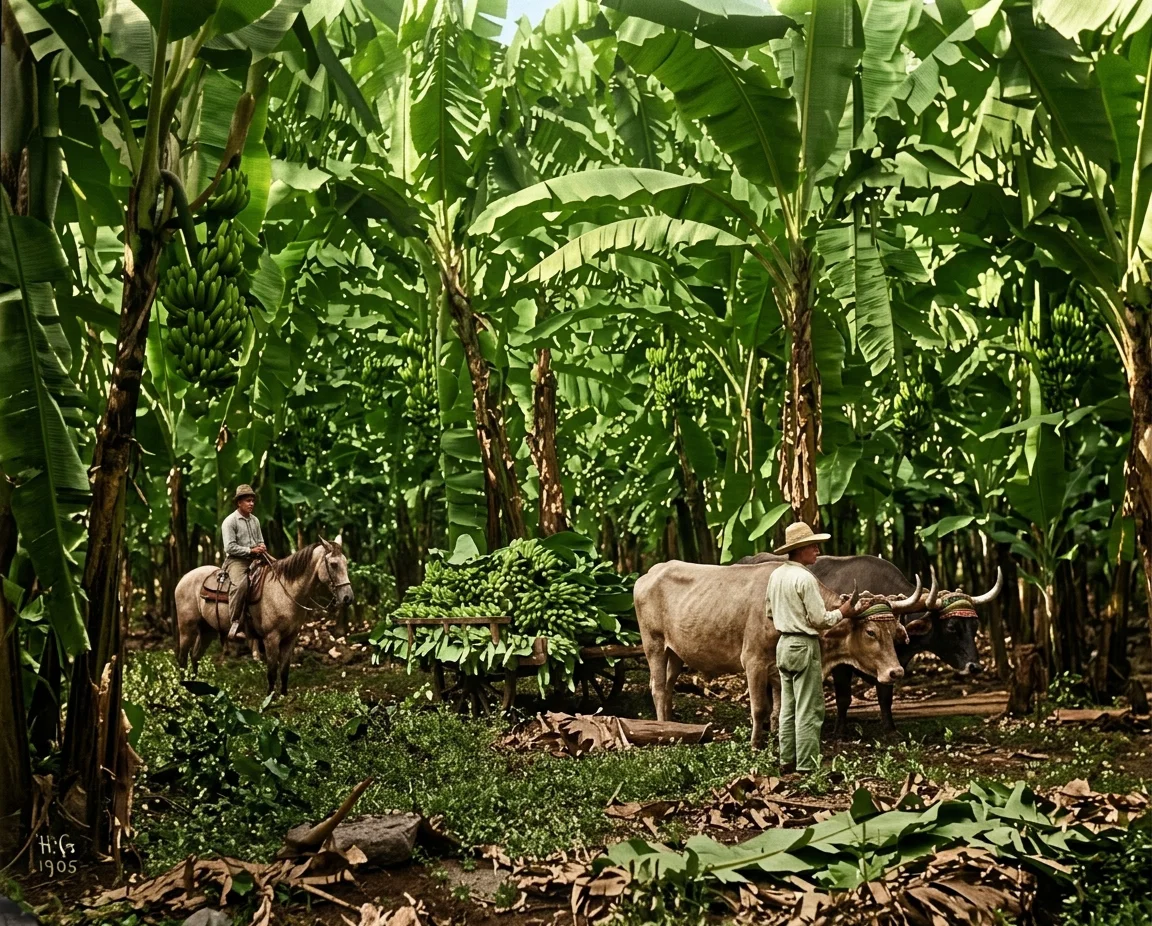
As our train whirls us along through tropical wonders, we have a good view of the country. We sweep through great banana plantations, with their plants extending up above the top of our car, their green leaves waving in the breeze made by our train as we hurry by. Again, we see the bananas cut, and stacked high upon carts, to each of which is hitched a yoke of oxen. We notice that the yoke, instead of being fastened across the neck of the animals, thus enabling them to pull by their shoulders, as they do in America, is placed across their heads, and they pull by their horns. There are great piles of bananas by the side of the track, awaiting the train that is to take them down to Port Limon, there to be loaded on to the steamer, and taken to the United States. Vast quantities are raised for the American markets. Then we are whirled through cocoanut groves on the one side, and orange groves on the other.
No other part of the grand division has so dense a growth of wood as Central America, and the trees are so bound together by small vines that one can walk through the forest only by cutting his way a foot at a time. Among the many trees are the mahogany, the ebony, and the rosewood, which are shipped to all parts of the world, for furniture making. Other products of Costa Rica that find their way to all parts of the world, for furniture making. Other products of Costa Rica that find their way to all parts of the United States are chocolate and coffee. The former is made from the seeds of the cocoa-tree. This tree is planted much as we plant the peach- or the apple-tree. After a few years, it bears a fruit about eight inches long, in which are the seeds from which chocolate is made. There are large orchards of coffee-trees, with their beautiful green leaves and their bright-red berries. In each berry are two kernels of coffee. Great expense, as well as labor, is required to get not only the banana to the market, but also the coffee, chocolate, and cocoa.
We are slowly climbing the mountains, for San Jose is many feet above the sea. How pure the air is, and how grand the scenery! The many varieties of fern-trees nod to us as we pass, and the trees, covered with orchids, send in through the open windows their sweet perfume. The mountains rise almost straight above us, and the track seems to hang to the very mountainside, winding about like the letter S. We shoot through a tunnel, then across iron bridges over deep canyons, every turn bringing new pictures. Up we climb, and the very clouds are below us. We have just passed through a rain cloud, and we see a bright rainbow in the valley below. Sometimes we shudder, and shut our eyes, as the train crawls along the edge of a precipice. We do not see many birds, catching only a glimpse of a bright-colored macaw or a beautiful parrot. We may see a monkey grinning at us from the branches of a tree. There are a great variety of lizards, and one may chance, if he is not a vegetarian, to eat one when called out to dinner, especially the iguana lizard, which is sold in all the markets.
As we near the summit, we notice that the sign-boards are all in Spanish, and our fellow passengers all speak that language. Our train makes a long stop at Cartago, a city of about fifty thousand inhabitants. What a crowd there is at the station, and what a confusion—all the men and women jabbering and gesticulating much! But they are very polite. Even the boys take off their hats when we ask them a question.
The houses are all built with one story, and of adobe, with tile roof, and in such a manner that they form a solid front around the block. Here is the volcano Irazue, thirteen thousand feet above the sea, the only point from which, it is said, can be seen the two oceans. We look down into the fissures made by the eruption, and throw stones down into them, but are unable to hear them strike the bottom. We pass by a stream where the women are doing their week's washing. They dip the garment into the stream, then strike it on the rocks again and again. When clean, it is dipped into the stream, and put on the grass to dry. This is the way washing is done all over the country.
While in San Jose we visited the market, a long, low building, and as we looked at the stalls, we saw that Costa Rica is a land of good things to eat. There are string-beans half as long as your arm. These, tied up in bundles, are sold for so much a bunch. There are also sweet potatoes, cabbage, cauliflower, celery, lettuce, green corn, and tomatoes. As we walk through the market, we almost forget we are not in America. Fruits are plentiful—oranges, limes, guavas, mangoes, breadfruit, pine-apples, papaws, alligator-pears. Thelatter is about the size of the American large pear. The meat tastes like fresh butter, and is eaten with salt.
The women, as they form groups in the parks, are all smoking their cigarettes, and our hearts ache as we think of the many thousands of Spanish people in our field, and remember that we have only just started the work for them, with only one Bible worker.
HARVESTING BANANAS IN COSTA RICA