Entering the Philippine Islands

8%

Review and Herald Publishing Association · Takoma Park Station, Washington, D. C. · Jul 12, 1906

FromReview and Herald, Vol. 83, No. 28.

Read the full edition

Entering the Philippine Islands

J. LAMAR MCELHANY
On Wednesday, March 28, we left Sydney, Australia, for the Philippine Islands, on the Japanese liner “Yawata Maru.” After our last view of the many dear friends who stood waving their “farewells” from Circular Quay, and while steaming down the beautiful Sydney harbor, we took a retrospective glance at the past few years. In July, 1903, we left our home conference, the Southern California, to come to Australia. We were moved to take this long voyage to a distant land by the appeals made for more workers to carry the third angel’s message into the ripening fields of the Australasian Union Conference. The experience we have gained in our labors in Australia has been a great blessing and benefit to us. And now we were starting on another longvoyage to the Philippine Islands; but with our original purpose still in view, however, for this group, together with all the other Malaysian islands, forms a portion of the Australasian Union Conference. During our voyage of sixteen days we sighted almost countless islands. These islands are waiting for the law of God. O, how long must they wait? We wish all our people could have the privilege of seeing these great unentered fields; surely it would kindle the spark of missionary zeal into a flame that would burn until the Lord comes.
We reached our destination, after a safe and pleasant voyage, on April 13. At present we are the only workers in this great and needy field. Elder E. H. Gates spent a few weeks here looking over the field, and then proceeded to Singapore. Brother R. A. Caldwell, who canvassed here for some time, is at present in Hongkong. He will doubtless return here soon to make this field his headquarters.
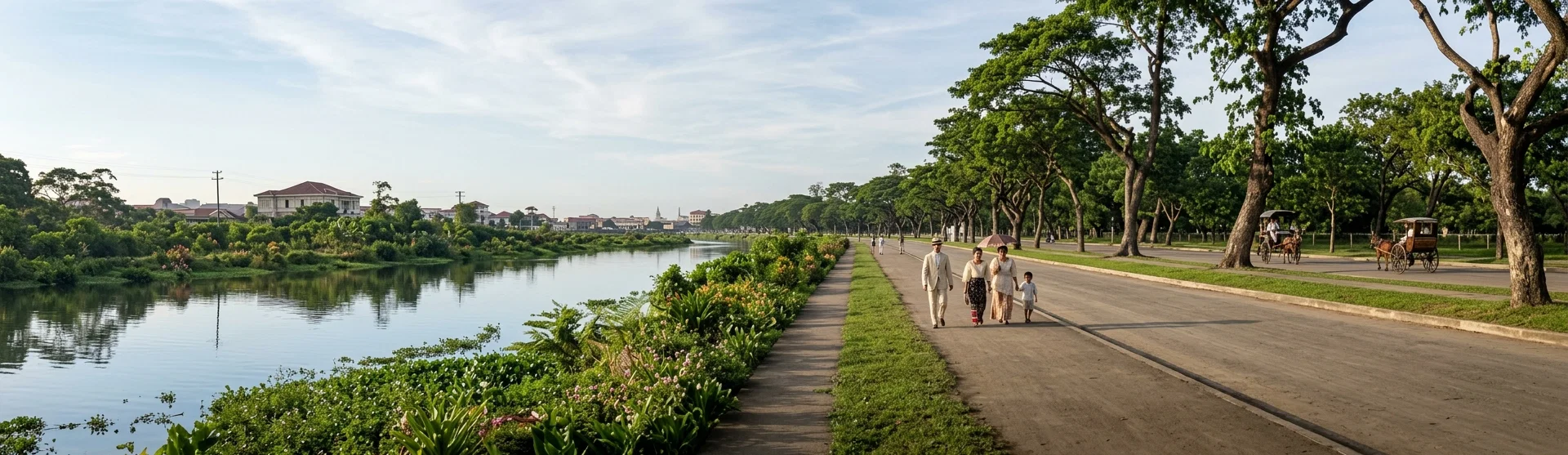
ALONG THE BOTANICAL GARDENS: BAGUMBIA ROAD
At present we are endeavoring to find a suitable location for a mission home, but this is a most difficult thing to do in Manila on account of the high rents. A house suitable for our use, and that is proof against typhoons, rents for from fifty to sixty dollars a month. With water and lights and living expenses proportionate, it is an expensive place in which to live.
Our arrival was just at the beginning of the hot season, and we have found the heat quite trying. A few days ago we experienced our first typhoon, which was severe, but fortunately of short duration. A few native houses were blown down, and some buildings unroofed.
On the evening of the same day that we landed, we witnessed a spectacle that clearly set before us just the conditions existing here. A “Roman Catholic Good Friday procession” was fully an hour in passing the building where we were staying. A vast crowd witnessed the procession, while thousands were in line marching, each one carrying a lighted candle. Image after image, gaudy with decorations and some decked with priceless jewels, were carried in the procession. Bands of music, singers, and surpliced priests, and the American archbishop in his purple robes, all combined to make up a scene long to be remembered. It would be impossible for one to imagine such a scene without seeing it. To the Filipino, this is religion. Naturally excitable and emotional, his senses are wrought upon as he sees and hears. He is carried away and mystified. The mystery of iniquity, Rome, makes ample provision for keeping him in that condition. As for touching his life and making a better man of him, restoring the moral image of God in his soul, there is nothing of the kind done. He turns away, after bowing to the image of the virgin, with its potential charm, to break every commandment of the decalogue.
The Filipinos need the third angel’s message. True, they do not sense their need, but their need is emphasized by just such scenes as described above. This message is the only deliverance for any people from all the deceptions of the papacy. May God help us in giving the message to these millions in the Philippine Islands.
There are many obstacles confronting us in starting the work here, chief of which is the language. It has been generally supposed that the Spanish language was universally spoken here, but this is not true. Out of a population of nearly eight million, only about eight per cent of the people understand even colloquial Spanish. The others must be reached through their own tongues, of which there are many. One good authority declares that “there are in the Philippines one hundred and fifty native tribes with names.” There are said to be forty-seven tribes of Malayans, sixteen of Indonesians, and twenty-one of Negritos, and even these tribes are subdivided into many more, each speaking different dialects. The Visayan tribe is the most numerous, numbering 2,601,600; the Tagalogs come next, with 1,663,900. The natives in and about Manila are mostly of the Tagalog race. The native newspapers of Manila are printed in Spanish and Tagalog. A great deal can be done in sowing the seeds of truth through the medium of the Spanish language, and for this purpose we need a large supply of Spanish literature. As fast as these native languages are acquired, literature must be produced in them so these people can receive the message. It is impossible to speak of the Filipino people as a whole; they range from the civilized Tagalogs to the head-hunting Igorrotes in the north of Luzon and the fierce and warlike Mohammedan Moros in Mindanao and Sulu.
The people are suspicious of Americans, and it takes some time to win their confidence. Medical missionary work will prove to be a great door-opener here for the message. We are anxious to have this part of the work begun soon in connection with our mission. The natives are very ignorant of the laws of health, and can not understand why they must keep clean. The health authorities have had a great deal of trouble with them, especially in times of cholera outbreak. Often they would conceal the presence of the disease until some one died, and then, to avoid quarantine, bury the body under the house or throw it into the river. There have been several cases of cholera since we have been here, resulting fatally in each instance. There is great need of medical missionary work in the Philippines. We need a good doctor to connect with the work here.
There are about ten thousand Americans here besides the army, which numbers probably between twelve and fifteen thousand. The Australasian Union Conference has entered heartily into the work assigned them by the Lord, of carrying the third angel’s message to the great island field of the Pacific Ocean and adjoining waters, and as fast as their slender resources of men and means admit, move out into the unentered territory. We believe, however, for reasons too apparent to need stating, that our brethren in the States will take a special interest in the opening up and development of the work in the Philippines. We hope the way will open for the mission to own a building suitable for the work. This is our most pressing need.
We shall be able to use a large amount of literature, both English and Spanish. Signs, Watchman, Life and Health, and all standard publications and tracts, also Spanish papers, health journals, tracts or books for free distribution, will be thankfully received. Domestic rates of postage apply between the States andthe Philippines. Pray for the work and workers in the Philippines. Our present address is 107 Calle Fundicion, Walled City, Manila, P. I.