ANOTHER phenomenon of Iceland, quite remarkable in connection with the kind of volcanic eruptions, is the earthquakes. These are usually an indication of an eruption to follow. The waves are either from north to south, or from east to west.
History mentions several great earthquakes. Among the most severe are those which occurred in 1896. Not less than two hundred farms were destroyed at that time, though no persons lost their lives.
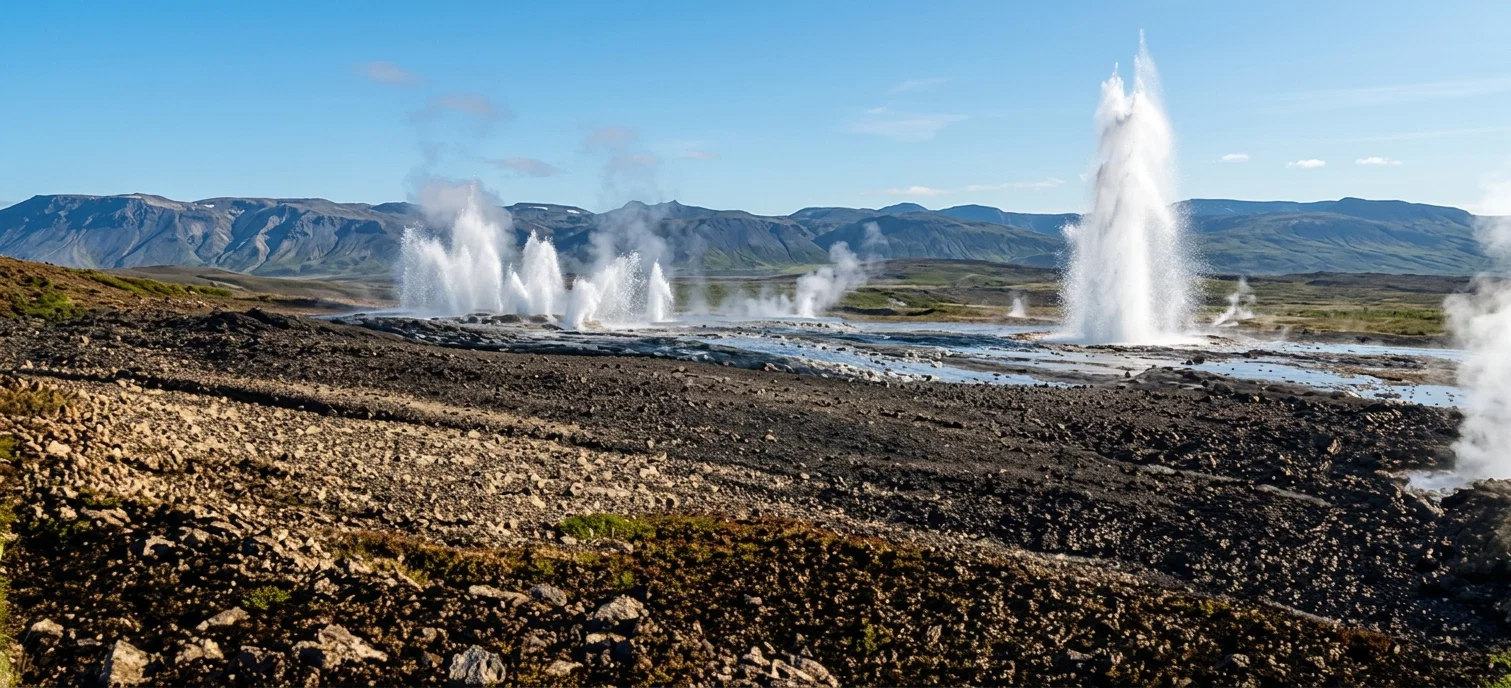
One of the most remarkable characteristics of Iceland is the warm or boiling springs. There are quite a large number of these. Some are fountains, which at times throw the boiling water several yards into the air. The most remarkable of these are Great Geyser and Strokkur, in the southwestern part of the island. Great Geyser sends forth its water generally once every twenty-four hours, and sometimes to a height of from ninety to one hundred and twenty feet. Strokkur, on the other hand, can be made to throw out water by throwing something into it. If a piece of hard earth is thrown into it, you can hear a noise, and the water comes streaming up, carrying with it that which was cast into the spring.
In a little while the water comes again with a gush. Great Geyser is in action only when the sun is shining; and its pure, clear, high column of white mist, which divides itself into millions of bright crystals, is one of the most beautiful sights one can behold.
Another kind of spring is the warm fountain. Of these there are many. The water gushes slowly out of the ground, and fills a larger or smaller hole, from which it flows. Several of these fountains are utilized for cooking food. It is only necessary to put a pot over the warm water, and it soon boils. These warm fountains are also used as laundries. In a country like Iceland, where there are no forests, it is natural that every opportunity be improved to save fuel, and so these natural wonders serve a good purpose. Every day people may be seen a little way out from Reykjavik, coming to the fountains with their clothing to wash.
This hot water is also used for bathing purposes, although it has to be carried some distance to be cooled. One such bathing institution is found in Reykjavik. But the most celebrated of this kind is in the west. It was built by the celebrated historian, Snorre Sturleson, and is thus nearly seven hundred years old. It is still used, however.