Mission Work in India

6%

Seventh-day Adventist Publishing Association · Battle Creek, Mich. · Feb 17, 1903

FromReview and Herald, Vol. 80, No. 7.

Read the full edition

Mission Work in India

J. L. SHAW
The largest missionary conference ever held in southern Asia convened last month in Madras. The Decennial Conference, as the name implies, meets once in every ten years, and accepts as its delegates, representatives from all Protestant missions in India, Burma, and Ceylon. The privilege of attending a gathering of this kind gives one a far broader idea of mission work in this part of the Orient than could be gained in any other way. To meet men and women from all parts of this field engaged in various kinds of mission work,—to talk with them and to hear their experiences,—tends to deepen the desire to see India evangelized in this generation. There are many missionaries in India, and among them are consecrated, devoted men and women who are throwing their lives into the work of winning souls. It is inspiring to talk
with men who have put in fifteen, twenty, thirty, and even forty years of service for the Master in this land where at best many perplexities and hardships come.
At the opening of the conference an address of welcome was given by John Murdock, who came to India in 1844. He told in few words and broken voice of some of the trials and triumphs of truth which he had witnessed. Confessing that his work was almost over, he exhorted younger men to faithfulness, telling them that the motto of his life, like that of Carey, was, “Attempt great things for God, and expect great things from God.” At the conference in 1892 this aged brother said, “Long before another conference shall meet, I must lay down my pen,” but his life has been spared, and still he labors on.
The lives of such men and the effect of the work they have done are known only to God. Many have spent long years in patient work with little apparent fruit; but as years go by, one plants, another waters, and still another reaps, so that slowly but surely the gospel of the kingdom is finding its way to the darkest corners of India.
At this conference the recent census of India, though not officially published by the government, was given, showing the combined population of India and Burma to be 294,361,056. Of these 207,147,026 are Hindus; 62,458,077 are Mussulmans; 9,476,759 Buddhists, and the rest of the population is divided up among Christians, Jews, Sikhs, Jains, Parsees, and others. During the last ten years, although the population has increased one and one-half per cent, the Hindu population shows a decrease. On the other hand, the Christian population shows an increase from 2,284,380 in 1891 to 2,923,241 in 1901, or about thirty-one per cent. Missionaries think this numerical increase a great cause of rejoicing; but when it comes to resorting to numbers as evidence of Christian growth in India, it is easy to err; for the word “Christian” in India is probably the most misused word in any language or literature. One man wears one form of dress, and is called a Hindu; another wears another form of dress, and is called a Mohammedan; and still another, because he wears a European costume, is called a Christian. When it comes to be a matter of custom and dress, it certainly is unsafe to look to numbers. We might add, however, that the numerical increase of Christians shows that in some measure the prejudice of the native is abating toward the Christian religion. Especially is this evident when we consider that Hinduism, by far the most prevalent religion in India, has fewer devotees than it had a decade ago. We are glad to say that Hinduism is in a measure losing its hold upon the Indian. Western education is revealing the nothingness of this religion, but it is sad to record that while Christianity is making some progress, infidelity and atheism are getting possession of the educated classes to a remarkable extent; so themissionary, while rejoicing at the decline of Hinduism, groans at the spread of Western unbelief in the Orient.
We feel certain of this, that a knowledge of the Christian religion is being carried to the masses as the years go by. The Bible is continually being translated and re-translated into many different languages, and its circulation is being widely increased.
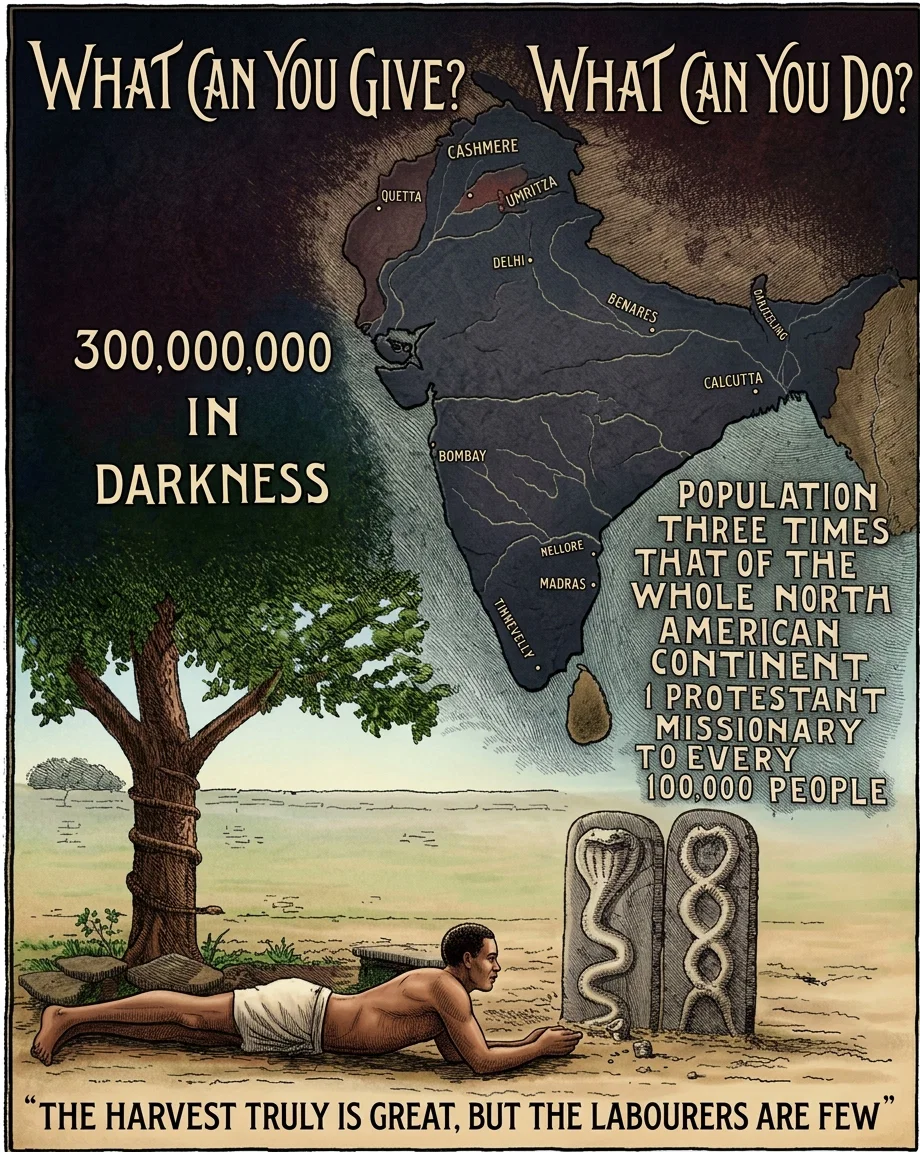
THE HARVEST TRULY IS GREAT, BUT THE LABOURERS ARE FEW
Missionaries have done much in educating the people and teaching the English language. It is surprising to see how the native people in Madras speak English. Every servant speaks in English. In this respect natives of Madras are in advance of those in other parts of India. This is due in part, probably, to the fact that missionary efforts have been more extended for a longer period here than in other places, and in part to the cleverness of the people of Madras.
It is estimated that there are five million natives of India who can speak the English language, and year by year the number is increasing. In large cities the rising generation are fast getting hold of it. When we consider the fact that there are more young men every year attending colleges in India than in England, and thousands are taking their degrees every year, some idea can be gained of the rapidity of the introduction of Western education and the English language.
All this is simply preparing the way for the third angel’s message. While we are so slow in getting hold of the vernacular to carry the truth to the people in their own language, they throng our doors who talk our tongue.
There are as many people in India who speak the English language as comprise the whole population of Australia. Is not this an evidence that God is opening the door for the entrance of his Word in this land? and can we not see him going out before us, and hear in the wide diffusion of English education in India the voice of God saying, Now, just now, is the time to take hold in earnest in the East?
Come along, then, brethren and sisters in the home land, you who have heard the call to India ringing in your ears. Delay no longer. Twenty people die every minute in this land. As the second-hand moves around, every third second some one dies who never learned to love our Lord. Every year more than eight million die not knowing that “God so loved the world, that he gave his only begotten Son, that whosoever believeth in him should not perish, but have everlasting life.”
Think not of home and country while issues so great are at stake, and souls are dying whom you might help to save.
There are trials and perplexities to be met, but there are victories to be gained, and men and women to be saved. Some people get suddenly frightened when India is mentioned. They think of the bubonic plague, the excessive heat, the cholera, and the snakes, but if such things as these hold us from doing our duty, what shall we do in the swellings of Jordan? There are three thousand foreign missionaries in India, and some have lived here fifty years. Any one who is young and of reasonable health should be able to work in India. We say to you, “Come;” if God bids you “come,” come on.
The accompanying drawing shows but one corner of the great East. There are the unentered fields of Africa and China, with their cry of human woe ascending to God. What shall we do? What can we give? These are the questions this denomination must answer, and answer soon. Our faith demands a consecration no less than all. “Whosoever he be of you that forsaketh not all that he hath, he cannot be my disciple.”
Calcutta, India.