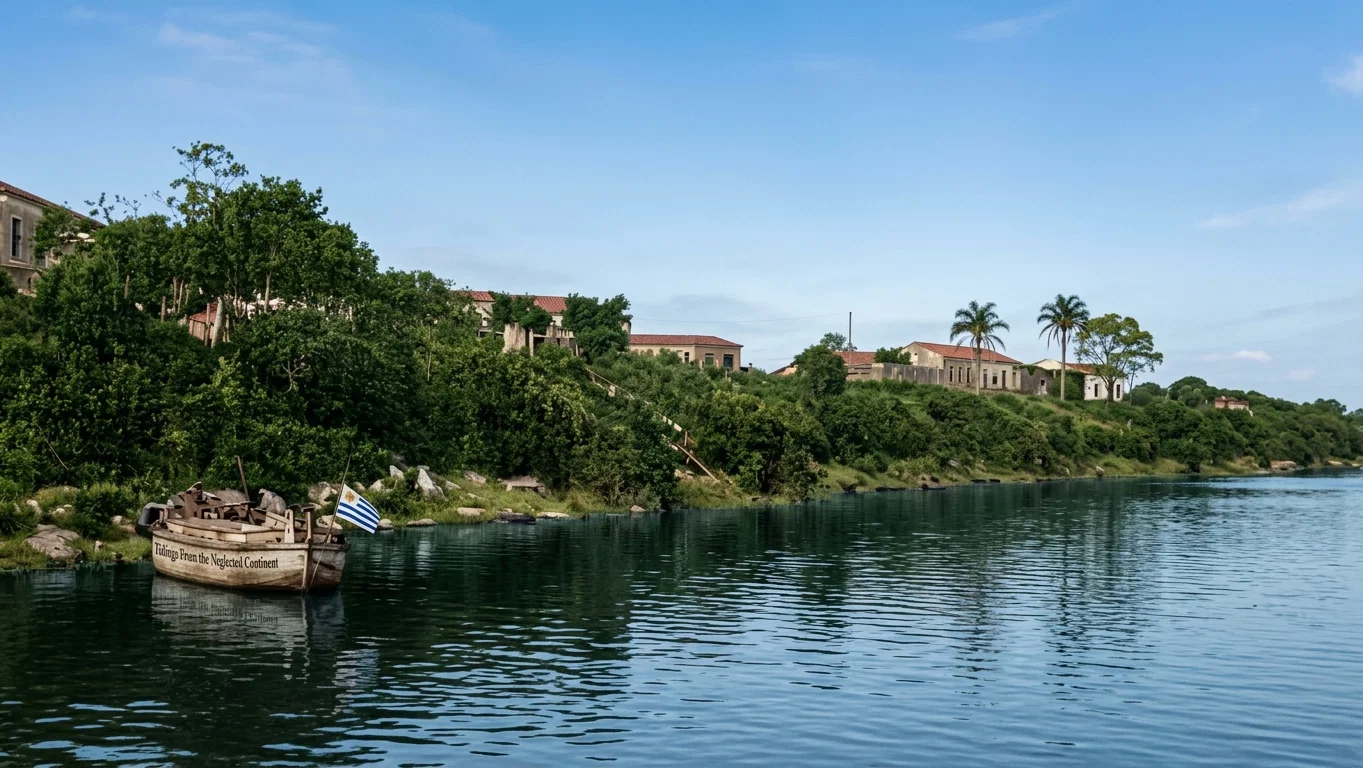
THE South American field is divided into three distinct fields: the Brazil Conference, embracing the republic of the same name; the River Plate Conference, embracing the republics of Argentina, Uruguay, and Paraguay; the West Coast field, including Chile, Bolivia, Peru, and Ecuador. The first named contains nearly one half of the territory of South America, with nearly one half of its population—about 17,000,000 souls. The River Plate Conference occupies 1,339,196 square miles of territory, and has a population of 6,400,000. The area of the West Coast mission field is 1,397,926 square miles, with a population of 10,000,000.
PAYSANDU, ON THE URUGUAY
Each of these fields is sufficiently large for several conferences and mission fields, which would naturally fall into three union conferences, in harmony with the present division. As the work spreads and becomes stronger, this must be the inevitable result.
Of the more than twenty states of Brazil, the work has gained a foothold in seven. There are between five hundred thousand and six hundred thousand Germans in this republic, and about five sixths of the nearly nine hundred Sabbath-keepers are of that nationality. About one hundred and fifty are natives. Very little direct effort has been made for the latter class, owing to the fact that the laborers have generally been unacquainted with the Portuguese language. That there are so many native Sabbath-keepers from so little effort is evidence that there are many souls among the natives of Brazil waiting and praying for some faithful laborer to come to their rescue.
The laws grant liberty in the preaching and in the distribution of the Word of God. We are praying that something more definite may be done for these fifteen million Brazilians. Had we more means, we could encourage some who already understand the language to devote their time in labor for them. Our hearts have been made sad when we could not do what it seemed to us might and ought to be done. A goodly number have accepted the message, have been baptized, and have united with our churches, during the last year. Besides the native Brazilians and the Germans, there are also many Italians, French, Indians, etc.
The River Plate Conference has not grown during the last year as much as our workers had hoped, a fact which has greatly pained them. One new church has been organized, and the membership of the conference has increased fourteen. Some others are keeping the Sabbath and awaiting baptism. Owing to the drought and general hard times, the tithe has fallen off very materially. Elder E. W. Snyder has been laboring in Paraguay, and as a result there are several keeping the Sabbath there. He has now been called to take charge of the office in Buenos Ayres, and consequently Paraguay has been left destitute of a laborer for the present. Special attention has been given during the last year to the canvassing work. Owing to the hard times, it had a hard struggle, but it has made a successful start. With the openings that will develop from this, and a more liberal ministerial effort in new fields, toward which plans are being laid, we look for greater results during another year.
For the West Coast field the least has been done, although it has by no means the least population. But little ministerial effort, comparatively, has been put forth. Much of the fruit is the result of the ministry of the faithful missionary canvasser. Thus far most of the work has been done in Chile, and in this republic nearly all our Sabbath-keepers are located. Elder Balada, our Spanish minister, has been laboring in Peru during the last year. As a result he reports a few keeping the Sabbath. Neither in Peru nor Bolivia does the law permit the holding of public meetings by Protestants, and this has necessarily affected any public effort. The work must be done in private meetings and from house to house. On this account it would seem that the missionary canvasser will be able to accomplish most. Elder Balada now thinks of going to Spain, his native land, or returning to Chile, which will again leave Peru destitute of a laborer. With the exception of a trip into Bolivia by two of our brethren in the interest of our Spanish paper, Los Senales de los Tiempos, on which several hundred subscriptions were secured, several thousand sold, and many sent gratis, no work has been done for that republic.
Ecuador was the last of the South American republics to open its doors to the gospel. To-day its laws are among the most liberal of the whole South American field. No one has as yet visited that country in the interest of present truth. We are glad to learn that Brother F. H. Davis, one of the pioneer canvassers to Chile, is about to enter this republic as a permanent field of labor. Brother E. W. Thoman is also planning a trip to the ports of Peru and Ecuador in the interest of the Senales.
Special efforts have been made on the West Coast, as well as in other fields, in behalf of their missionary paper, with excellent success. At the close of last year an edition of five thousand was printed monthly, and the subscription list was about eighteen hundred. Several thousand copies were sold during the year, and, not counting the editorial work, the paper was self-sustaining. Since the mailing of papers in both Chile and Bolivia is free, it affords excellent opportunities for paper work. About forty persons were baptized during the year.
In the West Coast field there are four15organized churches, with a membership of ninety-three, and fifty other Sabbath-keepers. The River Plate Conference has fifteen organized churches, with a total membership of four hundred and thirty, and thirty other Sabbath-keepers. Brazil has fifteen organized churches, with a membership of six hundred and twenty-two, and one hundred and twenty-two other Sabbath-keepers. The West Coast field has two canvassers, the River Plate Conference has six, and Brazil has reported none, although it has several. It will be seen from this, that, while we have great reason for gratitude to God for what he has done, the light must be within sight of but very few of these thirty-five million souls.
Thus there is spread before us an unlimited field, with many difficulties peculiar to it, which makes it one of much perplexity. Our literature in both the Portuguese and Spanish is very limited, and greatly needs to be enriched. With this in view, the committee has considered the matter of starting a publishing fund, by means of which necessary literature might be produced that would meet our need, but we are painfully conscious of the fact that this will take more means than we can raise here. When this need is met, we shall have the means to reach those who can read. Then we are confronted with the question of how to reach the much larger number who can not read. Being Catholics, they have no confidence in the Bible. It appears to me that their confidence must be won through the medical missionary work; not necessarily nor primarily medical missionary work from an institution; but we need doctors, nurses, and others who will live among the people as Jesus did, who will be teachers sent from God, teaching the truth in all its parts, and who, like Jesus, will heal the sick. Could we have physicians like Livingstone in his work in Central Africa, who would be bearers of the great threefold message for this time, who would pass over a considerable range of territory regularly, doing real Samaritan work, lifting the people, and thus wooing them to Him only for whom we labor, there would be room for any number. Could such men be connected with the gospel minister, and be content to labor in apparent obscurity, we can but believe that our illiterate field would soon resound with the glory of God's message of mercy. This field needs men and women who will become one with the people, meeting them in their huts and hovels, teaching in public and from house to house, willing to endure privations and hardships, content to live on what there is, and never losing sight of the value of a soul.