Church Buildings

7%

Seventh-day Adventist Publishing Association · Battle Creek, Mich. · Jul 21, 1903

FromReview and Herald, Vol. 80, No. 29.

Read the full edition

Church Buildings

Jamaica

Eighteen months have passed since my last report relative to the progress of the great message in Jamaica. The silence has not been because of nothing to report; far from it, for the Lord has certainly been blessing the work. From a mission field Jamaica has grown into a conference, which was organized by Elder W. A. Spicer at the beginning of this year. At the present writing, all branches of the work, which are being handled here, have fallen into line, and are running well under the new arrangements. In fact, never since my connection with the work here, has it made such progress as during the last six months. Over one hundred have been baptized, making the number of baptized Sabbath-keepers now in the island about thirteen hundred. Only those who, so far as we know, are trying to live up to the light of the truth are counted; many others not yet baptized are keeping the Sabbath. The opposition that waxed strong last year has largely given way, and a spirit of inquiry and investigation seems to be quite general throughout the island. It is impossible to fill a tithe of the invitations that are received to “come and teach us the truth.” In many places the lay members are urged to tell what they know about the soon coming of the Saviour. A spirit of devotion has taken possession of the majority of the members. The tithe and offerings since the first of January have amounted to about one thousand four hundred dollars, which is fifty per cent more than for any corresponding period in the past. There is no excitement; that condition of mind seems to be taking possession of the people, that I have thought would exist under the outpouring of the latter rain.
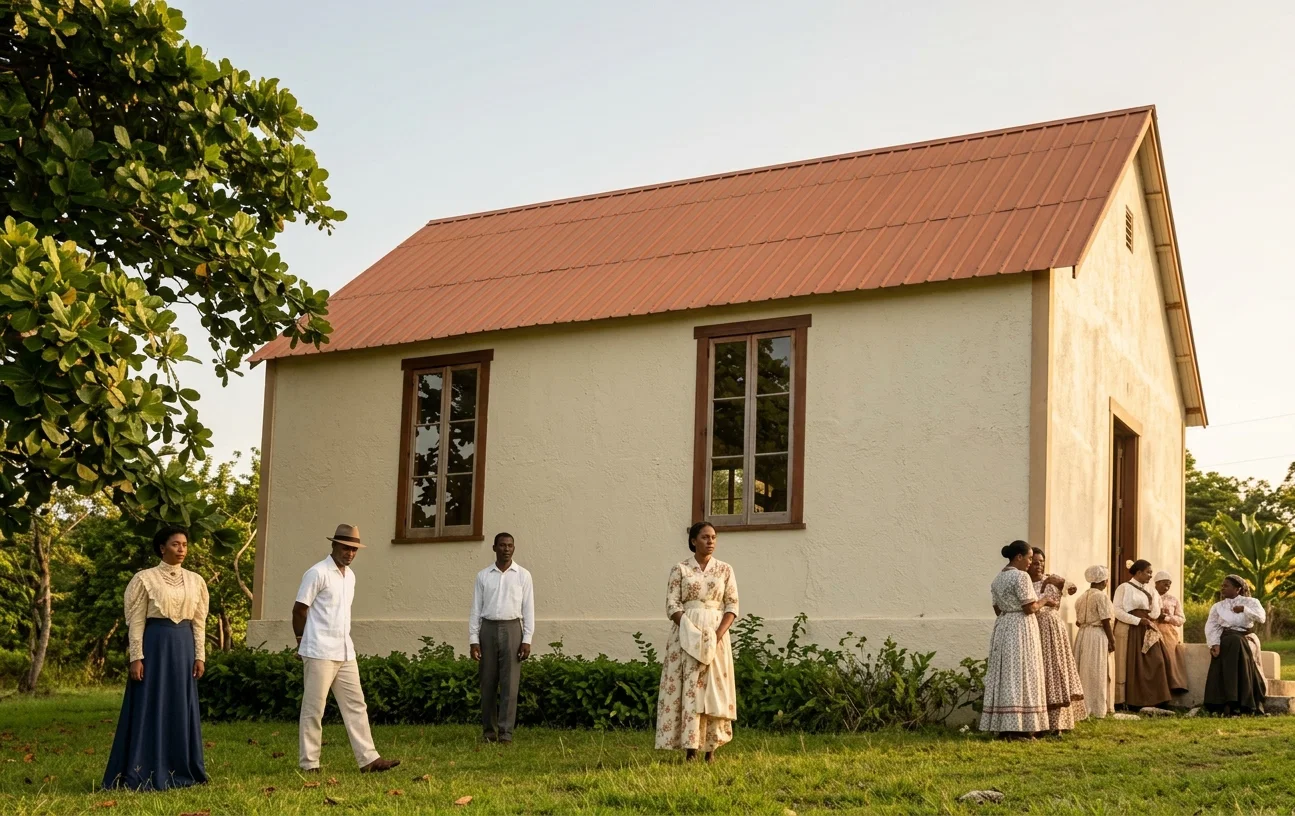
A JAMAICAN CHURCH
A JAMAICAN CHURCH

Church Buildings

Whenever a company is raised up in any place, in order to establish the work it has seemed to be a necessity to erect a church building; for halls are unknown, and the schoolhouses, being controlled by the different denominations, can not be obtained, and the people object to attending services in private dwellings. To erect places of worship to accommodate the rapidly increasing members has demanded quite a share of attention, and much perseverance. There have been as many as eleven churches building at the same time. At several places where the buildings were nearing completion, the brethren, on hearing of our contemplated departure from the island, said they would put forth extra efforts and finish them, that we might have the privilege of participating in the dedication; and in the short space of seven weeks, eight buildings were completed and dedicated,—at Warsop, Santa Cruz, Contented Hall, Big Woods, Glengoffe, Trinityville, Moore Park, and John’s Hall. These buildings have an average size of about thirty by eighteen feet, with walls ten feet high. The material is Spanish walling, in imitation of cut stone on the outside, and hard finish on the inside; the roofs are of shingles or corrugated iron; the woodwork is painted in two or more colors, making a very neat as well as durable building.
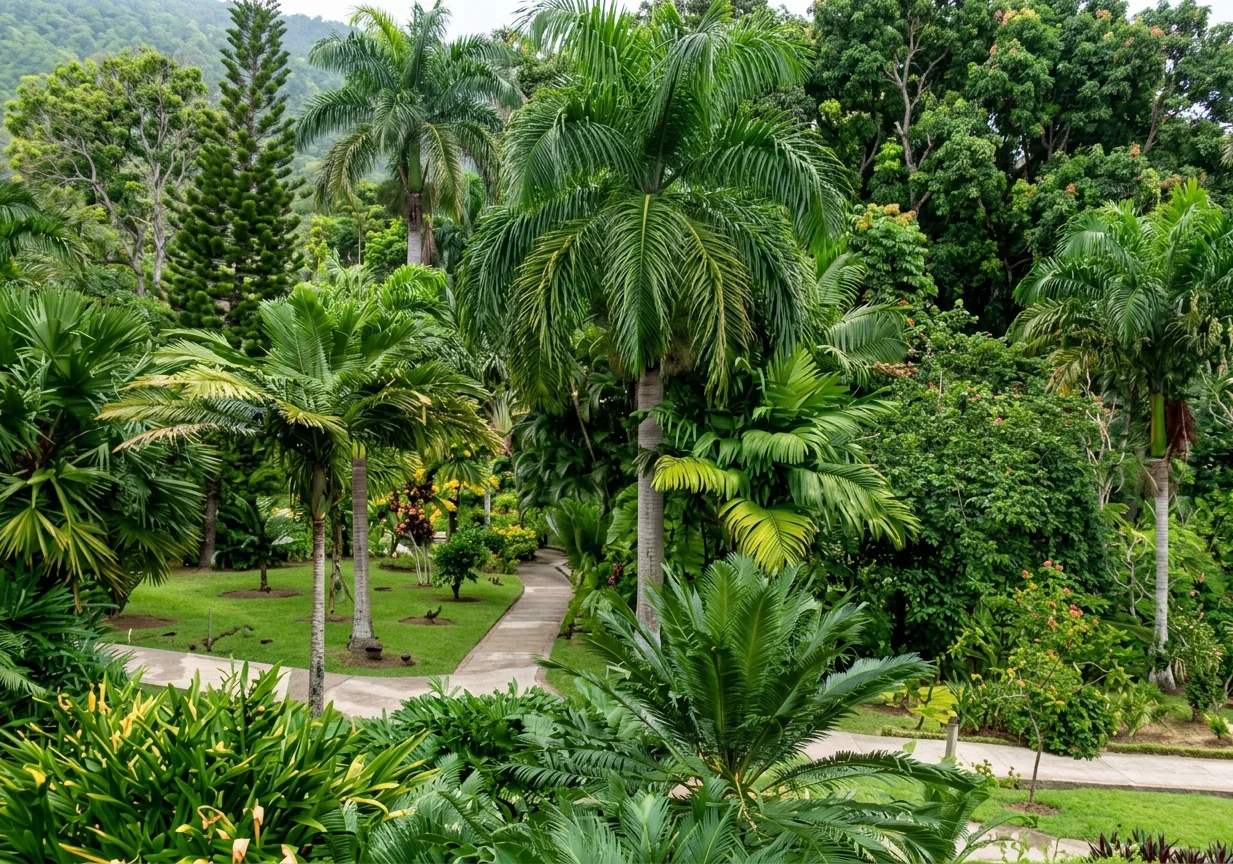
SCENE IN THE BOTANICAL GARDENS, KINGSTON, JAMAICA
The expense of putting up one of these buildings is well told in the words of the chairman of the building committee of John’s Hall church. “The materials for a lime kiln were obtained one and one-half miles from here down in the valley.” The wood was cut from six to eight feet long, and was piled in a circle to the height of six feet. The limestone was piled on top of the wood, then the wood was fired, and the lime was burned in that way. “All the timbers and boards for the building were sawed out of the trees by hand. The whole of the materials were conveyed to the spot on the heads of the brethren and sisters, from far distances and over difficult places. Thus the whole church has been carried on their heads. Not one farthing has been paid for labor; about one hundred and ten dollars in cash was used.” The expense of putting up one of these buildings is nearly equal to that of one twice the size in Michigan. Not a penny of assistance has been received from outside the island. The completion of so many churches in so short a time has caused considerable talk among some not of our faith, and it is a real source of encouragement to our people, for they see what can be accomplished when they roll up their sleeves and go to work. There are now twenty churches in the island, and five more are building.

The Sabbath-Schools

At the close of 1901, the Sabbath-schools numbered twenty-nine, with a membership of 1,053; at the present time there are thirty-nine schools, with a membership of 1,172, being an increase of ten schools, and 119 in membership. The donations have increased from $136.25 in 1901 to $299.22 in 1902, and $157.89 for the first six months of this year. At the close of 1902, the expenses of the schools were all paid, and the treasurer turned over $96.70 to the field.
Four day-schools are in operation, with an attendance of about one hundred and twenty. At the present time teachers are needed for at least twelve other schools. How much we need a school for the training of teachers and laborers in all branches of the work.

The Canvassing Work

Three times under the old system of the canvasser paying for the books after making his delivery, has the canvassing work gone to the wall in this island, leaving a debt against the canvassers of over $2,000; and at the close of 1901 there was not one canvasser in the field; all had become discouraged, and said it was impossible to deliver the books. Aboutone year ago we began experimenting on the cash system, by requiring that the money accompany the order for books. It succeeded so well that the new conference voted for the cash system. It has been adhered to without deviation. The results have been truly gratifying. There are now nine canvassers in the field, and all are profuse in their praises of the new plan. Some of them deliver one hundred per cent of their books, and none have reported a delivery of less than eighty per cent. The people take the books and pay for them without complaint. It seems evident that the Lord is approving of the carrying out of his plan to “owe no man anything.”
Now comes the regrettable part, to me at least. I had thought to remain permanently in this island, unless called away by the Mission Board. But six years of rugged mountain traveling, together with increasing age, has told upon me to that extent that I decided after much prayer and deliberation to resign, and take a short period of rest. I do not expect again to find a field where the associations with the laborers will be any more agreeable, or the people any more willing to accept the blessed message.
So I can truly say, It is with feelings of deep regret and sorrow that I sever my relations with the brethren and sisters, and bid good-by to the beautiful island of Jamaica. F. I. RICHARDSON.