Our Work in the Austria-Hungarian and Balkan States Mission Field
By J. F. Huenergardt
J. F. HUENERGARDT
THE readers of the REVIEW will doubtless remember having read an article or two some time ago in the Missionary Magazine about our work in Rumania and Bulgaria. We now wish to add to this something concerning our work in other parts of this mission field.
First comes Bohemia, a country with six and one-half millions of people, mostly Catholic. During the last few years there has been a move ‘away from Rome.’ In Bohemia there have been several Sabbath keepers for some time; but there was no real effort to advance the cause of present truth until a few months ago, when Elder J. P. Lorenz was sent from Germany to begin the work in Prague, the capital city. The provinces of Schlesien, Steiermark, Mähren, and Tyrol, with millions of inhabitants, have not even been touched.
In Vienna, the capital of Austria, other denominations have made considerable progress, in spite of the opposition of the ecclesiastical powers, which have, to a great extent, control of the civil power in Austria. As a rule, the people are14stanch Catholics; but many are hungering for something better, and when they are instructed in the simple gospel of righteousness by faith, they are willing to leave ceremonialism and follow the truth. It is impossible to get permission to sell religious literature, if it is non-Catholic in nature. The Bible worker, however, in laboring in a quiet manner in the family circle, would find no obstructions in his way. We pray that the Lord may send us the proper workers for this needy field.
In Hungary we enjoy more liberty than in Austria proper. The Hungarian loves liberty, which he has often bought dearly in days that are past. The population is of several nationalities, ranging as follows: Hungarians, about eight and one-half million; Slavs, six and one-half million; Rumanians, three million; Kraats and Serbs, three million; Germans and Saxons, two and one-half million. Besides these, there are Poles, Russians, and Bulgarians.
These people have their various confessions. The Hungarians are divided, some belonging to the Catholic faith, while others are Protestants. The Germans and Saxons, principally of Transylvania, are Lutherans. The Rumanians belong to the Greek United Catholic and to the Greek Oriental churches. Besides these there are the Jews and the Militarians.
Hungary was undoubtedly first settled before the time of Christ. During the decline and fall of the Roman empire, its soil was trodden by many different nations. The Rumanians claim to have been here before the Hungarians, who, according to history, took possession of the territory in 896 A. D., under their leader, Arpad. About the year 1000 A. D. the Hungarian tribes were converted from heathenism to Catholicism, by their king, Stephen. For that great act he was classed among the saints by the people at that time.
As the government became more and more settled, the rulers decided to people some of the uninhabited districts of the country. The soil being rich, and the climate favorable, it was not difficult to persuade the inhabitants of the more populous countries of Europe to immigrate; and so it came that in the eleventh and twelfth centuries the Germans, Saxons, and Flemings established colonies in the fertile valleys of Transylvania. Later, other nations came in,—the Slavs, Armenians, etc. This intermingling of nationalities caused much strife and bloodshed, and so the country has developed very slowly.
The people in the villages are uneducated, very few being able to read and write. Rapid strides are now being made toward civilization, and the young people are better educated than those who are older. Judging from the condition of the people and their circumstances, we must acknowledge that the government is faithfully doing its duty in the upbuilding of the nation.
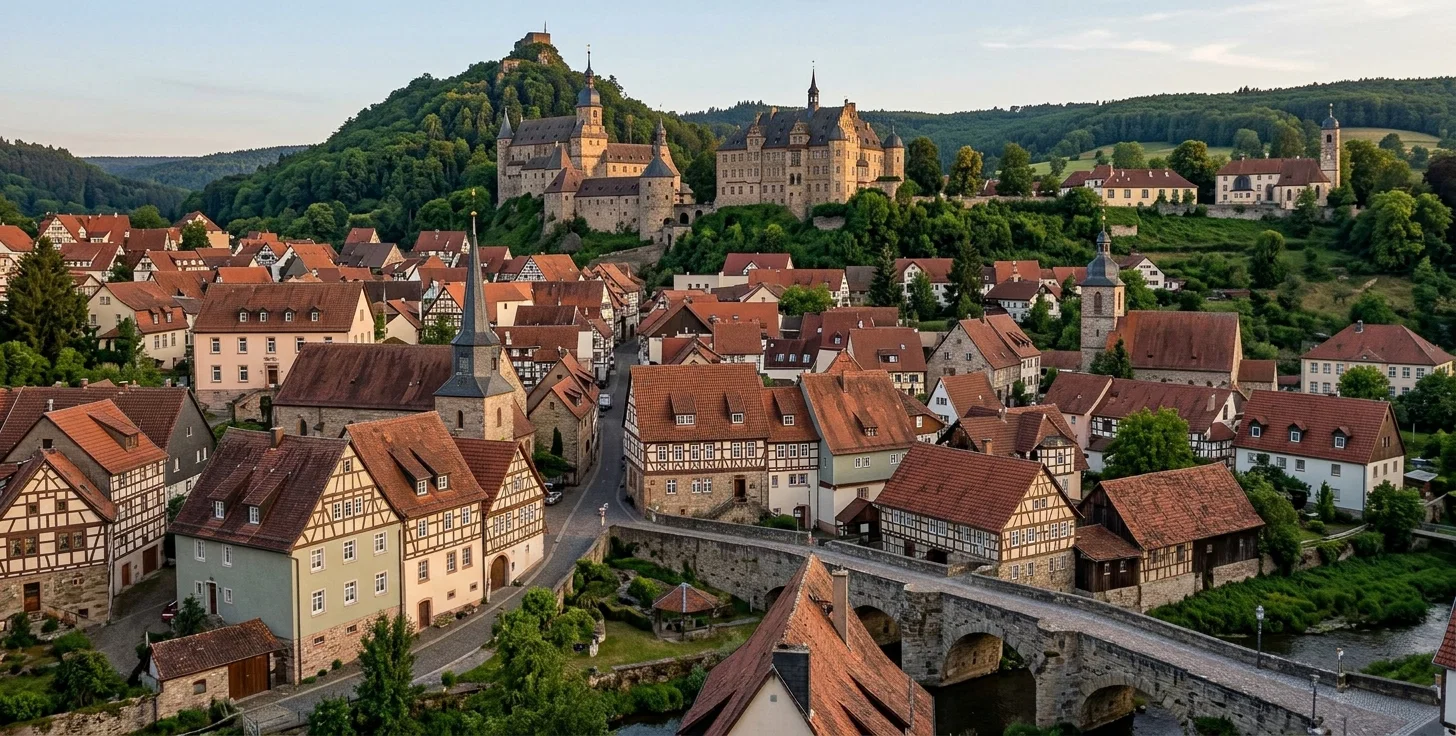
AN OLD STYLE SAXON TOWN
The light of the Reformation, which was kindled in Germany and other countries also, threw its rays into darkest Hungary. Honterus, a disciple of Luther, after gaining his education in Germany, where he also accepted the principles of Protestantism, returned to his native country, and proclaimed the simple gospel, which resulted in winning the entire Saxon nation to Protestantism. The work of reformation also spread among the Hungarians, and many noble families accepted the new faith. The Bible was translated by both Catholics and Protestants, but the translation of Károly Gáspár was regarded the best. The first edition was printed in 1587.