The Eastern Polynesian Mission

9%

Review and Herald Publishing Association · Takoma Park Station, Washington, D.C. · Apr 1, 1909

FromReview and Herald, Vol. 86, No. 13.

Read the full edition

The Eastern Polynesian Mission

B. J. CADY
The people of Pitcairn Island were the first in eastern Polynesia to accept the truths of the third angel’s message. Many of our readers doubtless remember when our missionary ship, the “Pitcairn,” was purchased eighteen years or so ago, and sent out to the South Sea islands. When it started on its mission, the first island visited was Pitcairn, where the inhabitants had begun to observe the Sabbath of the fourth commandment. Here, a large number were baptized and organized into a church. The ship then sailed to the Society Islands, which lie twelve hundred miles a little to the north of west from Pitcairn Island. Three islands of this group were visited at that time,—Tahiti, Raiatea, and Huahine,—and as a result, a few persons on each of them became interested in the truths of the message. The ship called at Rurutu, in the Austral group, at Rarotonga, of the Cook Islands, and then went on toward the west, visiting Fiji and other islands of central Polynesia, and also Norfolk Island and New Zealand. On its way back to the United States, Brother E. H. Gates and wife were left on Pitcairn Island, and Brother A. J. Read and wife at Tahiti.
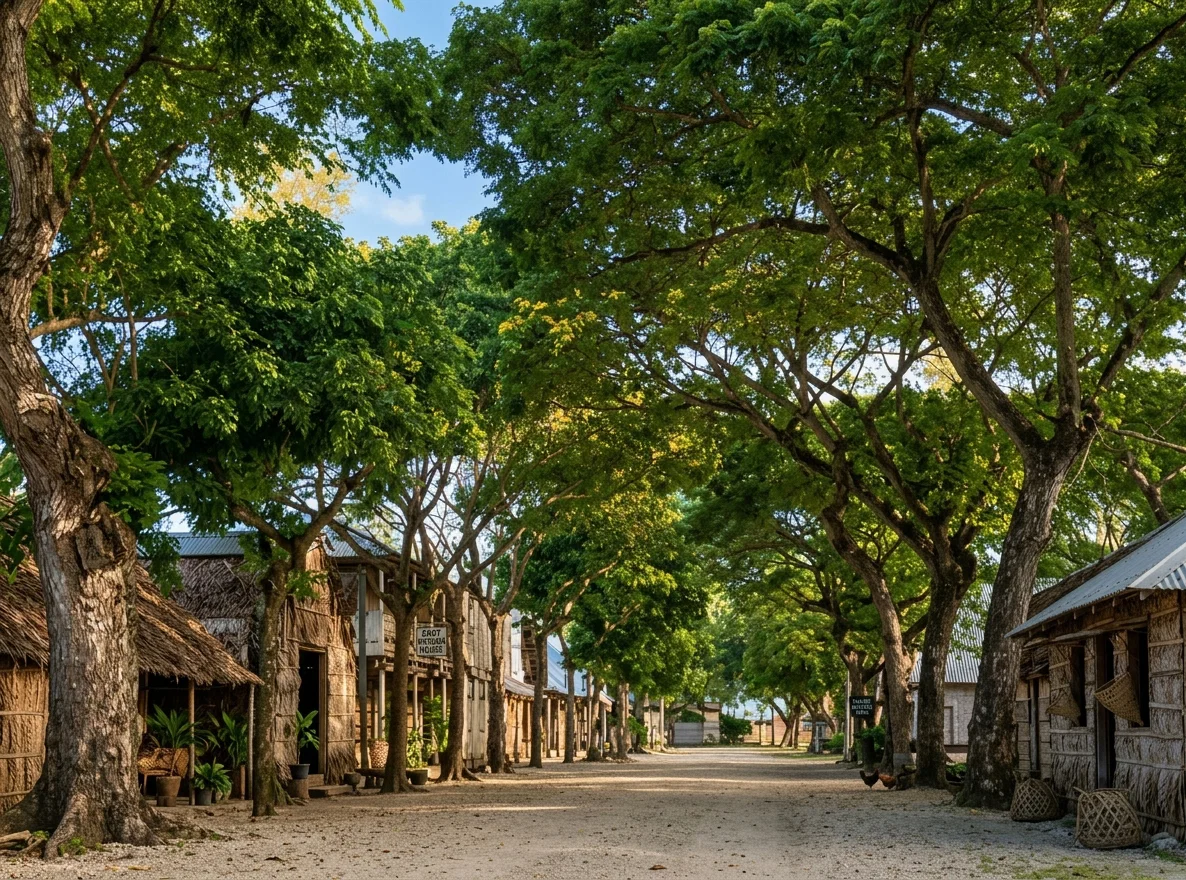
STREET SCENE IN RAIATEAN VILLAGE
In January of 1893, the “Pitcairn” started on its second cruise, visiting Pitcairn Island first, and then the Society Islands, as on the previous trip. Brother and Sister E. C. Chapman were left in Tahiti to start the printing work, after which we visited Raiatea, the second island in size and importance in the Society group, which lies about one hundred twenty miles from Tahiti. Here, the natives made an urgent plea for a missionary to be left among them, and it was finally decided that Mrs. Cady and I remain.
During the sixteen years since we first came to this field, quite a number have come and labored with us for a time, but for various reasons, the most of them have returned to the home field. At present, we have Brother and Sister George Sterling and H. L. Fowler looking after the training home and other interests on Raiatea, and Brother and Sister Henry Thomas have lately come to Papeete, Tahiti. Brother M. W. Carey, of Australia, is laboring on Pitcairn Island, and Brother F. E. Lyndon and wife, of New Zealand, are at Rarotonga. Some of our island people have developed into workers. Paul Deane, who labors for the natives, is on the island of Huahine just now, and Brother J. R. McCoy, of Pitcairn, travels with our missionary schooner the “Tiare.” His daughter Winnie is proving a valuable assistant in the circulation of the Tahitian paper. One of our native brethren of Rarotonga has recently visited Aitutaki and Mangaia, laboring in the interests of the truth and in the circulation of our Rarotongan literature. We have also some young people in our training home at Avera, Raiatea, who we hope may soon be prepared to take some part in active service for the Master. At present, my wife and myself are on a furlough in the United States, but we hope to return to the islands in July.
We now have three organized churches and three church buildings on Tahiti, one organized church on Raiatea, a company of Sabbath-keepers on Huahine, a church on Pitcairn, and one on Rarotonga in the Cook Islands. For some time, we have been collecting money to build a church on Raiatea, and hope to get it up before the end of this year.
We have two small eight-page papers in the Tahitian and Rarotongan languages that are printed monthly at our Avondale Press in Australia. These papers are well received, not only because literature in the island languages is scarce, but because they are made both interesting and instructive to the native mind, and are attractive in appearance. They both have a good circulation. We have about four hundred subscribers for the Tahitian paper in about fourteen different islands.
The Tahitian language is used in nearly all the eastern Polynesian islands. In the Cook Islands, the language varies somewhat from the Tahitian, yet is very similar to it. The Marquesas islanders have a different dialect, also the Gambier islanders, but there are very few of the people in the eastern Polynesian field who do not speak and read the Tahitian, as Tahiti is the commercial center, and there is a great deal of traffic betweenit and all the surrounding islands. The Tahitian Bible is used by the natives all through this field, except in the Cook Islands, where the Rarotongan language is spoken.
The Cook Islands and Pitcairn belong to Great Britain, but all the rest of the islands in this field are under the French rule. Our people are generally acquainted with the history of Pitcairn Island, and know that its inhabitants are English-speaking people. They have a peculiar dialect that they use among themselves, but all speak and read the English. It has been a little over one hundred years since Christianity was first introduced into these islands, and now the majority of the people are nominal Christians. In the Society, Austral, and Cook islands, the Protestant religion, as taught by the London Missionary Society, predominates. The Tuamotu islanders are usually Mormons or Catholics, and the majority of the Gambier islanders are Catholics. Both Catholics and Protestants are working in the Marquesas Islands, but I understand that heathenism still prevails among the people to a great extent.
Because of evil habits, there is a great deal of sickness among the natives, and they are rapidly decreasing. They are slow to adopt new ideas, and even after they accept new truths, it is very hard for them to change their manner of life. On this account, the work moves slowly; and the people are not very stable, so we are often disappointed in them. Yet, we are told that among the redeemed there will be representatives from every kindred, nation, tongue, and people; so we trust that some of these people are to be there. They must have an opportunity to learn the truth of God, and some one must teach them and bear patiently with them, as the Lord does with us. So we deem it a privilege to labor among them, trusting that we shall have some sheaves to show for our work at last.