The war between Japan and Russia has at last broken out, and we feel anxiously over the effect it may have upon the Lord’s work in these two countries, and in other parts of the world. In fact, there seemed to be danger that other nations would be involved. So, before and since the opening of the war, we have been praying that the Lord would still hold the winds of strife. Then news came that the United States government, through Secretary-of-State Hay, had proposed to the other great powers that Russia and Japan be prevailed upon to recognize and preserve the integrity of Chinese territory outside of the disputed territory of Manchuria. The other powers have received this proposal favorably, and it has also been agreed to by the two belligerents. This will certainly tend to simplify matters by confusing the war to a limited territory, and by averting complications with other powers. The student of prophecy can but recognize a power behind the scenes, working to hold in check the elements of strife, that the gospel of peace be not hindered. Let us still pray that this war may be brought to a close soon.
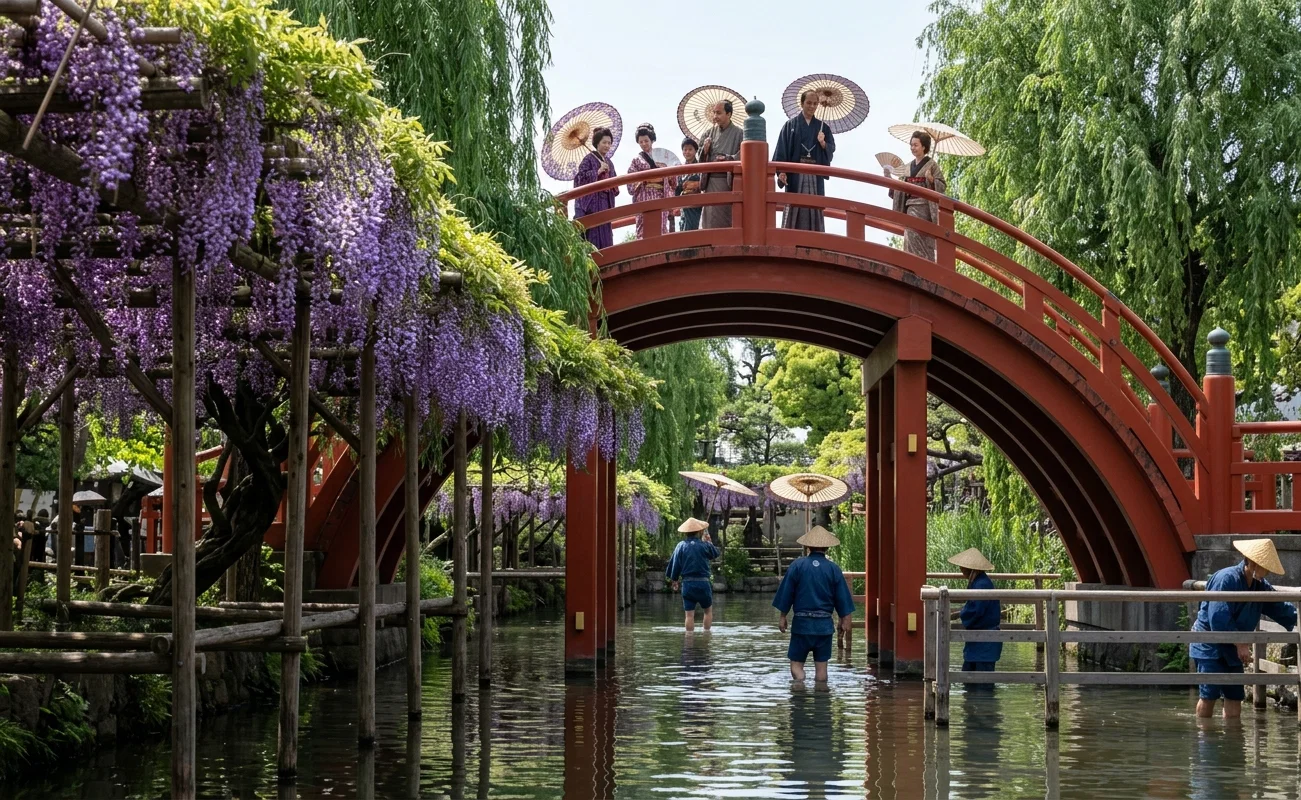
From “The Four Track News” WISTERIA AND FIRST BRIDGE TEMPLE, TOKYO, JAPAN
The Japanese hope to win by controlling the sea with their fleet. They claim to be able to place a much larger force in the field than the Russians can transport and maintain over the single line of railway through Siberia. But the Japanese admit that their weak point is their financial standing. Should the war continue more than a year, or more than eighteen months at the longest, Japan would be brought into serious financial straits. But the people are intensely patriotic, and will do their utmost to maintain their national standing. The emperor and the empress have contributed some of the imperial treasures to the war fund. At a meeting of prominent citizens held in Tokyo, a well-known bank president made a speech, in which he proposed that wealthy Japanese contribute to the war fund their costly treasures of gold coins and curios. Then he set the example by turning over to the Bank of Japan seven gold cups and a quantity of rare gold coins. This example has been followed all over the country, and large sums have been contributed. Marquis Tokugawa, former lord of Mito, contributed from the family treasures to the amount of thousands of dollars. One wealthy Japanese owns a very valuable collection of works of art, — an art museum in itself. This collection is valued at several hundred thousand dollars; and the owner has offered it for sale, the proceeds to go to swell the war fund.
And this they do to win praise to the individual, and prestige to the nation. What shall we say of the wisdom of these “children of this world”? And to what lesson is there in all this for “the children of light” who have treasures laid up on the earth?