Among the Parliamentary Papers yesterday issued was one of an extremely interesting character, in the shape of a report forwarded to the Admiralty by Commander George F. S. Knowling, of his Majesty's ship “Icarus,” dated Honolulu, March 31, in which that officer gives an account of his visit to Pitcairn Island. Commander Knowling says:—
PITCAIRN ISLAND.
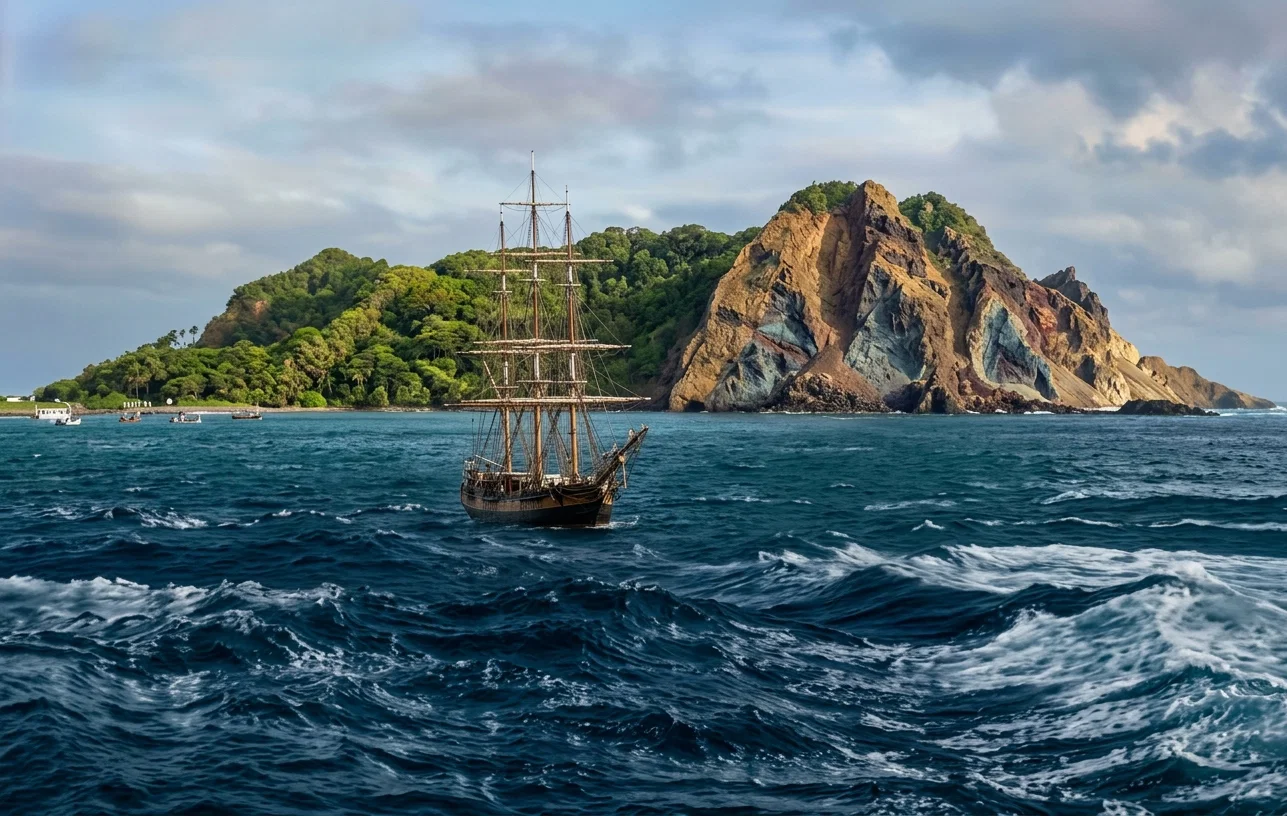
“I arrived in Bounty Bay at 5 P. M. on Feb. 21, 1901. A boat-load of islanders (men) came off; but in view of there still being several cases of dengue fever in the ship, I allowed only Mr. James R. McCoy, the Chief Magistrate, on board. He reported all well in health, one hundred and twenty-six people on the island, the adult females being rather in excess of the males. Arrangements were made to land next day, and I then proceeded to Northwest anchorage, where there was less swell; anchored there—losing an anchor, which was afterward recovered—for the night, and landed at Bounty Bay the next morning. After this I communicated with the island each day, myself and a few officers landing, but by the surgeon's advice no islanders were allowed on board. The swell continued more or less heavy in both anchorages, so we stood off and on, or lay to off the island during the remainder of our stay. Mr. McCoy has only recently returned to the island, he having very pluckily piloted a burning ship to Mangareva, beaching her there rather than agree to her captain running her, as he wished to do, on to the coast of Pitcairn.”
“Supplies of the following things are abundant: poultry and goats (the latter the islanders either shoot or drive in from the hills; and the young goats, of which we took a large number, are excellent. There are two herds of these, each numbering about one hundred); cocoanuts, bananas, pineapples, marsh- and water-melons, limes, oranges, mangoes, pumpkins, coffee, tomatoes, sweet potatoes, Indian corn, and arrowroot. A strong blow in August last, followed by what is described as a tidal wave, and which swept away a portion of the boathouse in Bounty Bay, did much damage among the oranges, almost destroying this year's crop, and also blew down large numbers of banana trees.”
“There is an abundance of water in Brown's well, which is nearly in the center of the island, fed from the high hills around, and which has not been known to run dry since the present inhabitants' return from Norfolk Island. A water-course leads the water from the well to a tank close above the village. There is another large well farther to the westward, and there is generally plenty of water.”
“During the last four years thirty-five vessels, on an average, have called at the island each year, but the islanders generally seem to see very little of the crews of merchant vessels. In most cases only the master of the vessel lands for a short time, the ships scarcely ever anchoring. During his stay last month in Mangareva (Gambier Islands), Mr. McCoy endeavored to arrange something in the way of a regular trade between the two islands, and one of their vessels has since called at Pitcairn, taking away large quantities of bananas, pumpkins, and arrowroot. The leading men here think that they will be able to maintain this trade. There is now a very fair road leading to the landing place at Northwest anchorage.”
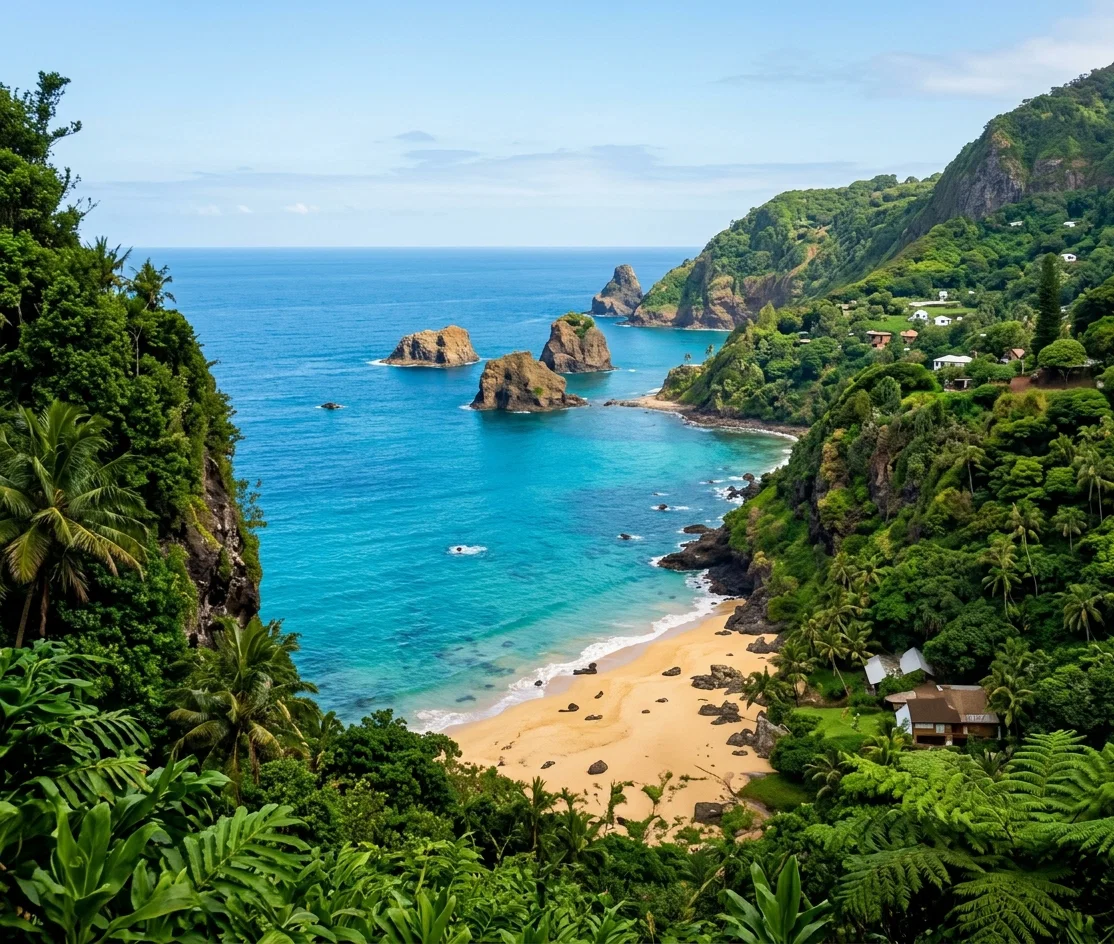
BOUNTY BAY, PITCAIRN.
“The adult males have to give all their labor during the early part of the day—from after an early breakfast at 5 A. M. until 2 P. M.—to works for the public good, directed by the local Parliament of seven. At the present time twenty-nine men are available, and their labor is divided between building a new church adjoining the present school-room, a new whaler, and the necessary boat work, shooting of goats, etc. The dinner hour is at 2 P. M., and the remainder of the day the people employ themselves about their own business of gardening, etc. The women of the family do all the housework, and many of them smooth and paint cocoanuts, plait and decorate mat bags, etc.”
“Disease appears to be still almost unknown. The typhoid of 1894 was brought here by a ship-wrecked crew, and no other epidemic has touched the island since. The leading people prefer to continue, as hitherto, without medicines of any sort. One small boy has been recently killed by a fall while chasing goats on the cliffs. Thursday October Christian, son of the man of the same name, and grandson of Fletcher Christian, master's mate of the ‘Bounty,’ is the oldest man on the island, aged now eighty-three; two other men are over seventy-five, and the oldest woman is seventy-two. None of these old people suffer from anything beyond the weakness of old age, and all seem thoroughly contented and happy. The early loss of the front teeth in the upper jaw continues among many of the islanders, but the teeth of numbers of adults, as well as of the children, are without a flaw. Some families, in which up to the present there has been practically no intermarriage, still suffer from this loss of teeth. No one smokes or uses intoxicating liquor. Men, women, and children seem, without exception, in robust health and full of vigor.”
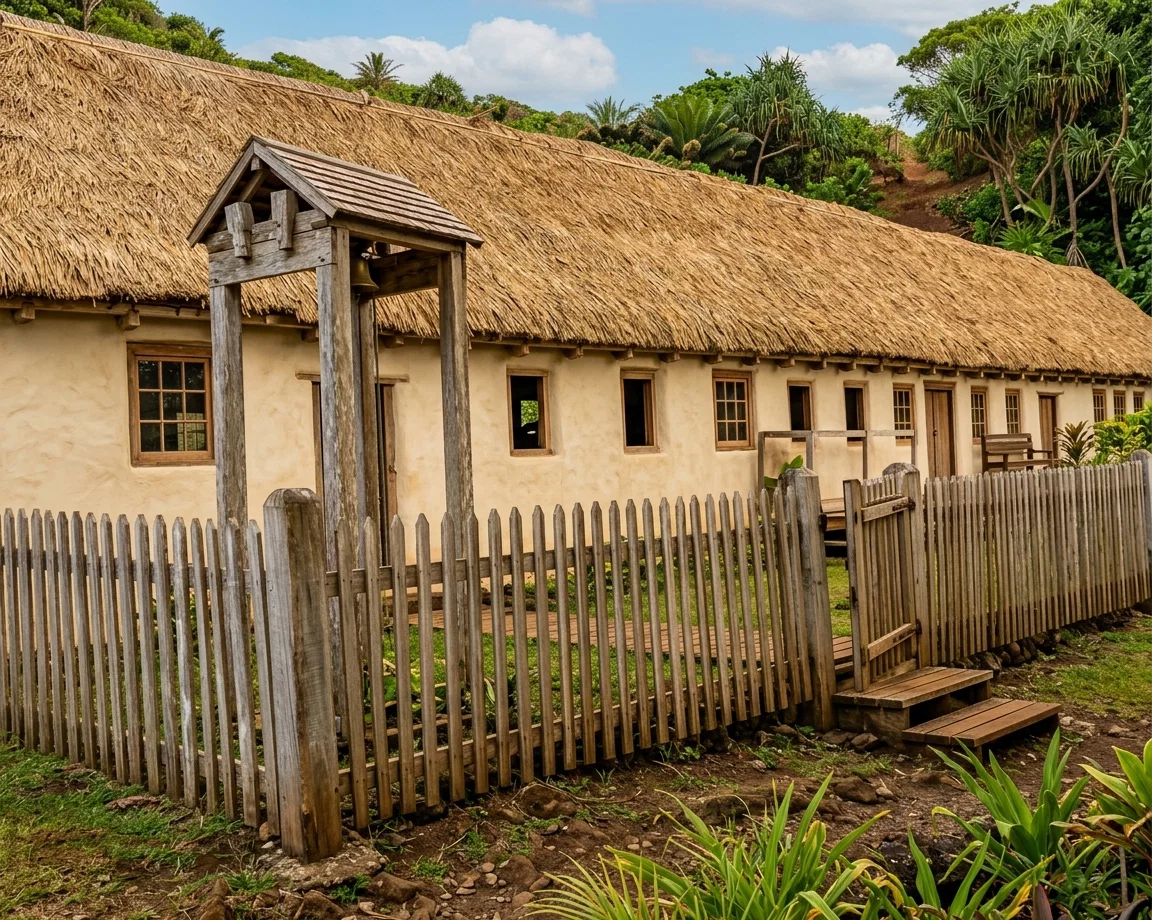
S. D. A. CHAPEL, PITCAIRN.
“Thanks to the care of the elected Parliament—consisting of seven members, with Mr. McCoy as President—full employment is found for every one. The discipline seems to be all it should be, the islanders contented, and the day's work often, to my knowledge, such as would astonish748many a British laborer, as it astonished, on more than one occasion, myself and the ship's company. Their religion remains that of the Seventh-day Adventists. The Saturday services are well conducted, and the strong religious feeling which was once so marked a characteristic of the islanders appears—after the check it received a few years ago—to have again gathered strength.”
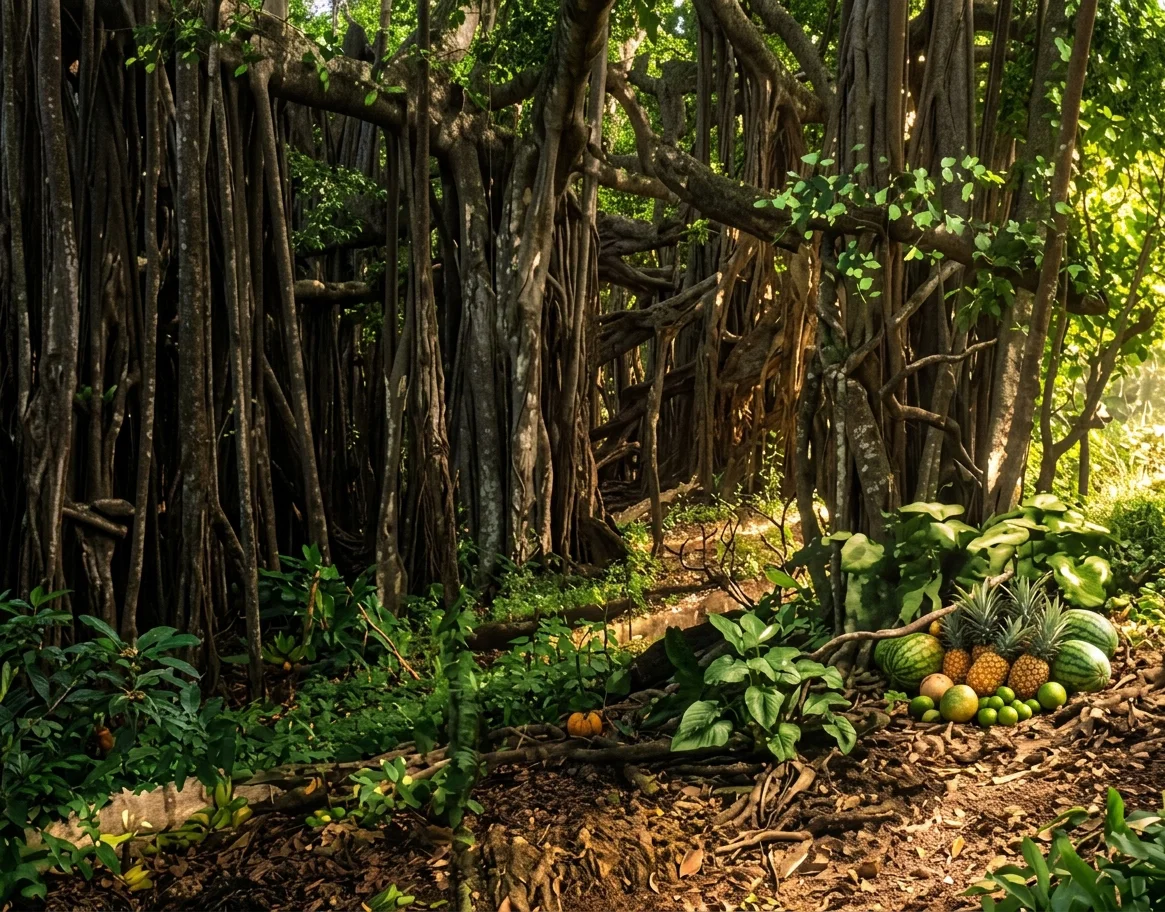
BANYAN TREE, (PITCAIRN) COVERING OVER THREE ACRES.
“To Mr. McCoy's firmness and tact, ably seconded by the six other elected members of the Parliament, I consider is due the general improvement which must have taken place in the island since the date of the ‘Royalist's’ visit. It was common talk, during our recent visit to both Honolulu and Tahiti, that the islanders were rapidly deteriorating in morals and physique, a condition of things which my officers and myself—after the best opportunities of judging—believe does not hold good at this time; and, on the other hand, looking to the present flourishing state of the island and its people, it is difficult to understand how reports to their detriment can have got abroad. Mr. McCoy had been away for a few months before the murder case which preceded the ‘Royalist's’ visit, and he admits that he found on his return much that needed improvement. A strong hand is naturally required at the head of this unique community, and fortunately Mr. McCoy is likely to be at the front for many years to come. The names of the present seven members of the local Parliament are as follows: Mr. James R. McCoy (President), Mr. Charles Vieder Young (Judge), Mr. Benjamin Stanley Young (Judge), Mr. Gerard Bromley Christian, Mr. Ernest Hayward Christian, Mr. Moses Young, and Mr. George Francis Warren (Secretary).”
“The principal difficulties which the near future may bring to the island are, I think, three; namely, (1) the absence among the men of early middle age of a fitting successor to Mr. McCoy; (2) the surplus of females in the present and rising generation, a difficulty naturally accentuated in a small and secluded community. Any arrangement which would include the removal and care of some of these youthful females—of whom some of the grown-up ones would now willingly leave—would be a work of useful philanthropy; (3) the tendency growing among the islanders to make use of a sort of language of their own, which I am told is a clipping of English words, and which is, at the best, a species of pigeon English. This shows signs already of making some of them appear slow of comprehension when addressed in English.”
“Much rain has fallen on the island of late, but only one day during our stay was wet. The wind blew generally from the northeast, with little strength, but bringing a long swell and often a confused sea into both anchorages, making landing at Northwest anchorage impracticable, and in Bounty Bay possible only under an islander's pilotage. The current at the anchorages was generally westerly, and at times reached a strength of one and a half knots. During the visit of the ‘Icarus,’ and at what may, I think, prove to be a somewhat critical stage of their existence, I found the leading islanders always grateful for any recognition of their recent improvements, and for advice as to their future conduct, and I feel sure that such recognition and advice from the higher authorities would strengthen their hands, and be of much value to the whole community.”