In the Question Chair

6%

Seventh-day Adventist Publishing Association · Battle Creek, Michigan · Jul 23, 1901

FromReview and Herald, Vol. 78, No. 30.

Read the full edition

In the Question Chair.

[Designed for the consideration of such questions as will be of interest and profit to the general reader. All correspondents should give their names and correct post-office address, that queries not replied to here may be answered by mail.]
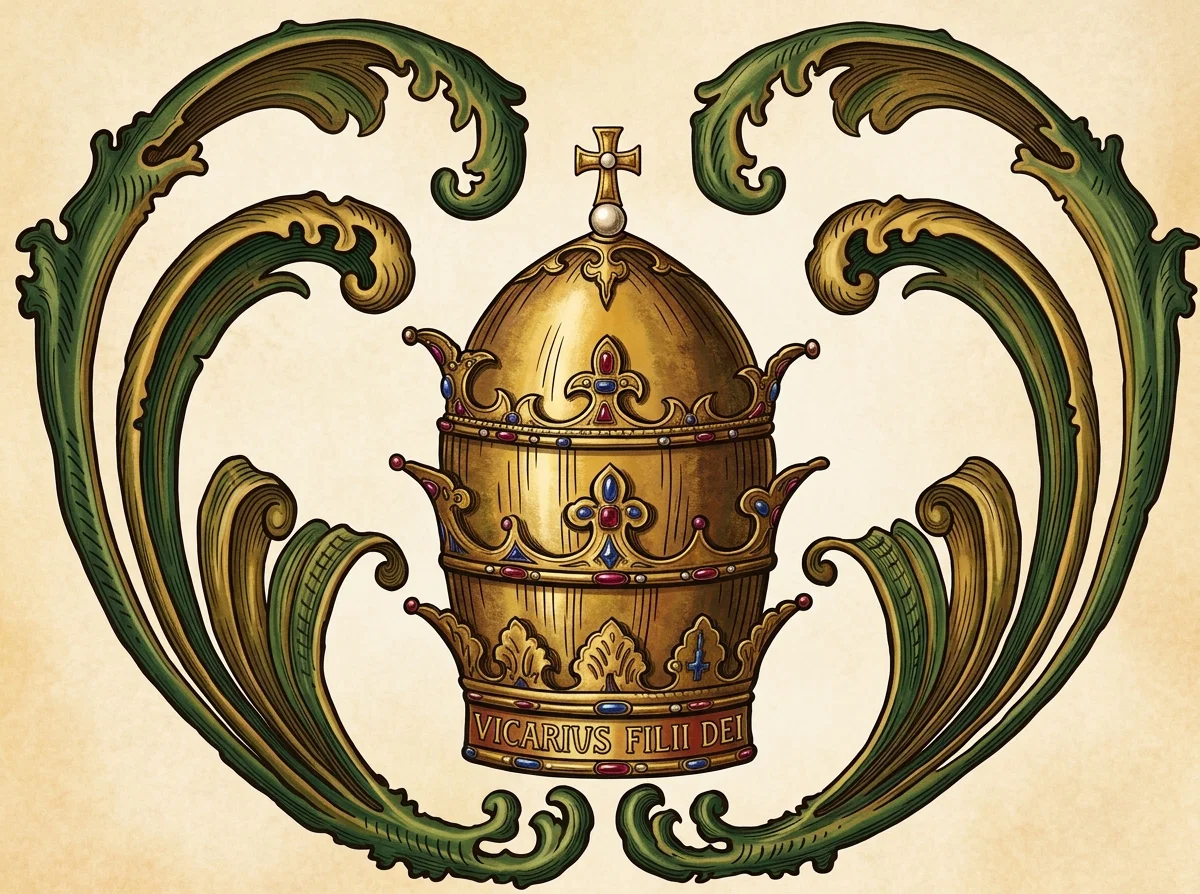
What authority have we for the statement that the pope sometimes wears, or has worn, on his miter the words, “Vicarius Filii Dei”? It is disputed by some.
O. H., College Place, Wash.
Ans.— We have for it the statement quoted in the work on “Daniel and the Revelation,” page 586, commenting on Rev. 13:18. The statement purports to be from a work entitled “The Reformation,” bearing date of 1832. The declaration is that a gentleman visiting Rome, on the occasion of a Romish ceremony, witnessed the passing of the pope in the procession, with the motto fixed upon the front of his miter in dazzling letters of burnished gold, “Vicarius Filii Dei,” Vicegerent of the Son of God. Some of these letters stand for numbers in the Roman enumeration, the sum of which makes the number 666, the very number called for in the prophecy: Thus, v, 5; i, 1; C, 100; i, 1; v, written anciently the same as u, and having the same numerical value, 5; i, 1; l, 50; i, 1; i, 1; d, 500; i, 1; total, 666. We have no reason to doubt the accuracy of the statement here given, that this motto appeared on the miter of the pope, on the occasion here mentioned. This, of course, might refer to a particular pope, only on a particular occasion. Other popes may not have worn the title thus emblazoned on the miter; and as it is disputed that any of them ever did, let us consider how that would affect the question. No one can dispute that the popes all claim and assume the title, “Vicar of Christ.” See Standard Dictionary under “vicar;” also the Century Dictionary, under the same word. This book says: “Vicar of Jesus Christ, a title assumed by the pope, with reference to his claim to stand in the place of Jesus Christ, and possess His authority in the Church.” And what is the meaning of “vicar,” as used by the pope?—The same as “Vicegerent,”—Latin, Vicarius,—and the words “of Christ,” the same as “of the Son of God,” expressed by the Latin words filii Dei. So we have, according to all authorities, the title of the popes containing the exact equivalent of the words given above, Vicarius Filii Dei, the numerical value of which is 666. So, however much it may be denied that the popes wear the title above referred to, in that exact language, it cannot be denied that the common title which they do assume is its exact equivalent.

820.—The R. R. Prophecy.

Will you please tell me where in the Bible is found the prophecy of a modern locomotive and a train of cars. C. C. M., Fields, Lorain Co., Ohio.
Ans.— In Nahum 2:3–5 is a prophecy supposed to point out modern developments in railroading; such as the chariots raging, or jostling together, in the broad ways; seeming like torches, as an engine does, pouring out its smoke in the daytime, and flame and sparks by night; and running “like the lightnings.” Many trains are named “lightning” trains. Of course those who glory in the name of “higher critics” (Jude 13), whose business seems to be to criticise, question, and deny everything, oppose the application of this scripture to the railroad cars as we behold them to-day. But while it would not be consistent, perhaps, to attempt to apply everything as minutely as some do, there are some leading points so strikingly consistent and forcible as pointing out the cars that it seems hardly possible to apply them otherwise.

821.—More About Melchisedec.

Did Melchisedec ever officiate in the heavenly sanctuary? If so, at what time?
Mrs. A. P. H., Sedalia, Mo.
Ans.— Melchisedec, being only a man and living and dying like other men, if he ever was connected with the heavenly sanctuary, must have been taken at some time to heaven, of which we have no specific account. He was not Enoch nor Elijah, who were translated (Gen. 5:24; 2 Kings 2:11), nor Moses, who was raised from the dead. Matt. 17:3, 4; Jude 9. If, therefore, he was ever taken to heaven, he must have been one of those who were raised at the crucifixion and resurrection of Christ (Matt. 27:51–53), and one of the “multitude of captives” whom Christ led with Him to heaven, at His ascension (Eph. 4:8, margin), and who is now one of the four and twenty elders, and one who helps compose one of the “living creatures,” who have been redeemed from the earth (Rev. 5:9), and who are the assistants of Christ in His present sanctuary work. Rev. 5:10. It would seem very consistent and appropriate that he should be one of these; but here we cannot speak with certainty; for the names or former positions of these people are not given.

822.—Physical Condition of the Sanctuary.
In studying the Sabbath-school lessons, and always in reading about the ceremonial law, the query has arisen in my mind how the premises in the vicinity of the tabernacle could be kept in a tidy condition when there was so much shedding of blood, and sprinkling of blood on the floor and on the various instruments and furniture of the tabernacle, such as the ark, altar of incense, altar of burnt offering, etc. Also at the dedication of Solomon’s temple, when such a vast number of offerings were made, how was the blood disposed of? In addition to all this, the continued burning of the lamps must have had a tendency to soil the walls of the holy place. How could the premises, under these circumstances, be kept in such a condition as would become the house of God? We have no record in the Bible of any time of special cleansing of these parts. Do the Testimonies anywhere speak of it?
E. R. H., South Kirtland, Ohio.
Answer.— We do not write the word “Answer,” with the expectation of being able to clear up fully the query; for, as our correspondent said, the Bible contains no record of such general clearing-up time, and we are not aware that the Testimonies speak of it; but when we consider that the services of the tabernacle, after it was permanently located in Palestine, were practiced in the same place for scores and even hundreds of years, it is evident that some process of physical cleanliness must have been resorted to, to keep them in a usable condition. We have often thought of the immense number of oxen and sheep offered at the dedication of Solomon’s temple,—“twenty-two thousand oxen, and an hundred and twenty thousand sheep” (1 Kings 8:63),—which must have given the temple court the appearance of a great slaughter house, and wondered how the débris was disposed of. Perhaps what we saw in Jerusalem may afford a partial explanation. Standing in the outer court of the Mosque of Omar, which covers the ancient site of the temple of Solomon, we were shown channels worn, or cut, in the rock, which here comes to the surface, leading to openings communicating with underground chambers, as shown by the hollow sound made by striking upon the places, and were told that the rock below was honeycombed with subterranean chambers to receive the blood in times of sacrifice. But even this would, by years of constant use, become unsalutary, and offensive and need cleansing. How much was enjoined upon those who had charge of the vessels of the sanctuary, as they bore them from place to place, to keep them free from physical impurities, we do not know. In the tabernacle service, blood was, of course, a familiar object, designed to keep constantly before the mind that without the shedding of blood there is no remission. Heb. 9:22. And it is evident that there must have been some provision by which to keep all the utensils scrupulously clean, when we consider that the service was part of a system in which a vessel even ceremonially unclean was broken in pieces and cast away. Lev. 15:12.