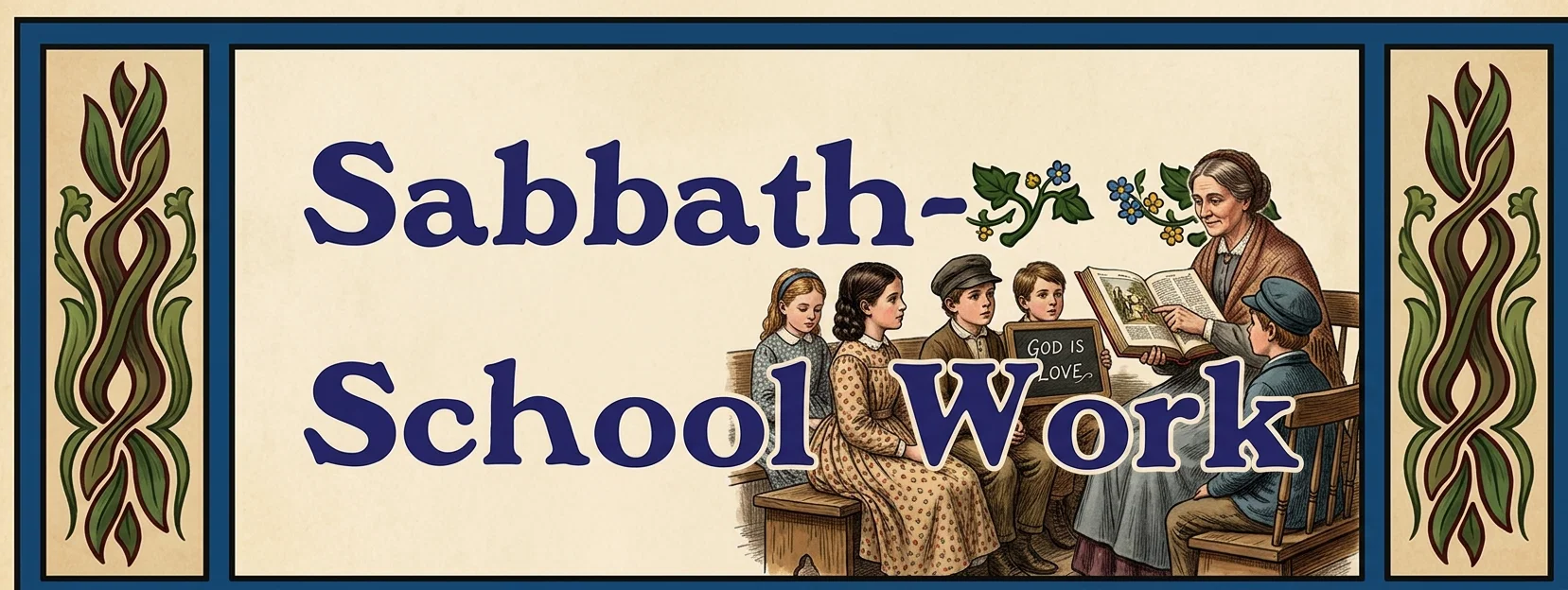
Sabbath-school Work

4%

Seventh-day Adventist Publishing Association · Battle Creek, Mich. · Nov 26, 1901

FromReview and Herald, Vol. 78, No. 48.

Read the full edition

Sabbath-school Work

A SKETCH OF THE BATTLE CREEK SABBATH-SCHOOL FROM ITS COMMENCEMENT TO THE PRESENT TIME.

The beginning of our Sabbath-school work in this city dates from the autumn of the year 1855. In the month of October of that year the small plant of the Review Office was moved from Rochester, N. Y., to the village of Battle Creek. There were fourteen persons, in all, who then came to this place. Elder James White’s family numbered seven, and there were also Brother J. W. Bacheller and his mother and sister, Brother and Sister Belden (the parents of F. E. Belden), Brother Uriah Smith, and the writer, all of us making the fourteen already mentioned.
At that time there were ten families of Sabbath-keepers living in this place, and in these families there were about twenty children and young persons, who, with their parents, made forty Sabbath-keepers. These, with those who came from the East with the press, constituted the charter members of the original Battle Creek church, as follows:—
Cyrenius Smith, Delphia J. Frisbie,
Louisa Smith, Zerah Brooks,
William Smith, Mrs. Z. Brooks,
Martha L. Smith, David Hewitt,
Lorinda Smith, Olive Hewitt,
A. A. Dodge, Walter Grant,
Caroline Dodge, Nancy Grant,
Henry Lyon, S. B. Warren,
Deborah Lyon, Mrs. S. B. Warren,
J. R. Lewis, J. P. Munsell,
Mrs. J. R. Lewis, Matilda Munsell,
J. B. Frisbie, Mrs. Mary E. Tozer.
At that time there was no church building here for believers in “the present truth,” and our meetings were often attended by fifty persons or more. This congested condition of the meetings immediately led to the erection of a small chapel, which stood about a dozen feet south of the flat which is now in process of erection on the west side of Cass Street near Champion Street. This small church building, 18 x 24 ft., was put up in the fall and winter of 1855-56, and was without doubt the first meeting-house erected by Seventh-day Adventists.
At this early date, and before any place of worship was constructed, the Sabbath-keepers then living here had a Bible class study and a small Sabbath-school. The one brother who had a burden in this matter, and who led out in forming the nucleus of a Sabbath-school, was Brother Merritt G. Kellogg. He was the oldest brother of Dr. J. H. Kellogg, and has long been a faithful medical missionary among the islands of the Pacific.
Brother Kellogg at first did not have the assistance that he should have had in the Sabbath-school work, but there soon came an admonition from the Lord which prompted others to take hold and assist.
In starting the Sabbath-school work, the one great embarrassment was the lack of suitable lesson helps, as we have at the present time. And in the absence of such assistance, lessons were generally given out from some portion of the Bible; verses were committed by the children, and questions were asked on them by the teachers. There had previously been printed a few Sabbath-school lessons in the Youth’s Instructor, in Rochester, N. Y.; but as they were not issued in book form, these lessons were not generally available at this early date.
For the use of young people and adults, there had been prepared in 1855 a series of fifty-two Sabbath-school lessons by Elder R. F. Cottrell, on the “Commandments of God and the Faith of Jesus.” These were issued in a neat little volume called the “Bible Class,” by Elder James White, and for years this book was the basis of Sabbath-school study by the young people and the older ones. But as Elder Cottrell’s excellent book was run from type, and no plates were made, after a while the edition was exhausted, and the study of this book necessarily ceased. Hence for a number of years lessons had to be improvised for the school as the tact of the leaders and workers could suggest. In prosecuting the work after this method, quite a number of the books of the New Testament, and several in the Old, were gone through in our Sabbath-school study.
But notwithstanding the several inconveniences under which the work was carried on, the Sabbath-school gradually increased in interest and size, and this was especially so as people began to move to Battle Creek. In 1855 our school numbered fifty persons, divided into ten classes, and Brother John P. Kellogg, the father of Dr. J. H. Kellogg of the Sanitarium, was superintendent.
In 1863 there were seventy-five souls in our Sabbath-school, the same number that went down to Egypt in the days of Joseph. In 1870 the school had increased to one hundred persons. In the year 1877 was created the “General Sabbath-school organization,” which gave a decided impetus to the work; and from that time to the present there has been a more intelligent and definite purpose before the school, which has not only told in Battle Creek, but throughout the world where the truth has gone. From this date also there has been no lack of suitable lesson helps for both young and old.
In the earlier period of this work there were no regular Sabbath contributions as at present, but funds were frequently raised to assist the needy, and to furnish our youth’s paper to those unable to subscribe. From time to time more or less of this benevolence was connected with our Sabbath-school work. When Brother G. H. Bell became connected with the Battle Creek Sabbath-school, about 1868, a much greater effort was made to raise funds than previously.
Mention has been made of the embarrassment in Sabbath-school work on account of having no lesson helps for the young children. To supply this great lack, in 1863 a sister by the name of Adelia P. Patten, now the wife of Elder I. D. Van Horn, began a series of Sabbath-school lessons in the Youth’s Instructor, entitled “Bible Knowledge for Little Children.” There were one hundred and four of these excellent lessons, and they treated upon Old Testament history, beginning with the book of Genesis, and ending with the teachings and life of the Saviour. These important lessons were a great blessing in Sabbath-school work in Battle Creek and in the cause at large.
During the years 1861, ’62, and ’63, a series of “Miscellaneous Bible Questions” for children and youth was furnished by the editors of the Youth’s Instructor, through the columns of that paper, which tended to create a lively interest in Sabbath-schools wherever they were in existence. This was learned by the frequent letters that came to the Review and Herald Office.
Up to the year 1878 there had been one serious hindrance in Sabbath-school work, not only in Battle Creek, but elsewhere, in the lack of a suitable song book in connection with our schools. But about this time it pleased God to raise up Brother J. E. White, who, with the aid of Brother F. E. Belden and others, brought out the Sabbath-school song book entitled “The Song Anchor,” which had a remarkable circulation, and which has stimulated the zeal of multitudes in this blessed line of work. Before this we had only a little primer of hymns printed in Rochester, N. Y., a compilation of about eighty pages of words only, without music, to which tunes were adapted when the book was used. But this little book was only a stepping-stone till something better was provided. It may also here be added that “The Song Anchor” has been followed by other excellent books of a similar character, which have been a decided blessing in Sabbath-school interests.
In glancing over the past history of our Sabbath-school in this place, it must not be neglected to state that in no small degree the success of the work depended on the energy of our secretaries. A good system of reporting greatly tended to the upbuilding of the work. And on this point honorable mention may be made of such faithful secretaries as Mary Kelsey White, Mina Fairfield, Jennie Tremblay Richards, Winnie Loughborough Kelsea, Maud Sisley Boyd, and very many others. Some of these are now sleeping, but they will surely come forth when the trumpet sounds, and share in the great recompense.
It is a pleasant point here to state that in the diversified history and varied experiences of the Battle Creek church during the past forty-six years, the Sabbath-school work has been continued with no serious interruptions nor long vacations. In summer and in winter, in heat and cold, during rain and shine, the Sabbath-school work has gone forward with no serious break.
One more item in this connection it is proper to not pass over, and that is the superintendency of the Battle Creek Sabbath-school. As already mentioned, the first superintendent, in 1855, was Brother M. G. Kellogg. He served awhile, then this mantle of responsibility rested upon his father, John P. Kellogg. Later on the writer looked after this interest awhile, and in 1865 Brother G. H. Bell, in the Lord’s providence, was raised up to put his shoulders to the Sabbath-school wheels. As time proved, he was the man for the place. He printed valuable Sabbath-school lessons in our youth’s paper, for children and young people, and later, these were carefully revised and placed in permanent book form, and constituted the eight valuable series of lesson books known as the “Progressive Bible Lessons.”
Brother Bell’s health not being good, he was succeeded in the superintendency by Brother Wm. K. Loughborough, who had already served as Brother Bell’s assistant. And these two brethren, far more than others, stood at the head of the Sabbath-school work in this city. For years Brother Loughborough especially was connected with our school. Being a master mechanic, and a man of taste, if we had an outing for the school, or special exercises for the holidays, this brother was the one to step forward and spend much time and means in making things interesting for the school.
But it is not best for the same one to carry a particular burden too long, and so after a long service Brother Loughborough was succeeded by Elijah Gaskill, now a faithful ship missionary in Cape Town, South Africa.
Before finishing this history of the Sabbath-school work in Battle Creek, we will give a list of the names of the persons who have acted as superintendents or assistants from the time of Brother Gaskill down to the present.
They are as follows:—
Brother C. W. Stone, C. D. Rhodes,
Prof. A. B. Oyen, Homer Aldrich,
Dr. J. H. Kellogg, Frederick Griggs,
Wm. C. Gage, F. W. Howe,
G. W. Morse, F. E. Belden,
Moses E. Kellogg, C. J. Hibbard,
A. F. Ballenger, W. H. Saxby,
E. S. Ballenger, J. W. Collie,
L. T. Nicola, C. F. Marvin,
and the present incumbent, Brother H. E. Osborne.
This sketch would be somewhat incomplete if no mention was made of the various places in which the Sabbath-school work here has been carried on. As previously stated, our first little schools were held in private houses; then two months later in the humble chapel erected on Cass Street. But as the Review and Herald Office attracted believers to this place, the small 18 x 24 ft. building became too strait for us; and in 1857, two years later, another church building, 26 x 42 ft., was built on Van Buren Street, and dedicated and used by our people as a place of worship, and for Sabbath-school. But the word of God grew and multiplied, brethren and sisters continued to move to Battle Creek, and at the end of eleven years it became necessary to have a still larger house. Then twelve vacant lots just west of the Public Square were bought, and a commodious house, 44 x 60 ft., was erected, the house on Van Buren Street being sold to the colored people. This last place of worship, and for Sabbath-school, served us well until the year 1878 when a much larger house for worship and for our large Sabbath-school seemed absolutely necessary. Then this third church building was moved against the south side of the Review Office, and incorporated into that institution. And in the memorable year 1878 began the construction of this commodious Tabernacle, which for a period of twenty-three years has served its part in this closing work.
GEO. W. AMADON.