Modern Babylon

4%

Seventh-day Adventist Publishing Association · Battle Creek, Mich. · Jul 31, 1900

FromReview and Herald, Vol. 77, No. 31.

Read the full edition

Modern Babylon

MODERN BABYLON
MODERN BABYLON
In the chapters already studied in Daniel, we have seen how the gospel of the kingdom was preached in Babylon to Nebuchadnezzar the king, and through him “unto all people, nations, and languages, that dwell in all the earth,” so that the knowledge of the true God, his manifold wisdom, his power to deliver, and his dominion in the kingdom of men, had been fully made known. By this revelation of the most high God, in the faithful testimony that had been borne by Daniel and his companions, and the experiences connected therewith, Nebuchadnezzar the king had been “turned to God from idols to serve the living and true God.”
With a genuine sense of the nothingness of man and the greatness of God, he praised and glorified the King of heaven. The signs and wonders that the high God wrought toward him, and his own conversion, had been heralded abroad by a royal proclamation, and thus the testimony that might have gone forth from Jerusalem as a world-wide message, went out from Babylon.
The same power that converts a man attends the story of his experience, when it is told to glorify God. Such testimony is the gospel in concrete form, and it requires no theological training to preach it. So Jesus told the man out of whom he had cast the legion of devils, “Go home to thy friends, and tell them how great things the Lord hath done for thee, and hath had compassion on thee.” So Paul, the great apostle to the Gentiles, before Felix, and again before Agrippa, told in simple language the story of his own conversion; and thus the gospel, the power of God and the light of the world, was preached in the king’s palace. So it was in Nebuchadnezzar’s case. And the divinely written history of his experience has been, and still is, preaching the same gospel to all the world.
The fifth chapter records the downfall of Babylon, with such a statement of the events of that fateful night as throws light upon the cause of its fall. But the lesson contained in this brief record, and its meaning at the present time, can not be rightly understood except as we see in the light of the Scripture the application that the Lord himself has made of the name of Babylon, and the meaning that he himself has put into it.
If we should anticipate our future studies a little by reading the remaining chapters of Daniel, we should readily see that, taken as a whole, the book of Daniel deals almost exclusively with the first and the fourth of the four universal kingdoms of the world.
In the earlier part of the book we have so much of the history of the first kingdom as serves the definite purpose of the divine historian, and in the latter part we have prophecies concerning the fourth kingdom. The second and third kingdoms are mentioned briefly, and serve merely to make the proper connection between the other two.
To the first three kingdoms the same names are given in the book of Daniel as are given in human history; namely, Babylon, Media and Persia, and Grecia; but to the fourth no name is applied. It is simply mentioned as “the fourth kingdom.” We shall also find that it is not so much the fourth kingdom, as a power developed in the fourth kingdom which occupies the prominent place in the prophecy; and this power is not designated by any name in the book of Daniel.
If we turn, however, to the book of Revelation, which is a supplement to the book of Daniel and deals wholly with the period covered by the fourth kingdom, we shall find further light upon these things. By a careful reading of the seventeenth chapter of Revelation, with special attention to the third, ninth, twelfth, and eighteenth verses, it will clearly appear that a power is described there which was to arise during the time of the ten kingdoms into which the fourth kingdom was to be divided, “that has sovereignty over the sovereigns of the earth.”
This power corresponds to the little horn mentioned in the seventh chapter of Daniel, and also to the little horn mentioned in the eighth chapter, and these symbols occupy the leading place in these chapters. It is a matter of common knowledge that the fourth of the universal kingdoms is known in human history as Rome, and that Rome as an ecclesiastical power has exercised much more influence upon the history of the world than has Rome as a civil power.
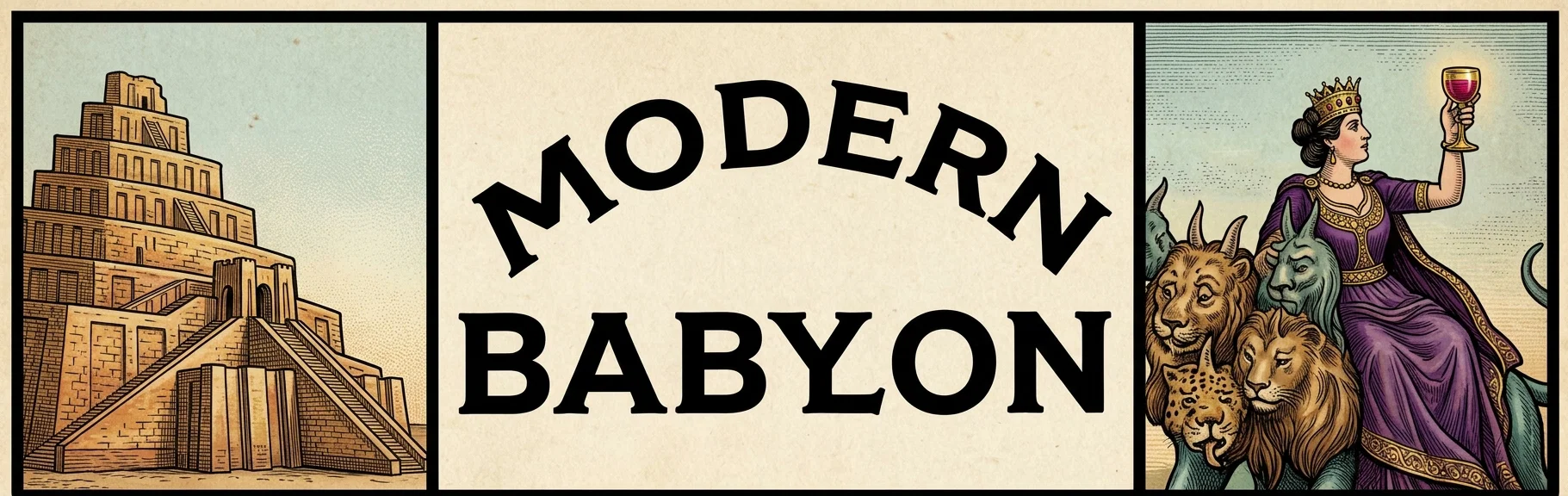
It is with ecclesiastical Rome, or papal Rome, or the papacy, that the prophecies deal more particularly, and it is this power which is described under the symbol of the little horn in Daniel and of the woman in the seventeenth chapter of Revelation.
This application will be fully justified by our further studies. But in this last chapter the Lord himself gives the name by which this power is known in the divine history: “And upon her forehead a name written, a mystery, BABYLON THE GREAT.” Rev. 17:5, R. V., margin.
We can now appreciate more fully the meaning of the historical portion of the book of Daniel. It is not merely to set forth general principles, although this is done most effectively, but it is to give a living picture of the closing events of this world’s history, during the time when “Babylon the Great” is again the chief power in the earth, and “reigneth over the kings of the earth.”
Thus the earlier part of the book of Daniel is truly a prophecy as well as a history, a history which is to be repeated “in the latter days.” And inasmuch as we are now living in the last of the latter days, in the very generation when this history is to be re-enacted, this book in the fullness of its meaning ought to be known in all the earth, and the picture drawn by the divine Artist in the history of Babylon ought to be so clearly in the minds of all the people that its counterpart will be easily recognized. This is the true message of the gospel of the kingdom, which “shall be preached in all the world for a witness; . . . and then shall the end come.”
The book of Daniel opens with a statement of the controversy between Babylon of the Chaldees and Jerusalem of Judea, which ended in the utter overthrow of Jerusalem, and the captivity of the professed people of God. This loss of their city and their kingdom was due simply to the previous loss of the kingdom of God from within, the apostasy of the people from right principles. Being corrupted by the principles of Egypt and Babylon, having lost the true power of the kingdom without acquiring even fleshly power in its place, they became worse and weaker than the nations about them, and were easily overcome by the king of Babylon. But Daniel and his companions, having retained the kingdom of God within them, carried with them into Babylon a power which finally conquered the king himself, and made him a loyal subject of the true God.
Since the days of Nebuchadnezzar, the people of God have never been fully out of Babylon, although there have been faithful men in all the centuries who, like Daniel and his companions, have had the kingdom of God within them; and while they have been outwardly in Babylon, yet they have not been identified with Babylonish principles. Through them the true gospel of the kingdom of God has been preached, and a long line of witnesses has testified to the superiority of its principles. In the meantime, Babylon of the Chaldees has become a waste and a desolation, and Jerusalem of Judea long ago lost its opportunity of standing forever, and is no longer “Zion, city of our God.”
And yet the controversy to-day is still between Babylon and Jerusalem, between the kingdom of this world and the kingdom of God. At the close of this long controversy between the two kingdoms, which, under ever-varying conditions and appearances, is always “the great controversy between Christ and Satan,” there will be a short but decisive struggle between “Babylon the Great,” the apostate church of any and every name which has adopted Babylonish or papal principles, and the citizens of “the heavenly Jerusalem,” those who stand for truth and righteousness. Then “shall that great city Babylon be thrown down, and shall be found no more at all,” “but the saints of the Most High shall take the kingdom, and possess the kingdom forever, even forever and ever.”
As a preparation for this closing scene in the conflict, the message is now going forth “to every nation, and kindred, and tongue, and people,” the same message which was proclaimed in Babylon of the Chaldees, and preserved for us as a living history in the earlier chapters of Daniel, “Fear God, and give glory to him.” And with it is now to be heard the further call as to Babylon, “Come out of her, my people, that ye be not partakers of her sins, and that ye receive not of her plagues.”
We are now better prepared to understand why it is that the prophecies which speak of the ruin of Babylon of the Chaldees mention details and describe a situation which could not possibly be fulfilled simply in the destruction of that city. Thus the prophet Isaiah says: “The burden of Babylon, which Isaiah the son of Amos did see. Lift ye up a banner upon the high mountain, exalt the voice unto them [compare Isa. 11:9 and Rev. 14:7], shake the hand, that they may go into the gates of the nobles. . . . The noise of a multitude in the mountains, like as of a great people; a tumultuous noise of the kingdoms of nations gathered together: the Lord of hosts mustereth the host of the battle. . . . Howl ye; for the day of the Lord is at hand; it shall come as a destruction from the Almighty. . . . Behold, the day of the Lord cometh, cruel both with wrath and fierce anger, to lay the land desolate: and he shall destroy the sinners thereof out of it. . . . And I will punish the world for their evil, and the wicked for their iniquity; and I will cause the arrogance of the proud to cease, and will lay low the haughtiness of the terrible. . . . Therefore I will shake the heavens, and the earth shall remove out of her place, in the wrath of the Lord of hosts, and in the day of his fierce anger. . . . And Babylon, the glory of kingdoms, the beauty of the Chaldees’ excellency, shall be as when God overthrew Sodom and Gomorrah.” Isa. 13:1-19. Again, the prophet Jeremiah says: “As Babylon hath caused the slain of Israel to fall, so at Babylon shall fall the slain of all the earth. Ye that have escaped the sword, go away, stand not still; remember the Lord afar off, and let Jerusalem come into your mind. . . . Wherefore, behold, the days come, saith the Lord, that I will do judgment upon her graven images: and through all her land the wounded shall groan. . . . And I will make drunk her princes, and her wise men, her captains, and her rulers, and her mighty men: and they shall sleep a perpetual sleep, and not wake, saith the King, whose name is the Lord of hosts.” Jer. 51:49-57.
It is evident that here the Lord has in mind, and is describing through the prophets, not simply the overthrow of Babylon of the Chaldees, but the final and complete overthrow of all which he calls Babylon in the earth. Thus the downfall of Babylon is a prophecy of the downfall of the whole world, the ruin of the nations, and in particular of that power which the Lord designates as “Babylon the Great,” “who opposeth and exalteth himself above all that is called God, or that is worshiped; so that he as God sitteth in the temple of God, showing himself that he is God.” 2 Thess. 2:4.
And so the cause which led to the downfall of Babylon of the Chaldees will in the same way lead to the downfall of the world; and the same experience of the kingdom of God within and faithfulness to its principles which not only gave light to Daniel concerning this downfall, but also saved him from it, will give light to the faithful, and will save them from the destruction that is even now threatening the world.
Therefore it is that this record of the fall of Babylon should be studied not simply as a record of a past event, but as a prophecy for the present generation, a prophecy which is even now ripe for fulfillment. “Flee out of the midst of Babylon, and deliver every man his soul: be not cut off in her iniquity; for this is the time of the Lord’s vengeance; he will render unto her a recompense.”
W. W. P.