The South African Conference

7%

Review and Herald Publishing Association · Takoma Park Station, Washington, D. C. · Mar 28, 1907

FromReview and Herald, Vol. 84, No. 13.

Read the full edition

The South African Conference

G. A. IRWIN
At six o’clock on the morning of Jan. 1, 1907, we cast anchor in Table Bay, thus bringing to an end a sea voyage of 13,256 miles—the distance from San Francisco to Cape Town. Brother Fortner met me at the dock, and took me direct to Claremont, a suburb of the city, and the place that had been chosen to hold the coming conferences and camp-meeting. On the way to Claremont I was informed that Brother and Sister Rogers, who were under appointment to Africa, and who had left the States about a month later than I, going by the way of England and the west coast of Africa, had arrived just thirty minutes ahead of me.
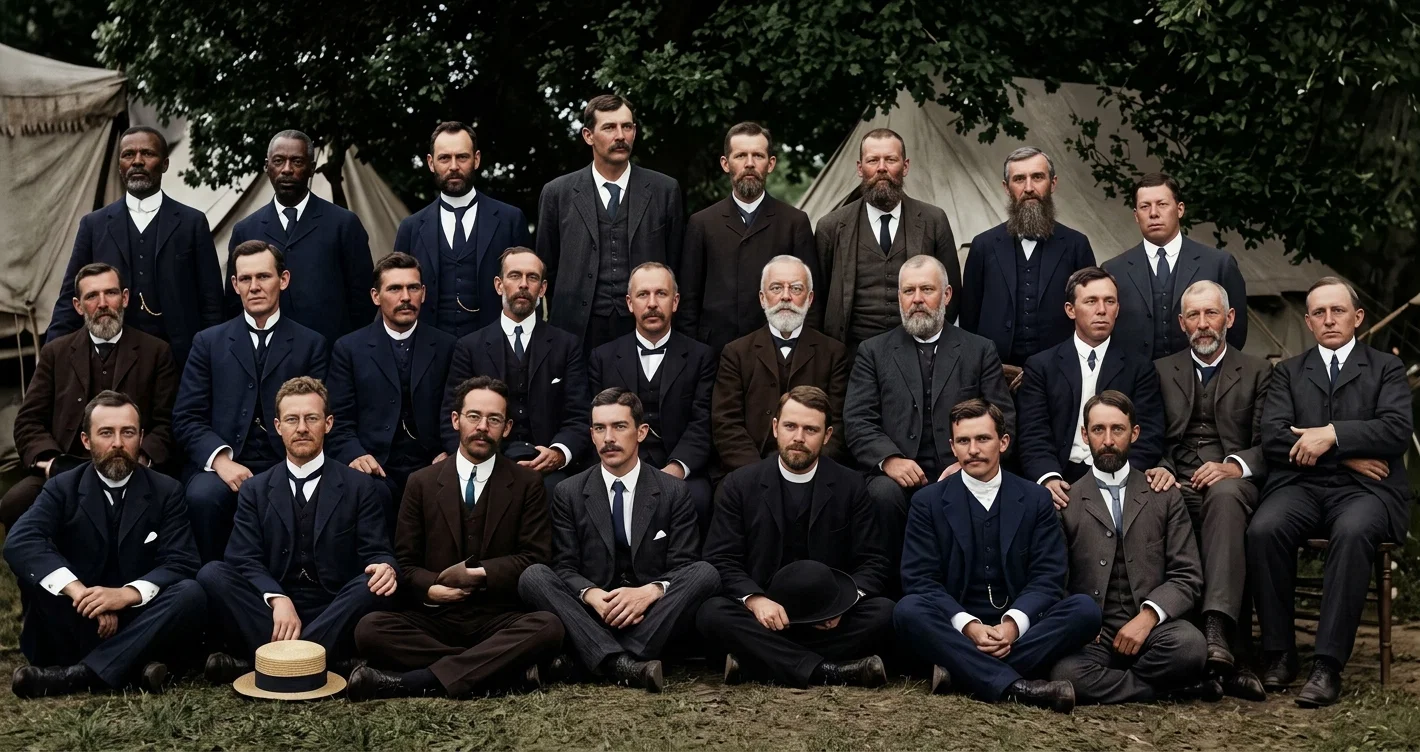
It had been arranged to hold the Cape Conference and the South African Union Conference in connection with the annual camp-meeting of the Cape Conference, and in order to have sufficient time, the meeting was to run from January 4-20, being in session over three Sabbaths. The first week was devoted entirely to business, with the exception of the hour from six to seven in the morning, which was used for Bible study and social meeting. The evening hour was devoted to a preaching service for the benefit of the campers, and any who might attend from the outside. While the attendance of our own people was not large, yet it was said to be the most representative gathering that they have ever yet held in this field, delegates being present from Rhodesia, Natal, Nyasaland, Basutoland, Barotseland, Transvaal, Orange River Colony, and all parts of Cape Colony. Each of the seven missions carried on among the natives was represented by the one standing at the head, and in four instances the wife accompanied her husband. In addition to the white delegates, there were two native laborers—Brother Moko, a Kafir preacher who had been connected with Brother Shone in the Kafir Mission, and Brother Kalaka, who has been acting as interpreter for Brother Chaney in the Basutoland Mission.
Believing that it would be of interest to the readers of the REVIEW to know how the work started in this field, I will at this point quote a few paragraphs from the report of the president of the Cape Colony Conference, as rendered during the session:
'In a most marvelous way the Lord started the message in this country, and no one can doubt but that the Holy Spirit was the teacher sent of God at that time. In the year 1885, or twenty-one years ago, the Lord led Brother Peter Wessels to accept the Sabbath. The Spirit opened his mind, and sent him to the Bible for truth, and point after point was revealed to him, baptism, and then the Sabbath truth. Not long afterward Brother Wessels met Brother William Hunt, who was then living in Kimberley. Up to that time Brother Wessels thought that he was the only Christian Sabbath-keeper in the world, and he was very glad to meet another person holding the same faith.
'Through Brother Hunt, Brother Wessels learned about the brethren in America, and he at once opened correspondence with them. Appeals were made for a minister to be sent out, and these appeals were emphasized by sending £50 to pay the passage. These appeals stirred the hearts of our brethren, and at the same time the Lord, through the spirit of prophecy, said that help should be sent, for the work would be prosperous from the start. Elders Boyd and Robinson reached Africa in 1887, and it was not long after that that the diamond mine was found on the Wessels’ farm. This was sold, and thousands of pounds found their way into the tithe fund, and other thousands were invested in other branches of the Lord’s work.
'In the beginning the power and blessing of the Lord attended the work. Love and unity bound the hearts of the believers together. The healing power of the Lord was among them, and the sick were healed. The message spread rapidly. Our books had a wonderful sale, and the hearts of the people were stirred as the message spread among them. The South African Conference was organized in the year 1892. From this point I will pass over the next few years with but one remark—Satan was angry with the woman (the church), and made war upon her, succeeding in crushing the confidence and love that existed, bringing weakness into our ranks.'
Without entering into details, I will supplement this bit of history by saying that the lack of love and confidence that brought the weakness referred to, cost them the loss of their large and well-equipped sanitarium, and the loss of students in their school, and came near depriving them of their orphanage property, to say nothing of the scores of bright young people, who became discouraged, and are lost to the cause in a time like this, when workers are so greatly needed. The Boer War, also, which began about this time, and continuednearly three years, proved a serious set-back to the work. Martial law was proclaimed, and rigidly enforced throughout the whole field. It was with the greatest difficulty that persons could obtain permission to go outside their own town or district. Papers were seized and burned, and every precaution was taken to keep men and women from giving aid and comfort to the enemy. Under the most favorable conditions, Africa has proved to be the most difficult field in all the world in which to get a hearing among the people, but when suspicion, distrust, and lack of confidence in the loyalty of her people to the government reached the point where it was deemed expedient to proclaim and maintain martial law, aggressive work was brought to a standstill.
This brief explanation will, in a measure, help the reader to understand why so little real progress has been made in this field in the twenty years that the work has been going on, and will account for the small membership (717) and the great dearth of experienced workers. Deplorable as are some of the past experiences, it is very gratifying to be able to report that although times are very dull, the clouds that have been hovering over our work are lifting, and it is taking on new life. Hope and courage are taking the place of discouragement, and there is a manifest desire to press the battle to the gates.
In the biennial period just closed, there has been a gain in the entire field of six churches and 110 Sabbath-keepers, making a total, at the present time, of twenty churches, and 717 Sabbath-keepers. The total tithe for the same period was £5,569 1s 8d, and the offerings for missions was £930 19s 5d. The South African Union Conference is composed of two organized conferences—the Cape and Natal-Transvaal—and seven missions and stations, as follows: Nyassaland, in charge of Brother Branch; Barotseland, in charge of Brother Anderson; and Basutoland, in charge of Brother Chaney; Solusi, Matabeleland, in charge of Brother Sturdevant; Somabula, Matabeleland, in charge of Brother Armitage; and Mkupavula, Matabeleland, in charge of Brother Sparrow. The seventh, and last established, is located in Cape Colony, among the Kafirs, and is in charge of Brother Shone.
The original territory of the South African Union Conference, embraced all the States bordering on and adjacent to the Indian Ocean from Cape Colony on the south to the Zambezi on the north, but by request of the General Conference they have taken charge of the Barotseland and Nyassaland Missions, which practically adds Rhodesia and British Central Africa to its territory. This makes a field nearly two thousand miles in length, with an average width of over five hundred miles. The Cape-Cairo railway runs directly through this territory north and south, and is finished within three hundred miles of its northern boundary. This territory contains a population of 7,739,513—6,604,153, or over six-sevenths of whom are natives. Of the 717 members composing the union conference, only 128 are natives. These figures show that greater proportionate effort must be put forward in the future to reach the natives with the message. Of all the reports presented during the conference none elicited such interest and attention as those from the persons laboring among the native peoples. Most of the missions now in operation, and where the largest part of the reported membership is located, are hundreds of miles away from Cape Town—the headquarters of the conference, and in some instances among people utterly heathen, while within a few hundred miles of the same city, there are millions who are partially civilized, for whom practically nothing has yet been done.
The time has passed in these older States and Colonies for obtaining large grants of land from either the government or indunas for mission purposes, but these people must have the message carried to them just the same. The zeal and courage of the few persons already engaged in this mission work is something wonderful. Each and every one stands ready, and some are even anxious, to push on and enter new territory, and will do so when some one is found to take the work already established.
The great need in this branch of the work in the South African Union Conference is a score or more of consecrated young persons who have a love for these ignorant people, and are prepared to teach them to become Christians, cure their simple diseases, construct dwellings, understand and exemplify agriculture—in fact, turn their hand to anything that is essential to the evangelization and elevation of this people. It may be said that this will take means as well as men. True; but we will never get the means until we make the forward move. It was when the priests’ feet touched the water, that the Lord parted the Jordan, and not when they stood afar off, magnifying the difficulties, and saying, ‘It can’t be done.’ When our people see something doing, and are made acquainted with the need, they will respond to the call for means. Our offerings and appropriation for Africa should be trebled the coming year. We owe it to the field; we owe it to the faithful men and women who are struggling on, in a fainting condition, physically; and we owe it to the memory of those who have laid down their lives to start this work.
A GROUP OF OUR WORKERS IN ATTENDANCE AT THE SOUTH AFRICAN UNION CONFERENCE