Gospel Work in Changsha

8%

Review and Herald Publishing Association · Tacoma Park Station, Washington, D. C. · Feb 7, 1907

FromReview and Herald, Vol. 84, No. 6.

Read the full edition

Gospel Work in Changsha

Hunan was one of the last provinces that held out against the entrance of the foreigner. Within only a very few years has Changsha become a treaty port. It is said the literati here are a very strong body. They have issued an anti-christian tract, the first edition of which was eighty thousand copies. Through its influence there was created a very strong prejudice against the work of Christ, which has served to harden men’s hearts against the entrance of the gospel.
Dense darkness abounds, and superstition, with fear of demons, is prevalent, keeping these poor people bound down by a cruel slavery. It needs to be seen to be realized. Very real are their fears of these demons. Various devices are used to frighten them away, or confuse them so they will not trouble the business or homes of the people. High walls are built around the houses to keep them out; screens are erected in front of the doors, and walls in front of their gates, for a like purpose. Streets and roads are made crooked to bewilder them,—this often necessitates going much farther than needful to reach a certain point,—and there are few roads fit for traveling.
In spite of these drawbacks, China is making some headway. But at the present rate it would be hundreds of years before she could take her place among the nations of the earth. The influence of Christianity is doing something to scatter the darkness—but how much more is needed! In this great city thereare nine missions, with three independent stations. The Chinese who accept Christianity are often persecuted by their countrymen. At Siang-tan, a city thirty miles from here, a dispute is in progress between students and church-members, caused by the refusal of a Christian shopkeeper to pay a temple tax.
It is we who have a special message to give in these last days, who can bring to the Chinese healing for the soul and health for the body, and best lend a helping hand to lift them out of this darkness and gross superstition. A lady physician of the Norwegian mission is the only one who has established a hospital and dispensary in this place, where the poor can go and receive help and treatment for their ailments. But here only women and children are admitted. The dispensary is open for three days each week, from nine till one. A small fee of two and one-half cents gold is charged each patient, if she has it; if she has not, care and medicine are given gratis. It has been my privilege to assist in this work the past month, while awaiting the arrival of our freight, and I can testify that it is a work fraught with great blessing. I am now in full charge for a fortnight, while the doctor is out of the city attending a conference. Last Wednesday was my first day alone, when I had thirty-four cases. Eleven of these were new ones, with history to take, examination and diagnosis to make, and treatments to be given. Five helpers assisted me. Some terrible cases present themselves, which yield very readily to simple treatments and medicines. The medicines (so called) most used are water, soap, bichlorid, condensed milk, and santonin, with a good laxative. It is surprising how very serious maladies disappear as if by magic.
The Chinese come very readily to the foreign doctor in cases of severe illness, as they do not have great confidence in their own medicine-men, whose futile efforts they have so often seen. Often all that is done for a patient is the holding of incantations over him by the priest. O for the consecrated physician, who will show them through his life what the love and compassion of the Saviour are!
A good oculist is sadly needed here. Cases of strabismus and myopia are very frequent, and could be corrected by glasses properly fitted. There is no oculist, to my knowledge, nearer than Shanghai, one thousand miles distant. The Chinese take readily to the wearing of spectacles, thinking it adds to their dignity. Frames made of tortoise-shell, with large circular glasses, seem to be a favorite style.
We visited a glass factory the other day, where lenses for spectacles are made. The process, which was interesting, was as follows: A large mass of melted glass is collected on the end of a pipe or blower, and carried up some steps to a platform, and held downward over a pit. The end is then applied to a bellows, by which a cylinder is formed, ten to twelve feet in length and three to four feet in diameter. That which is used for the spectacles is very thin and fragile. This is cooled, and cut into circles about one and one-half inches in diameter. They are then sent to the “eye man,” who fits them into frames most antique in style. He sells them to his unwary countrymen for ten cents or more.
The blind are very numerous, owing to the ignorance of the people in regard to infection. Smoke from the open fires, with no proper means of egress from the room, is a frequent cause of severe conjunctivitis, especially among the women. For treatment they sometimes go to a quack, who may have a limited amount of foreign drugs, with no knowledge of their use. He often puts carbolic acid in the eye, which finishes it.
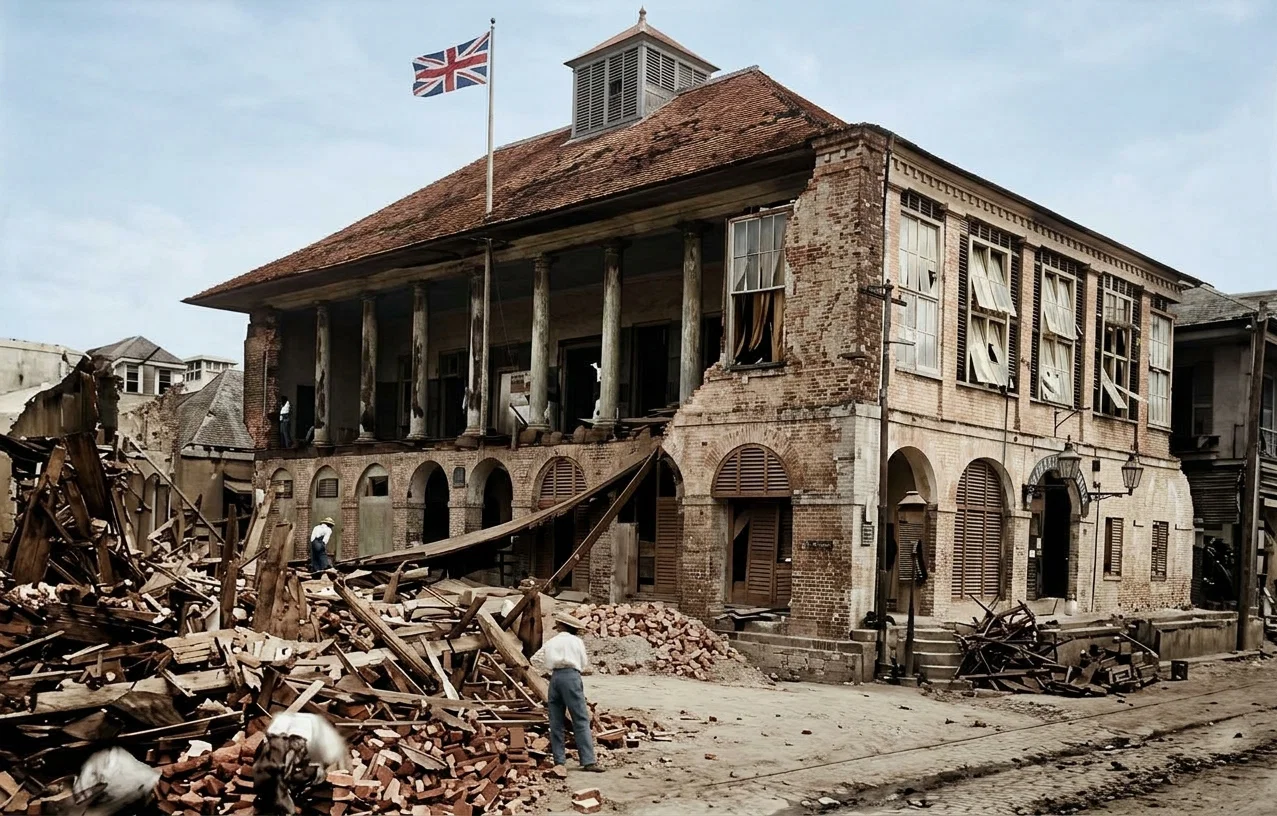
POST-OFFICE, KINGSTON, JAMAICA, WITH TOWN HALL ABOVE
A rational school of medicine, where young men and women could receive a practical training under Christian influence, would be a real benefit to the Chinese. It would do more toward breaking down the wall of prejudice than almost anything else. Other Christian organizations are recognizing this principle, and schools of higher learning and universities are being formed to train the young men and women for real, practical work, right in their own country. Yale University has started the nucleus for such a work here at Chang-sha. It, however, is not very popular, on account of the boycott on American institutions and manufactures in general. This kind of work takes time, patience, and a real work of grace in the heart. Of those taking this course of training, some would most likely become Christians. These should make efficient workers for the Lord.
May the needs of this great empire, with its more than four hundred million souls, speak to you; and God grant some may hear the Macedonian call, “Come over, and help us.”
Chang-sha.