The Meetings in Russia

7%

Review and Herald Publishing Association · Takoma Park Station, Washington, D.C. · Dec 27, 1906

FromReview and Herald, Vol. 83, No. 52.

Read the full edition

The Meetings in Russia

H. F. SCHUBERTH
As it was decided that Brother Ising and myself should visit the meetings in Russia this year, I left Zurich the evening of September 22, and was to meet Brother Ising in Berlin, whence we together would travel to Riga, where our first meeting was to be. From the reports in the newspapers, we knew that the conditions in Russia were not the most inviting, but we decided to go forward, trusting in the same God who had been with the three Hebrew children in the fiery furnace, and who had stopped the mouths of the lions, firmly believing that he still had a protecting care over his work and workers in these troublous times; and in this we are happy to say we were not disappointed. Each conference we attended was an occasion of special blessing from the Lord, and we were rejoiced to see that, in spite of the great difficulties that have had to be overcome, the truth has made good progress in each of the four Russian fields during the past year.
We reached Riga after two days and three nights on the train, and our meeting was from September 26-30. The conference was held in the recently rented hall occupied by the Riga church, which will seat about one hundred and fifty persons. Thirty delegates came from other parts of the North Russian Mission field. Most of these were Lettoniansand Esthonians, so that the Bible studies and business transactions had to be translated into these two languages. Aside from the Germans in the Riga district, there were but few Germans present, for in Volhynia, where the greater number of our German North Russian brethren live, there has been almost a total failure in the crops this year, so they could not secure the necessary means to attend. However, two men, one of whom was seventy years of age, walked over fifty miles to be present at the meeting, after which they walked back. Two other brethren, who came by train, were robbed of their tickets and purses. Another case showing the state of the city at the time might be cited: One of our sisters was on the way home after the evening meeting, in company with her ten-year-old daughter, when a policeman, without any cause, shot at them, and slightly wounded the child in both legs; she has since recovered. There was a general street-car strike, attended by violence and much throwing of bombs, and shooting on the part of the police, while we were holding our meetings; but nothing further happened to any of the brethren and friends that attended.
The outside interest was good, especially among the Lettonians, and every evening the hall was full. There are more calls from among the Esthonians, Lettonians, Germans, and Russians than our North Russian Mission workers are able to answer. We are happy that we could secure another Bible worker for the Esthonians, and a few colporteurs for the Russians, Germans, and Esthonians. However, the work among the Germans in Riga, Wilna, and in other parts, is somewhat neglected, as there are not enough laborers. There is an earnest call for another German worker.
It was at this meeting that we met Brother Itzmann, who had just finished his Russian head-master's examination, and was trying to secure a position where he could have the Sabbath free. He was invited to connect with the school at Friedensau, as Russian teacher. His father, who is not in the truth, opposed this. We had a season of prayer about it, and immediately after, of his own accord, the father gave his consent, and the young man prepared to go. The next day after his decision, he received an offer of a position at one hundred and fifty rubles a month; but he is now at Friedensau, and we hope that his experience there will be such that when the time comes for a school in Russia, we may have a properly qualified teacher to conduct it. As there are so many thousands of Jews in the North Russian Mission, we were happy that God brought to us a promising young man of that nationality, who is also now at Friedensau, to prepare for the Lord's work.
During the first three quarters of 1906, one hundred and thirty-one were added to our numbers in this field, by vote and baptism, making our membership five hundred and seventy at the present time. This field has a population of twenty-three million, and its list of workers is composed of three ordained ministers, two licentiates, two Bible workers, and six canvassers. Elder D. P. Gaede was again chosen director of the field.
Sunday evening, September 30, after having experienced considerable trouble in getting our passports arranged, we started for the place of our next meeting, the city of Bender, about an hour's journey from Odessa. This place contains twenty-four thousand people; and it is a noteworthy fact that, although the large majority of the inhabitants are Jews, yet up to the present time there have been no signs of a revolution. We arrived at Bender Tuesday evening, October 2. The South Russian meeting began the fourth, and lasted until the seventh. We were favored by nice summer weather, so that we could assemble out of doors, which was made necessary by the large attendance at the meetings—as many as five hundred being present, besides about one hundred and fifty of our own people. Many Jews came, and also a number of Russians. The Lord was in our midst. Special meetings were held for the native Russians, as they had a great many questions to ask us.
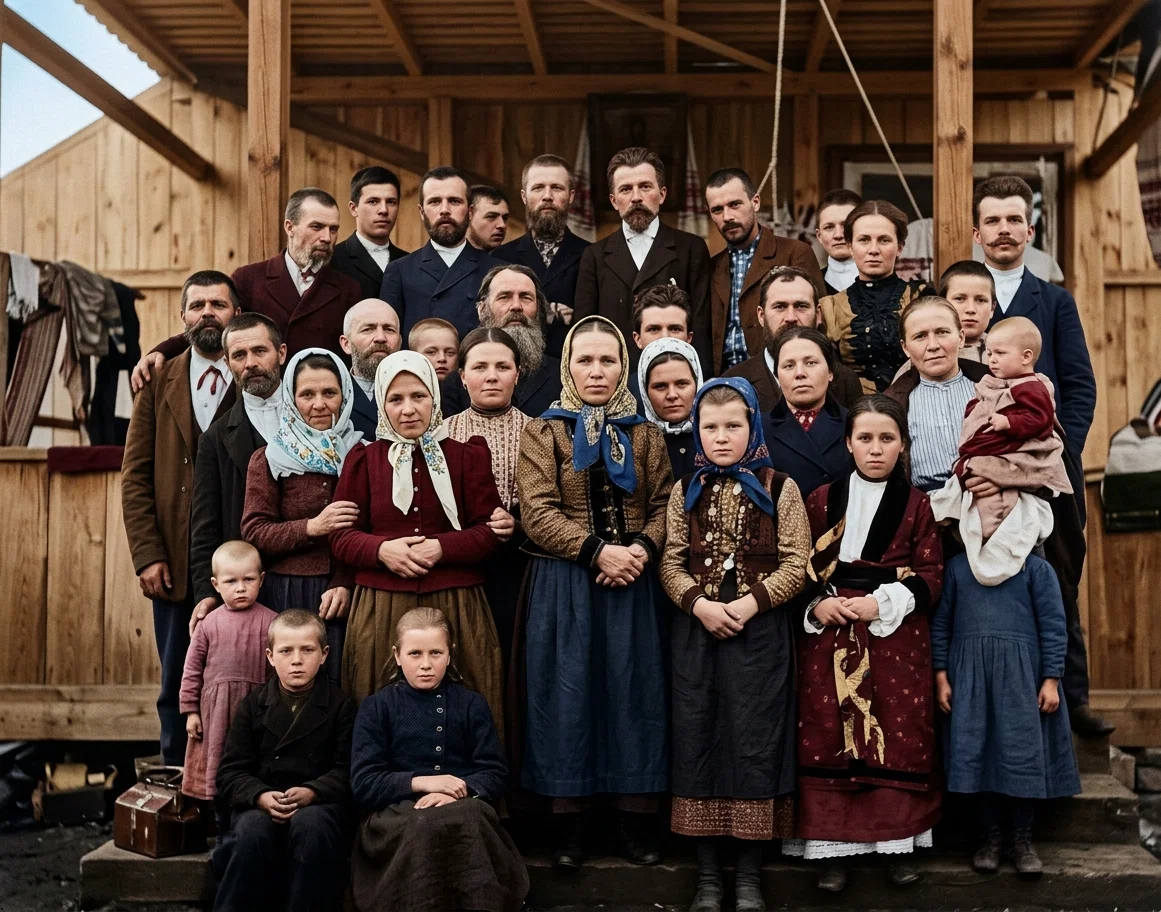
GROUP AT A GENERAL MEETING NEAR KIEF, RUSSIA
This was the first general meeting the South Russian Mission field ever held, as the field was organized at the beginning of 1906. They chose Elder D. Isaak as director of the field; and the other members of the committee are Brethren J. Perk, E. Albrecht, G. Fritz, and P. Thiessen. W. Schlegel is secretary; E. Creeper, treasurer; and W. Ising missionary and Sabbath-school secretary.
The brethren in session expressed their thanks to God for the favor with which the czar of Russia received our message of thanks for the liberty we now enjoy. They took a great interest in the educational question, giving about one hundred and fifty dollars for the educational work. They recommended that their members provide themselves with the books “Education” and “Ministry of Healing” that are now appearing in the German language, and do all they can to circulate our literature throughout Russia.
For the nine and a half millions of souls in this needy field, they have three ordained ministers, one Bible worker, and eleven canvassers who work all or a part of the time; eighty-one have been received since the beginning of 1906, making a present membership of three hundred and forty-seven in the South Russian Mission.
It may be also of interest to know that just now a great many persons are leaving Russia for Siberia. Some of our own people are doing this, too, and in one place so many had moved away that the church there had to be discontinued. However, as they carry the light of truth wherever they go, it will not be long before we shall have quite a goodly number of believers in Siberia. It is our plan to enter that part of the vineyard soon.
We trust that the friends of the message will remember the work and the workers and the people to whom the workers in Russia are sent, for we do not know how long the liberty we now enjoy may be granted to us.
Basel, Switzerland.