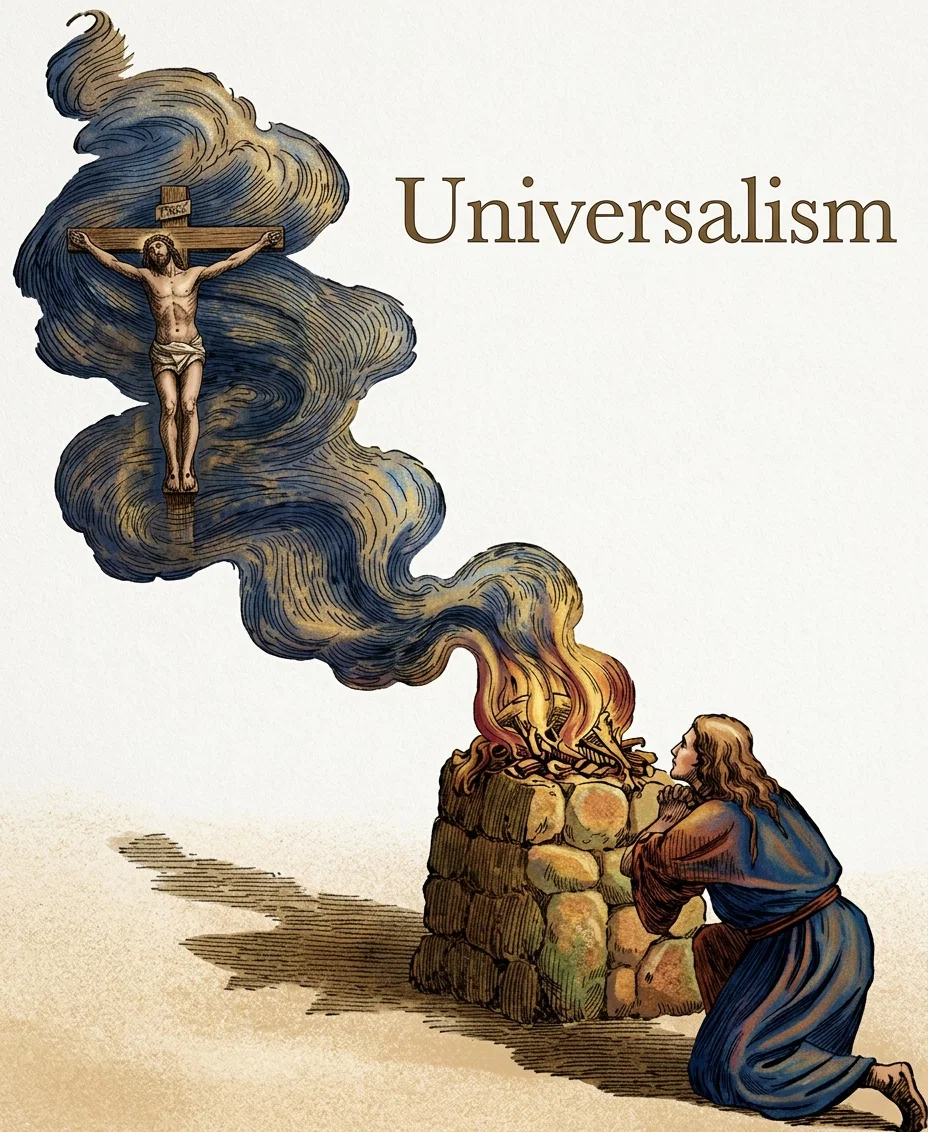
Some even in Paul's day thought that because Christ had died for their sins, they were no longer to regard the law of God. They considered being under the throne of grace as equivalent to making void the law of God. They preached that the love and mercy of Jesus had set aside the law of His Father. Well might Paul exclaim, “God forbid.” Rom. 3:31; 6:15. Yet these ideas are widely preached to-day when the claims of the law of God are urged upon the conscience; and many minds are darkened and confused thereby.
But that we cannot be true subjects of the throne of grace and be disobedient to God's law is very evident. The psalmist says of this throne, “Justice and judgment are the habitation of Thy throne; mercy and truth shall go before Thy face.” Ps. 89:14.
It is at the throne of grace that we find mercy. Heb. 4:16. But its foundation or habitation is justice and judgment, which cannot be if there is no law. In the typical sanctuary, the law of God graven on the immutable stone was just beneath the mercy seat, which was the cover of the ark, and with “the cherubims of glory,” represented the throne of grace, the glorious high throne that from the beginning has been the place of our sanctuary. In Ps. 85:10, we read, “Mercy and truth are met together; righteousness and peace have kissed each other.”
Truth and Righteousness
And again the psalmist says, “Thy law is the truth,” and “all Thy commandments are righteousness.” Ps. 119:142, 172. It is thus clear that the law, which is “the truth” and “righteousness” of God, is the very foundation of the throne of grace. And the law contained in the ark on earth was and is an exact copy of the law in the ark of the testament in the sanctuary in heaven. Rev. 11:19.
But as this law has accepted for the punishment of its transgression a Substitute in the place of the actual sinner, it has gone outside the boundary of its jurisdiction. The law is not made for a righteous man, but for the lawless; and of its own power, it can hold only those for whom it is made. Hence when it takes a righteous man in place of the sinner, it must meet the voluntary substitute on equal terms with itself. So mercy and truth meet together at the throne of grace; righteousness and peace, the peace that comes through justification by faith, have kissed each other.
But One Could Be Found
This is why, in all the universe, there was but one who could, in behalf of man, satisfy the claims of the law. He must be one equal with the law. No angel's life, whether Gabriel's or Lucifer's, can meet the penalty of the law for sinful humanity, or any portion thereof. Therefore Christ trod the wine press alone, while of people or of angels there was none with Him. And He did it “that the righteousness of the law might be fulfilled in us, who walk not after the flesh, but after the Spirit” (Rom. 8:4), and that He might be able “to declare His righteousness for the remission of sins that are past” (Rom. 3:25).
Again there are those who teach that this wonderful sacrifice of Christ is insufficient to atone for and dispose of the sins of mankind or even of the righteous, and another sacrifice is put in to meet the demands of the law for those who shall finally be saved.
Let us see. The sins of the whole world were made to meet on Christ. Isa. 53:6. If His death was not a complete satisfaction for the sins imputed to Him, what authority or right had He to come forth from the grave? Would not sin have held Him there? Or if we suppose He has risen with sin still imputed to Him, must He not then die again?
Took His Life
God forbid! The imputing of sin to Christ was not a mere theory. It was so terribly real that it took His life away. But when He had thus laid down His life, He was freed, or justified from the imputed sin of humanity; and according to the commandment He had received from His Father, He had the power to take up His life again. John 10:18.
Again, it is taught that the death of Christ atoned automatically for the sins of the world of all ages; that the whole human family was freed from sin to the fullest possible extent, so that no one of them, regardless of the way he treats his Saviour, will ever have to suffer for any of the sins for which Christ died. It is taught that when Christ died, the whole world died with Him the death that frees from sin.
Such teaching would spread this blessing over all the dives of infamy and all the palaces of sin in the world. But the word of God shows clearly that this is an error. The imputing of sins to Christ is not the removal of sins from mankind; for in the thirty-second psalm, God says: “Blessed is he whose transgression is forgiven, whose sin is covered. Blessed is the man unto whom the Lord imputeth not iniquity.” Paul, in Rom. 4:6, says that David, in the verses quoted, is describing “the blessedness of the man, unto whom God imputeth righteousness without works.”
But to whom does God impute righteousness without works? Verse 5 says that to him who “believeth on Him that justifieth the ungodly, his faith is counted for righteousness.” Then sin is imputed to every man—that is, the sins he commits right along every day—until Christ's righteousness is imputed; and this righteousness is imputed only to those who exercise faith, who “believe on Him that raised up Jesus our Lord from the dead.” Rom. 4:24. It is then plain that the death of Christ, except through the repentance of the sinner, did not take away the sin of the world. The human race as a whole was not thereby freed or justified from sin.
It is true that so far as the plan and purpose of God are concerned, all died in Christ when He died. For though it was Christ, and He alone, who died, the death He died was vast and broad enough, in the sight of God,
to answer for the death of all mankind; and all might, if they would, die into that death. “Know ye not, that so many of us as were baptized into Jesus Christ were baptized into His death?” Rom. 6:3. Thus it was Christ who died. Rom. 8:34. “He that is dead is freed [or justified] from sin.” In that Christ died, “He died unto sin once.” “Being raised from the dead,” freed from imputed sin, Christ “dieth no more; death hath no more dominion over Him.” Rom. 6:7, 10, 9. He is now our Advocate in the courts above. “If any man sin, we have an Advocate with the Father, Jesus Christ the righteous.” 1 John 2:1.
Authority to Give Righteousness
As our Advocate, Christ has the infinite merits of His sinless life and spotless sacrifice to present before the Father in our behalf. He “did no sin, neither was guile found in His mouth.” Hence for every sin sent up to Him by sincere confession, He can show the payment of the penalty by the wounds that our sins have made, paid by One who did not deserve to be treated thus, that the ones who did deserve it might, by the mercy and forbearance of God, go free.
To Christ, the Father has given the authority “to declare His righteousness,” through faith in His blood, “for the remission of sins that are past.” Rom. 3:25. From the throne of grace, all things that pertain to life and godliness are ministered by Christ to His people, to those who confess and repent of their sins, and believe on “Him that justifieth the ungodly.”
Freedom from sin is one of these blessings. But as in the type, it is a blessing obtained and retained on conditions. Those who confess and forsake their sins, and believe on Christ, can individually say by faith: I am “dead indeed unto sin, but alive unto God.” “I am crucified with Christ: nevertheless I live.” For “if Christ be in you, the body is dead because of sin.” Rom. 8:10. “And they that are Christ's,” that is, truly believe on Him, “have crucified the flesh with the affections and lusts.” Gal. 5:24. Then they are free from sin, and have peace with God through their Lord Jesus Christ. Yet in one sense, they are not entirely free from their sins; for as we shall see, sins, though forgiven, were not blotted out till the day of atonement, and were held again against those who proved untrue to their profession.
“Christ glorified not Himself to be made an high priest.” Heb. 5:5. He was called of God. To this call, He responded, “Lo, I come . . . to do Thy will, O God.” He became flesh. He learned obedience by the things that He suffered. “In all things it behooved Him to be made like unto His brethren, that He might be a merciful and faithful high priest,” able to succor the tempted. “And being made perfect, He became the author of eternal salvation unto all them that obey Him; called of God an high priest after the order of Melchisedec.” Heb. 5:9, 10.
His Offering the Antitype
Thus Christ entered upon His work as priest in the sanctuary above. And as the work in the type began with the daily service, so in the antitype; for those priests served “unto the example and shadow of heavenly things.” Heb. 8:5. Of Christ, Paul says: “Who needeth not daily, as those high priests, to offer up sacrifice: . . . for this He did6once, when He offered up Himself.” Heb. 7:27. This is a plain statement that Christ's one offering is the antitype of all the daily offerings of the Levitical priesthood, as well as the annual. Hence it is clear that Christ, at His ascension, began His work in the first apartment of the sanctuary on high.
(Continued from page 5)
This is the more evident from the fact that previous to the first advent of Christ, there was in the heavens no priest nor sacrifice, without which there could be no antitype of the service in the holy place of the earthly sanctuary; and the work there was not a shadow of that which then was, but it was a figure, or example, of that which was to be, of “good things to come.” Heb. 10:1. The whole sanctuary service in type pointed men to the future, to “behold the Lamb of God, which taketh away the sin of the world.”
In the holy place of the heavenly sanctuary, Christ ministered as our Forerunner and Advocate. For guilty men, He pleaded His divine sacrifice. All were invited to come boldly to the throne of grace. The gospel was preached in its fullness. Christ's disciples were filled with great joy; for by faith, they saw Christ, the propitiation full and complete for all their sins, sitting at the right hand of God, and declaring His righteousness for the remission of sins that are past, to every one who believed.
This was to continue, as in the earthly example and shadow, till the day of atonement, when a short, solemn, and decisive work should close up the plan of salvation, and the mystery of God be finished. What is the nature of this work? Have we reached the time? Has Christ begun His closing work as our Advocate? These are solemn questions, on which no one can afford to remain in ignorance.