Religious Influences in Japan—I

6%

Review and Herald Publishing Association · Washington, D.C. · Mar 29, 1906

FromReview and Herald, Vol. 83, No. 13.

Read the full edition

Religious Influences in Japan—I

MARIA L. EDWARDS, M. D.
It was my privilege to spend thirty-one days in Japan recently; and while visiting my sister, Mrs. F. W. Field, I spared no pains to become as familiar as possible with the conditions as they exist to-day. In this country are many places which are renowned for their ancient temples and shrines, some of which are from three hundred to five hundred years old. But I feel far more interested in the living than the dead, and hence spent my entire time in the cities of Tokyo, Yokohama, and Kobe, and the surrounding country, where I could come in contact with the schools, hospitals, and, in fact, with the people of to-day as they live and act and think.
Tokyo, the capital of the empire, covers about one hundred square miles of territory, with a population of about 1,500,000. Being the educational center of not only Japan, but also of the entire East, many of the bright young people of the Orient are there, and many of the later missionary efforts have been put forth there.
Yokohama is the seaport of Tokyo, and is eighteen miles distant, being connected by steam railway. An electric line is now being built between the two cities. Its population is 252,699. All the large ocean steamers stop here, and here are located offices of all these lines of steamers, as also offices representing many other lines of business, such as life insurance agencies, importers, and exporters. French, German, and English hotels are here, which are well patronized by the passengers, who spend their time on shore while the boats are loading or unloading their cargoes. The stores in Yokohama are far more like our own than are the queer little Japanese shops which are found in other cities less frequented by foreigners. Nearly all the clerks speak English fairly well, and they seem to know exactly the kind of silk, embroidery, hand-painted screens, shell work, velvet pictures, etc., that the foreigner will purchase.
Kobe is another seaport town, three hundred and seventy-six miles from Tokyo. It can be reached by rail or by boat. The trip by rail occupies the hours between 6 P. M. and 9:30 A. M. The population numbers 215,780. It is probably more foreignized than any other city in Japan, and as there is comparatively a large foreign population, our sanitarium was established there in 1903, under the direction of Drs. S. A. and Myrtle Lockwood.
To say that it is, indeed, a strange country with a strange people, does not fully express the facts. Things are so very different from what we have been accustomed to, and their tastes, desires, habits, lines of thought, etc., are all so different that I found myself daily studying the problem as to why we can notbetter understand their lives, and enter into their feelings, and why it has seemed so hard to bring them to an understanding and an acceptance of Christianity. I am convinced that when we know the religious influence, or, rather, the lack of Christian influences, in their past history, we can in part understand why their lines of thought and their standards of right and wrong are so different from those who have had a Christian ancestry.
Let us note the influences that have been at work in Japan in the past, and the influences of the present. This is made plain by Rev. D. B. Schneder, in his little book, "Japanese Buddhism."
This work shows why the Japanese people are standing just where they are to-day, and, also, why the time is now ripe to do a special work for that interesting people.
Buddhism is, and has been, the prevailing religion for many, many years; A. D. 552 is the year agreed upon when it first entered Japan. At that time there were possibly one hundred thousand people—hunters, fishermen, and farmers. The people were intellectually well gifted. Their prevailing religion was Shintoism, or the “Way of the Gods.” Its central thought was reverence and obedience toward the mikado, combined with worship of ancestors and of nature. It identified patriotism with religious devotion. Hence, doubtless, the unparalleled patriotism even of to-day; for to die for the country is a great honor.
Buddhism came by way of Korea, and the story runs thus: In A. D. 552 a Korean king sent to the court of Japan some golden images of Buddha, with some sacred books. The council called by the mikado to determine what should be done with them, fearing that the worship of foreign gods would be a dangerous insult to the native ones, decided to have nothing to do with them. But one of the ministers of state set up the images in his country residence, which was thus converted into the first Buddhist temple in Japan.
Soon after, the land was afflicted with grievous pestilence, and this was attributed to the wrath of the native gods. War broke out, the temple was burned, and the idols thrown into the river. Still greater calamities followed, seeming to indicate that, after all, heaven was on the side of the sun-gods. The tide turned. Priests and missionaries were invited over from Korea, and later emissaries came from China, and monks went to China to the fountain of the new faith. Emperors became patrons of Buddhism, and helped to build great temples and monasteries. Still, questionings as to the temple of the native deities caused some uneasiness, until the ninth century, when the great Kobo arose. He successfully brought the two together, through the supernatural discovery that all the Shinto deities were incarnations of Buddha, and, therefore, belonged to the Buddhist pantheon. The native deities were christened with Buddhist names, and the scheme was a success. Temples assumed a mixed character, and on the family shelf sat, side by side, Buddhist and Shinto idols, dispensing supposed favors to devotees with equal alacrity.
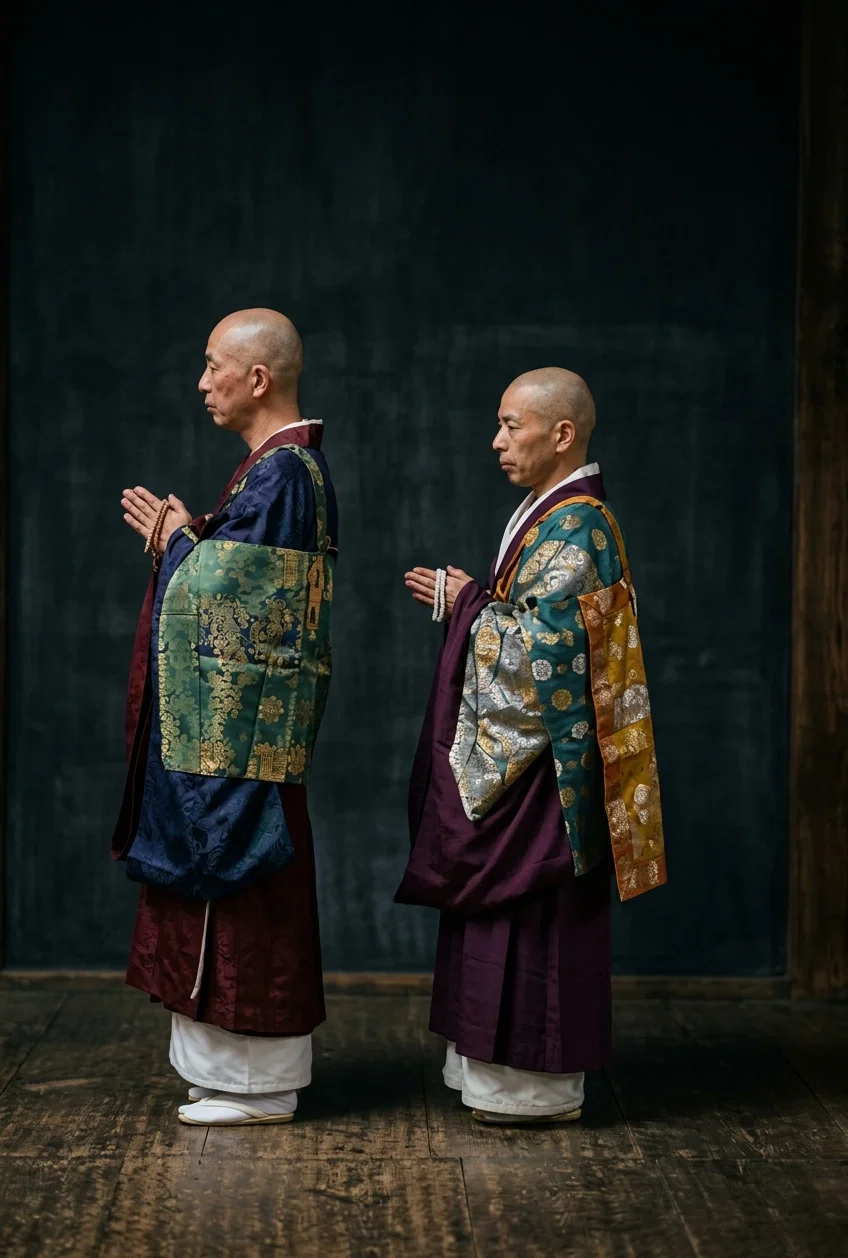
BUDDHIST PRIESTS
BUDDHIST PRIESTS
The history of Buddhism in Japan is a history of sects, which represent all sorts of one-sided emphasis on one or another element of Buddhist teachings, and all sorts of deviations therefrom. This inner history of Japanese Buddhism is interesting, not only for its own sake, but through the light which it throws on the religious tendencies of the Japanese mind; for in any country there is a process of interaction between the forces represented by the religion and the forces of the natural life.
Manifold ideas and practises have entered into the history of Japanese Buddhism, but certain elements, however, run through all the sects throughout the history of the faith: first, the transmigration doctrines, upon which Buddhism in all its forms unreservedly rests; second, pantheism, because of which gods represent forces, conditions, or principles, rather than distinct personal beings; a third, and less general feature, is the practise of religious contemplation, which requires that the subject sit for long periods quite motionless, legs crossed, hands in a certain position, the body erect,—as Buddha is nearly always represented,—mind fixed on vacancy, that Buddha might give an insight into deepest thought.
(To be concluded)
Moline, Ill.