R. W. MUNSON

6%

Review and Herald Publishing Association · Washington, D.C. · Dec 8, 1904

FromReview and Herald, Vol. 81, No. 49.

Read the full edition

R. W. MUNSON

Malaysia

R. W. MUNSON

“Behold my servant, whom I uphold; mine elect, in whom my soul delighteth; I have put my Spirit upon him: he shall bring forth judgment to the Gentiles. He shall not cry, nor lift up, nor cause his voice to be heard in the street. A bruised reed shall he not break, and the smoking flax shall he not quench: he shall bring forth judgment unto truth. He shall not fail nor be discouraged, till he has set judgment in the earth: and the isles shall wait for his law.” Isa. 42: 1-4.
More than twenty-five centuries ago God, by the mouth of his prophet, spoke these words of divine inspiration which have rung down the ages, and to-day are stirring the hearts of his covenant people to nobler efforts for the evangelization of the inhabitants of the island world.
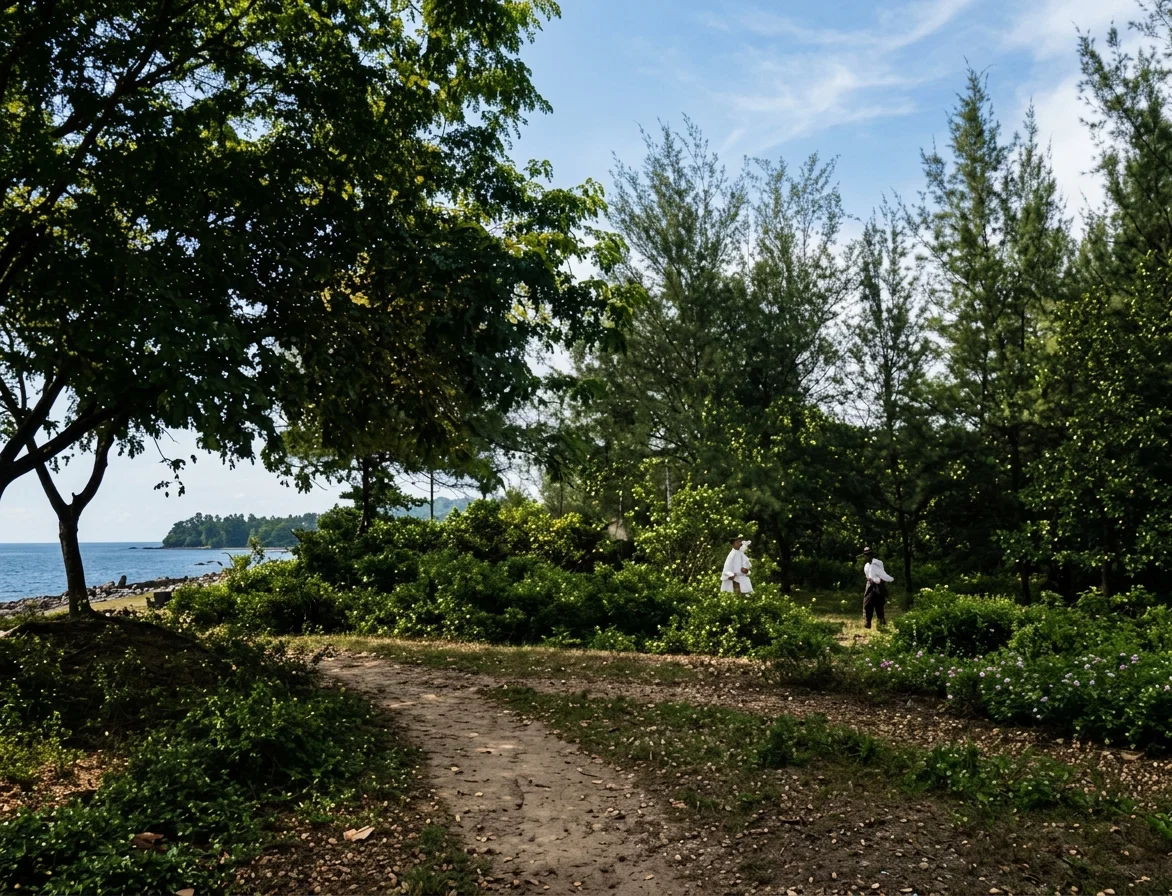
PARK SCENE, PADANG, SUMATRA
These promises are a great inspiration and comfort to those of God's children whose lot has been cast among these emeralds of the southern seas. God is not unmindful of his creatures, and he has a people among these simple island folk whom it is our duty to gather out as jewels for his crown.
Malaysia is of vast extent. Its islands are the largest in the world; indeed, they merit the dignity of the title of continents, as some of them are. It includes in this class New Guinea, Borneo, and Sumatra. Following these are the lesser islands, such as Java, Timor, Bali, Celebes, Luzon, Mindanao, and the groups, Moluccas, Philippines, and ten thousand lesser isles.
Malaysia extends nearly four thousand miles east and west, from ninety-five to one hundred and fifty-five east longitude. Its breadth north and south at its widest part is nearly two thousand miles, from nineteen north to ten south latitude, and includes 1,365,000 square miles of land area, and is spread over about four million miles of the earth's surface.
Its population approximates fifty million, more than half of whom are found in Java alone. This comparatively small island, not more than half the size of New Zealand, has thirty-three times its population. It is difficult to believe that so small a space, only fifty thousand square miles, can maintain in comfort such a mass of humanity; but that is what it seems to do, and the conditions must be very favorable, as the population has doubled once in every twenty-five years since the beginning of last century.
In speaking of the dimensions of the large islands, it is necessary to give something more than figures to aid the imagination in grasping their true magnitude. Both New Guinea and Borneo are more than three times the size of New Zealand, or about one tenth the size of Australia. If we took a steamer, and sailed at the rate of ten knots an hour, it would take us a fortnight to circumnavigate Borneo, providing we did not stop to coal or take in provisions.
The general topography of all these islands is a central backbone of mountains, skirted by gradually descending plains to the sea. A great volcanic belt runs throughout the entire length of the archipelago, containing scores of active volcanoes, and hundreds of extinct ones. On both sides of this line of fire, rich, fertile hills and plains slope away to the limpid waters of a shallow sea. A great part of this region is under cultivation, and produces rich crops of pepper, nutmegs, sugar, coffee, tobacco, rice, rubber, manila, hemp, gambir, rattans, cocoanuts, damar, cinchona, cloves, cinnamon, and other articles of lesser importance. Rattans and rubber are jungle products, and not the result of cultivation.
A missionary who has spent manyyears in the East Indies, and who has traveled, says of them: “Taken as a whole, the islands are exceedingly beautiful and fertile. Their beauty is gorgeous, and its like is unknown outside the mid-tropics. The waters amid which they lie are mostly shallow; and the deep-green tints of the ocean, the perennial verdure of the islands, the opaline tints of the lofty mountain tops, and the gloomy azure of the oftentimes cloudless sky present to the eye of the admiring traveler such a scheme of color as the earth can scarcely duplicate.”
There are many considerations that lead to the belief that this entire region was in the remote past connected on the west with the continent of Asia, and on the east with Australia, the dividing line between the two parts being between the island of Borneo and the Philippines on the west, and the Celebes and Moluccas on the east. The chief grounds for this belief are the similarity between the races of men and animals that are found, on the one hand, in Southern Asia and the western half of the archipelago, and between those of the eastern half and Australia, on the other. On the west are the straight-haired Malayan type, and on the east the long, crinkly haired Papuans.
The animal life is abundant and varied. The most important are the elephant, tiger, hippopotamus, rhinoceros, tapir, orang-outang, monkeys of many kinds, armadillo, peccary, deer-pig, moose-deer, and water-buffalo. Of the reptiles there are alligators, pythons, and many species of snakes, the giant lizard, and a vast number of smaller creatures peculiar to this latitude, and of great interest to the naturalist. The lakes and streams, not to mention the sea, swarm with wonderful specimens of the finny tribe, whose gorgeous coloring and fantastic forms outstrip the imagination in its unaided flights. There are prawns, crabs, giant turtles, and shell fish in great variety. The tortoise shell of commerce, if genuine, comes from the back of a large turtle that is common here. It grows in large loose scales, which are removed by pouring hot water over the backs of the turtles.
When the beholder sees these wonderful and weird creatures of the deep, darting in and out among the still more wonderful forests of tiny coral and flowers of surpassing beauty, he is led to exclaim, “How wonderful are thy works, O Lord, in wisdom hast thou made them all.”