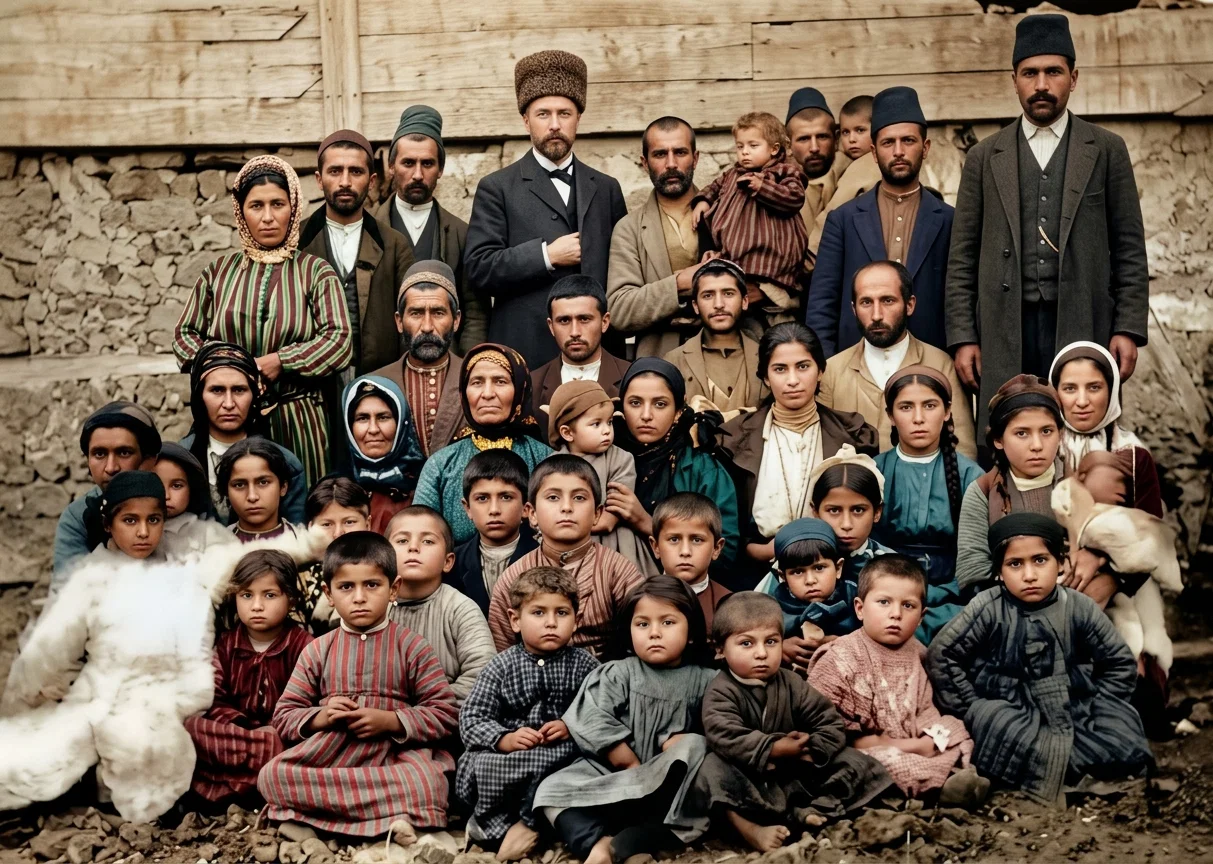
ACCOMPANIED by our medical missionary, Sister Snedjian, as interpreter, the writer has visited the different groups of Sabbath-keepers in the provinces of Brusa and Bithynia. During our visit last year we had some difficulty in getting permission to travel, and in two places found positive and firm resistance. This year we are glad to report, however, that the Lord opened the way for us to go forward with unusual freedom.
A GROUP OF ARMENIAN ADVENTISTS
In Constantinople we had a profitable meeting, with Brother Conradi in attendance. We then went to Bardizag, an Armenian town of ten thousand inhabitants remaining there one month. We presented the message of righteousness by faith every night to attentive audiences, sometimes numbering one hundred. The last week of our stay we connected with this the testing points of the faith, which some of the hearers could not bear, and showed their displeasure by breaking some of the windows in the lower story of our house. The brethren feared government interference if the disturbances should be repeated, and we decided to move on to another place, rather than to be sent out of the province altogether. After baptizing a sister, we went to Ovajik, where we have a company of about thirty.
In Ovajik the two local district elders had become somewhat discouraged, through false accusations, which caused them to resign. We remained ten days, holding also a general meeting for the district, with the happy result that the wounds were healed, and the two discouraged brethren were unanimously re-elected to their respective positions.
From this place we proceeded to Nicomedia and Ada Bazar. In the latter city we heard that enemies were waiting for an opportunity to accuse us to the government, so we decided to go first to a Greek village in the vicinity. Here some of the brethren had made preparations to plant tobacco, pleading that other crops had been a failure. We held a study touching this unclean and destructive plant and its withering physical and moral effects on mankind, based on science and the Bible, quoting among other scriptures 2 Cor. 6:16, 17, and Rev. 18:4. “Ye are the temple of the living God; . . . wherefore come out from among them, and be ye separate, saith the Lord, and touch not the unclean thing.” I am glad to report that all but one, who was farming on shares with an unbeliever, accepted the call not only not to touch, but also not to multiply, the unclean thing.
They also acknowledged that there are sometimes spiritual reasons for the failure of crops, and that, as Prov. 26:2 says, “the curse causeless shall not come.” After studying Mal. 3:8-12, one of the brethren testified that three years ago he quit bringing all the tithe into the storehouse, and from that time his crops failed. In the first two years he reaped less than he sowed, although the adjoining land of his neighbors yielded a bountiful harvest, thus fulfilling verse 9 and Haggai 1:1-11. Last year he determined to give the Lord his own, and the result was a good harvest. Even his wife, an unconverted woman, was moved upon by this experience to pay the tithe of her own income.
In this village the children surrounded the house on one of the holy days, and began shouting, which attracted a large crowd. They forced themselves into the house which we occupied, talking and gesticulating wildly. It seemed to us that these people were re-enacting the scenes of their forefathers in Ephesus, for the greater part knew not the reason why they were come together. Acts 19:32. The greatest confusion prevailed for a time; but the Lord heard the prayers of his people, and after about two hours they dispersed.
We then went to Ada Bazar. A member of the Protestant church offered his house, as ours was small, and did not have seating capacity sufficient for the people who desired to hear. We held three well-attended meetings in this house; but during the third, some young men raised a disturbance, which caused us to transfer the meetings to Tomluch, five hours’ distant. We remained three days with our brethren there, and returned to Ada Bazar, holding several meetings in another part of the city. We left for Nicomedia, holding one meeting there. Going to Bardizag, we accepted one sister by vote. The next day we started overland, in the saddle, for Shagshag. We could have gone by steamer in a much shorter time, but we would have been compelled to pass the police at the port, who prevented us from visiting the place, after repeated attempts, last year. Although the port was in sight of us all the time, we remained ten days in Shagshag without any opposition from the authorities, owing to the fact that the people of the village were friendly to us, and did not report our work.
From Shagshag we went to Kolutsh Kay (Sword Village), where we baptized one sister, the wife of an officer. Although we have only four members, about forty persons attended our meetings. One morning an impromptu meeting was announced. A woman who had manifested a good interest the evening before heard of it while kneading her bread. In her haste not to lose a word of the lesson, she neglected to wash her hands, and appeared in the meeting apparently unconscious of the dough upon her hands, until her attention was called to it by her friends. This woman has given satisfactory evidence that she esteems the bread of life more than the bread that perishes.
We had a new experience in holding the ordinances. In order to baptize the sister, we were compelled to go quite a distance from the village. And as we wished to reach another town before night, we held the ordinance of humility by a flowing brook. At night we arrived in an Armenian village named Karze (Stone Village), at the entrance to a rough, mountainous region. Among those who attended our meeting was a young man who had withstood our brethren for some time. He was especially displeased with a young brother who had recently connected with the company. After the service this opponent joined our brother on the way, and tried to persuade him to give up his obedience to the Sabbath. When his words proved powerless to persuade, he drew a dagger,14trying compulsion. The brother deftly grasped the weapon, and in the struggle that ensued managed to get it into his possession. Not wishing to hurt his assailant, he threw it into a field, where he found it early the next morning. We then took it to the ruler of the place, who remarked in a cold-blooded manner, “It is a shame for the young man that he allowed his weapon to be taken from him.” Apparently he did not see the necessity of condemning the horrible assault, but rather the awkwardness of the young aggressor. In this region, and, in fact, in all Turkey, it is customary to go armed while traveling. Among the majority, he who knows how to handle his weapons best is considered a truly great man, in the fullest sense.
From this place a ride of nine hours over the mountains brought us to Sel-louz, where we have some faithful and well-proved brethren. They have repeatedly suffered persecution, and to-day stand as faithful sentinels and witnesses in the district where the great Council of Nicæa was held in A. D. 325. After remaining with them five days, we left for the nearest government town, in order to have our papers arranged by the authorities. The kai-makam (ruler of the district) had a long talk with my interpreter, relative to our faith; and from the intelligent questions which he asked, we could discern that the Lord was working upon his mind to acquaint him with the great events which are to take place soon.
We took a carriage to Broussa, a city of about one hundred thousand people, eight hours’ distant. Broussa is noted for its natural hot baths, its beautiful silks and celebrated Turkish towels, and for being the first capital of the Osmanlis. We visited the different American missionaries, who have had good success in educational work. Here we have a small company of witnesses for the third angel’s message. As we found a good interest to hear, it was decided that the interpreter should remain for some time, while the writer proceeded to Constantinople. In the latter city we had the pleasure of seeing several meetings well attended, although at the time all gatherings were strictly forbidden.
In all these places we have seen grand opportunities for consecrated medical missionary workers. At present it is very difficult for ministerial workers to labor in this field, as meetings are forbidden everywhere. But we are glad to report that many obstacles placed in the way of ministering the word disappear before the intelligent and energetic nurse.
After a tour of four months, the writer reached his home in Palestine, where he met with a Syrian brother who had just arrived from America with the intention of presenting the third angel’s message to the Arabic-speaking peoples of Syria.