Every reasonably practical movement toward promoting world peace is eagerly watched by all who have the welfare of humanity at heart. And of the eight hundred peace organizations earnestly endeavoring to insure the ultimate recognition of justice and world peace, none is more conspicuous and impressive than the League to Enforce Peace which held its first assemblage in Washington, D. C., May 26 and 27, and of which the Hon. William Howard Taft is president. A full report of this significant conference will be given by Dr. Olsen, who also attended the last Hague Peace Congress. In the next article, addresses of men of national and international fame will be presented, discussing the world problems involved, the relation to the labor movement, and to the Monroe Doctrine. The title will be, “A Declaration of Interdependence.” EDITOR.
The World Cry for Peace
A Proposed League to Enforce It
By M. ELLSWORTH OLSEN
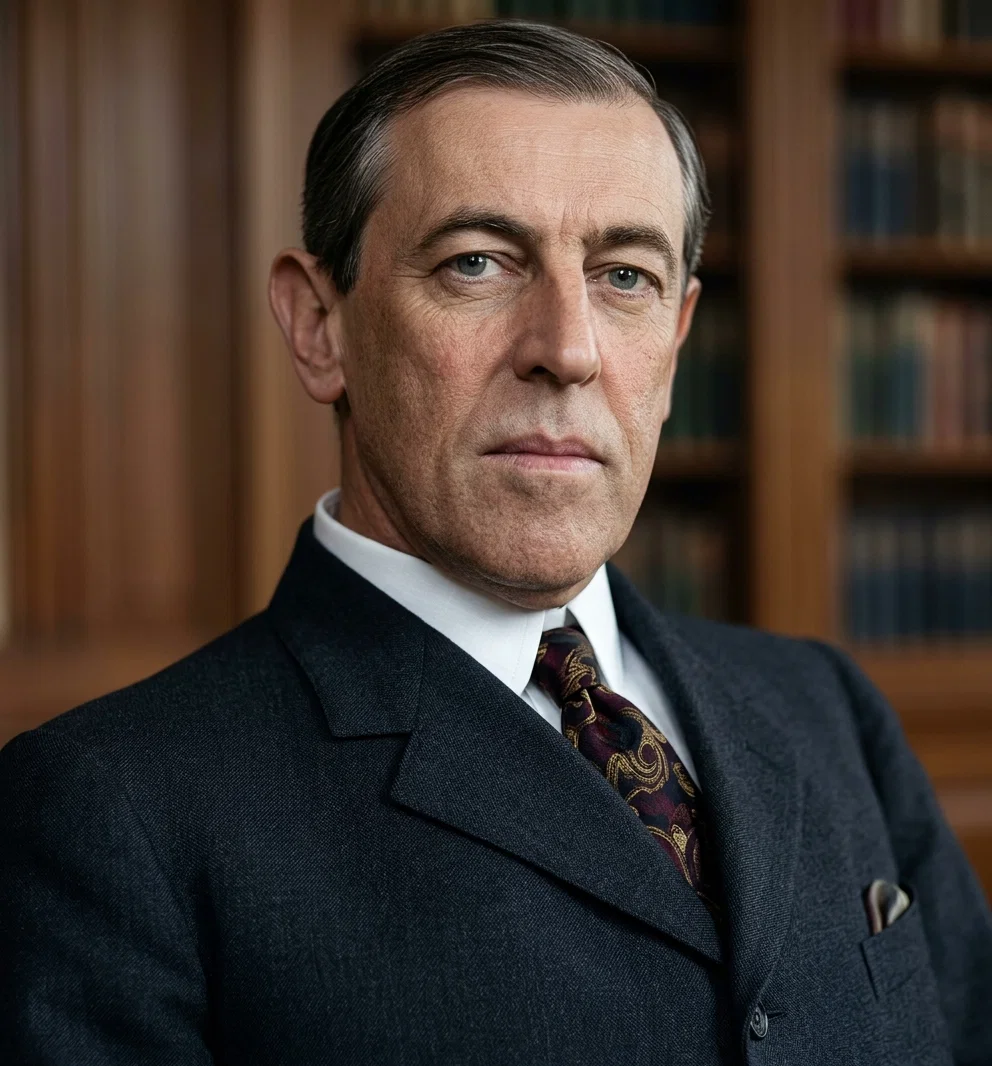
THE HON. WOODROW WILSON, PRESIDENT OF THE UNITED STATES
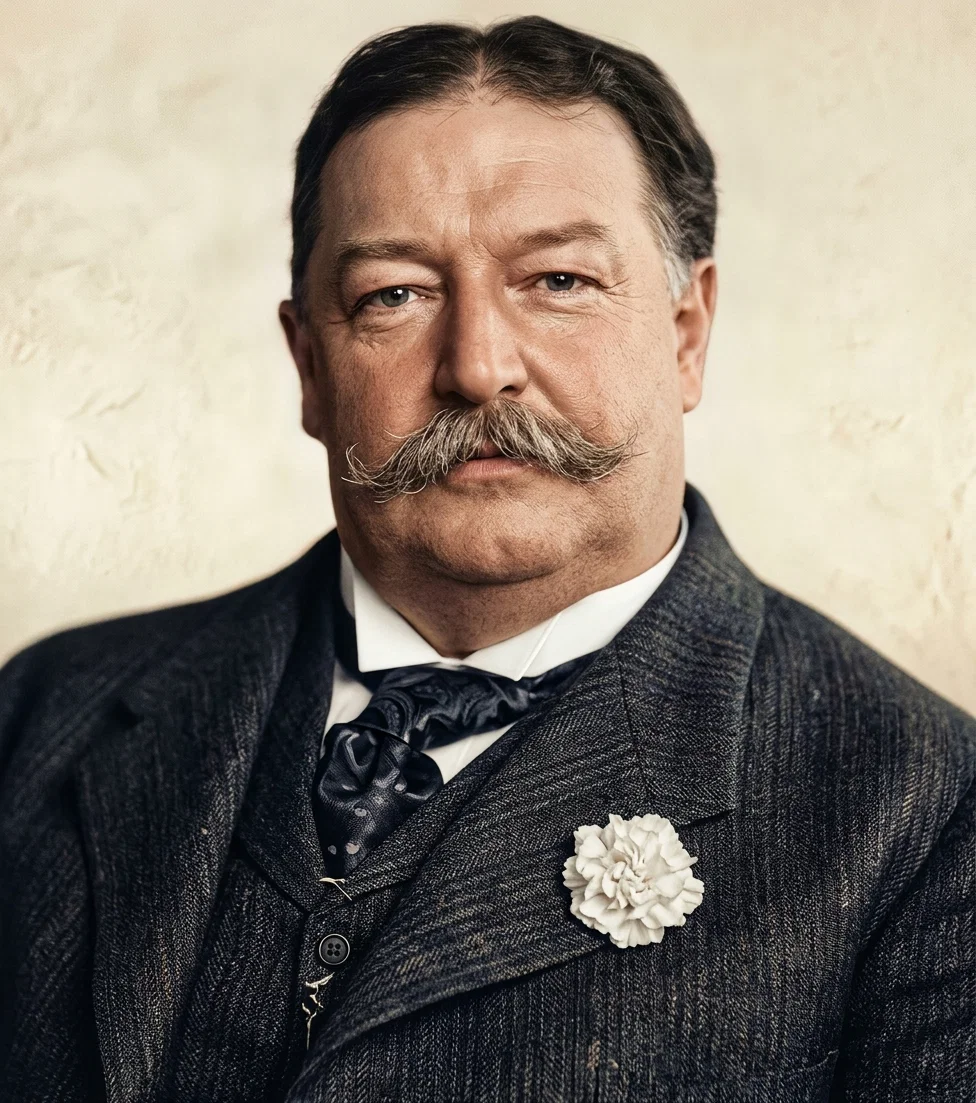
THE HON. WILLIAM HOWARD TAFT, PRESIDENT OF LEAGUE TO ENFORCE PEACE
EIGHTEEN years ago, in the summer of 1898, the young czar of Russia startled the world with his proposal for an International Peace Conference and the reduction of armaments. The conference was held at the Hague the following year, and attended by representatives of twenty-six states, and one of its results was the formation of a Court of Arbitration for dealing judicially with such matters as the nations might submit to it.
The second Hague Conference, held eight years later, in 1907, and attended by forty-four states, then practically the whole civilized world, devoted its attention chiefly to strengthening the work of the first. It set out five different methods of adjusting international difficulties without recourse to war: First, the powers signing the convention agreed in general to use their best efforts to bring about the peaceful settlement of all outstanding difficulties. Secondly, in case of serious disagreement, recourse was to be had to the mediation of one or more friendly powers. Thirdly, the powers agreed that it should not be regarded as an unfriendly act if one or more powers not involved in the dispute should, on their own initiative, offer their mediation to the states in disagreement. Fourthly, in disputes involving national honor or vital interests, the nations not able to come to an agreement by means of diplomacy, should institute an international commission of inquiry to render a solution easier by a full investigation of the facts. Finally, arbitration was recognized to be the most equitable means of settling disputes of a legal character.
Both conferences made certain declarations and suggestions which were not agreed to by all the important powers, but the foregoing statements were generally accepted. The question of limitation of armaments was taken up at the first conference, but was waived when the military representative of Germany refused to consider it. It was also waived at the second conference. Thus the chief object assigned for holding the conference was definitely set aside for lack of necessary agreement.
Peace Advocates Disillusioned
How far the general principles that were adopted have been followed in the years that have elapsed since the holding of these conferences, the reader may judge. The Boer war, the Russo-Japanese conflict, the war of the Balkan powers, and the present great European war, vastly overshadowing every previous conflict, have all broken out since the holding of the first Hague Conference.
Peace advocates, if not utterly discouraged, have at least been disillusioned. Evidently the idea of universal peace effected and maintained wholly by moral suasion is not a feasible thing. There must be an element of force in the program in order to make it practically operative in a world made up like the present one. This is what is attempted in the league whose first annual meeting is the subject of this article.
When the present war broke out, a year ago last summer, the Independent began to urge editorially the formation of a great world league to enforce peace, as the one practical means of maintaining international equilibrium. Other friends of peace who saw the weakness of previous attempts in that they lacked the element of force, began to think along similar lines; and the outcome was a meeting held in Independence Hall, Philadelphia, a year ago on the seventeenth of June, at which the League to Enforce Peace was brought into existence. A permanent committee was appointed, with Ex-president William Howard Taft at the head, and President Lowell, of Harvard University, as chairman of the executive committee.
Principles of the League
THE league thus organized has expressed its fundamental principles in these words: “We believe it to be desirable for the United States to join a league of nations binding the signatories to the following: “1. All justiciable questions [that is, questions involving only such issues as may be decided by the rules of international law] arising between the signatory powers, not settled by negotiation, shall, subject to the limitations of treaties, be submitted to a judicial tribunal for hearing and judgment, both upon the merits and upon any issue as to its jurisdiction of the question. “2. All other questions arising between the signatories and not settled by negotiations, shall be submitted to a Council of Conciliation for hearing, consideration, and recommendation. “3. The signatory powers shall jointly use forthwith both their economic and military forces against any one of their number that goes to war, or commits acts of hostility, against another of the signatories before any question arising shall be submitted as provided in the foregoing. “4. Conferences between the signatory powers shall be held from time to time to formulate and codify rules of international law, which, unless some signatory shall signify its dissent within a stated period, shall thereafter govern in the decisions of the judicial tribunal mentioned in Article One.”
With this simple statement of its principles, the league has been gradually organizing in the various states; and at this its first annual meeting, there were in the neighborhood of two thousand delegates who signified their intention to attend. The purpose of the gathering was to give a clear setting forth of the objects and scope of the organization, and lay some definite plans for the further promulgation of its principles, with a view to educating the people of this country to take an intelligent part in the reorganization of Europe, and in fact, of the world, which is likely to follow the present war.
The conference convened in the Belasco Theater, just across from the White House, Friday morning, May 26, and closed with a banquet on the following night. The delegates were representative men from all parts of the United States, some being sent by the governors of the various states, others coming at the invitation of the executive committee. There were presidents of colleges and universities, diplomats, members of Congress and of state legislatures, publicists, members of the Cabinet, and a number of prominent business men. All together, it was a meeting long to be remembered for the high moral tone that characterized the speeches, and for the fine enthusiasm and420love of humanity manifested by the delegates generally.
Modest Claims Put Forth
THOMAS RAEBURN WHITE, a lawyer of Philadelphia, gave the opening address, in the course of which he mentioned certain objections that had been brought against the league. Incidentally he pointed out that the claims put forth were modest ones.
“No one contends,” he said, “that the program of the League to Enforce Peace is perfect; no one believes that it will abolish war instantly, even among its members; but that is no reason for refusing its support. We do not condemn our educational systems because they have not put an end to illiteracy, or our religious or moral institutions because there is still evil in the world—we try to make these institutions better. The question is whether the establishment of the program of the League to Enforce Peace will on the whole tend to prevent war, and tend to promote harmony and good will among nations. If so, then we should give it our support. There can be no doubt that it will be of value in the great world movement toward a permanent organization among nations, which will some day provide for the suppression of international disorder as promptly as disorder is now suppressed in the best regulated communities.”
Isolation Henceforth Impossible
EDWARD A. FILENE, a Boston merchant, and a director of the Chamber of Commerce of the United States, showed how vitally America is related to Europe and the rest of the world in a business way.
“This war has emphasized the fact that the United States has become a world power. It has compelled America suddenly to think in terms of world civilization. Carefully sheltered from the recurrent storm and stress of European politics by our geographical location and our traditional policy of isolation, we have, as a nation, grown both powerful and rich; but the war has shaken down about our ears the House of Isolation. We have learned that isolation from world affairs is henceforth impossible, and that cooperation in world affairs is imperative. But we are groping for a program. The bigness of world demands makes hesitant a nation accustomed to national demands only.”
“International problems,” the speaker went on to say, “are fundamentally the same as individual problems, except they are bigger. To find a program for relations between nations, we need but to apply the principles of enlightened relations between men. In fact, I know no better guide for American action in the present crisis than a very old story about the duty one individual owes another. The story is familiar to you.”
Ridding Jericho Road of Outlaws
THE speaker here quoted the parable of the Good Samaritan. “To-day,” he continued, “the world is wounded. Civilization has fallen, bruised and beaten, by the roadside. There are only a few nations far enough removed from the conflict to be able to go in peace along the highway. Of all these nations, we are the most powerful. The United States may take either of two attitudes in the present crisis. Like the Levite, it may do the selfishly safe thing, preserving merely its own comfort and safety; or like the Samaritan, it may let the unfortunate situation in which the world now finds itself awaken it to the truth that strength owes a debt to weakness, and that order owes a debt to disorder.”
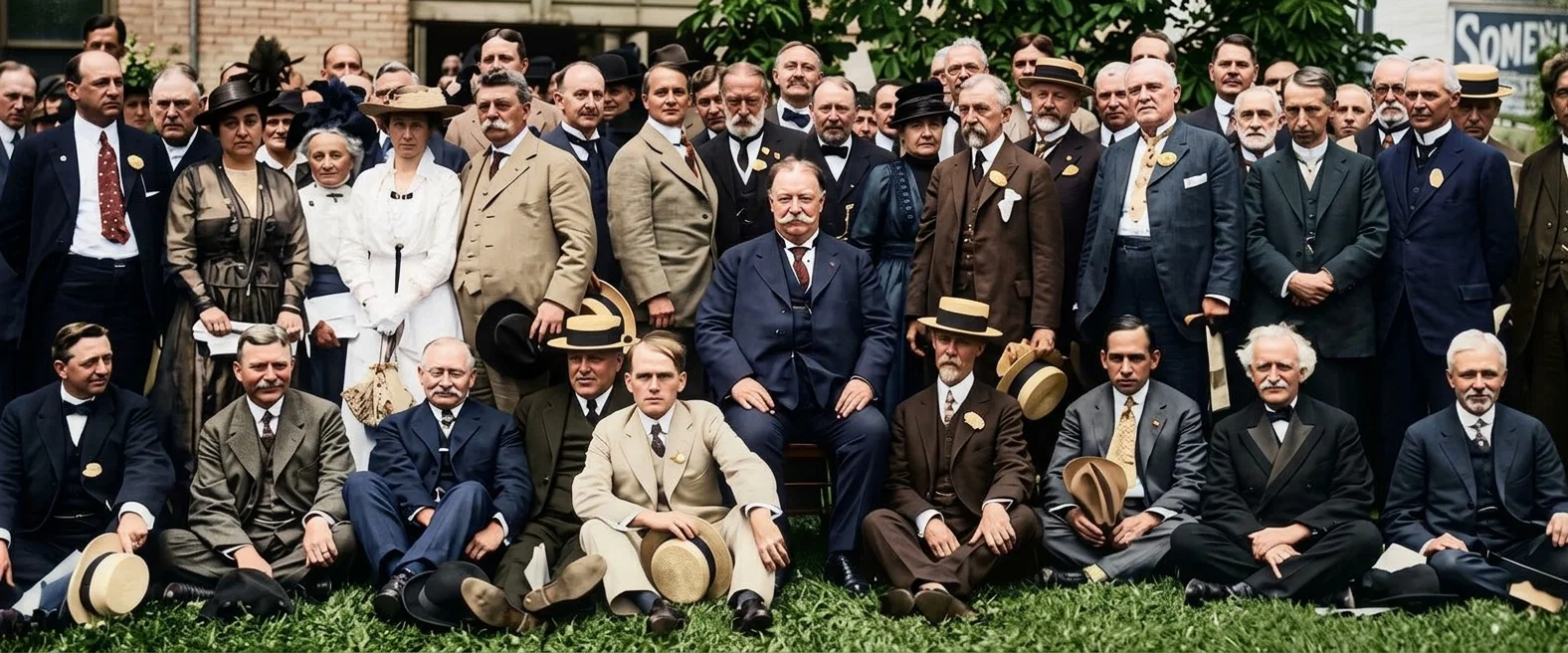
A FEW OF THE PROMINENT MEMBERS OF THE LEAGUE TO ENFORCE PEACE, GROUPED ABOUT FORMER PRESIDENT TAFT, WHO WAS RE-ELECTED PRESIDENT OF THE LEAGUE
“We have come to a time when the Good Samaritan is, in theory at least, accepted as an illustration of the minimum social responsibility that any civilized man must accept. The Good Samaritan is the classical example of remedial charity prompted by pity. The millions of dollars we have given to relief funds might indicate that the United States has adequately played the rôle of the Good Samaritan; but I am convinced that were this parable stated to-day, it would not limit the action of the Good Samaritan to dressing the wounds and paying the hotel bill of the victim, but would have him start a practical movement for ridding the Jericho road of outlaws, instituting adequate police protection, and making the road a safe avenue for travel. In other words, remedial charity is no longer a complete answer to give to suffering. We must add preventive measures.
Arms for Defense of Peace
“EVERY counsel of wisdom urges us as a nation to stand upon this platform. It is sound business policy. A peaceful world makes possible a permanently prosperous America. It is sound political policy. It will mean for us a foreign policy under which we shall consciously assume that responsibility in world affairs that duty demands. It will mean for us a domestic policy that will clarify many of our vexed questions. If we unite upon this program, all differences about the degree of preparedness necessary will be easily adjusted; for if we should adopt as our slogan ‘National Preparedness for International Peace,’ every man and woman in America would feel it to be not only a duty but a privilege to prepare themselves to do their share in preserving the peace and order of the world. The fear of militarism would be removed; for if we pledge our arms to the defense of the peace of the world, and agree to submit our disputes to an International Court before declaring war, we thereby protect ourselves against the possibility of our ever waging a war of conquest, and make impossible our hasty entrance into any war.”