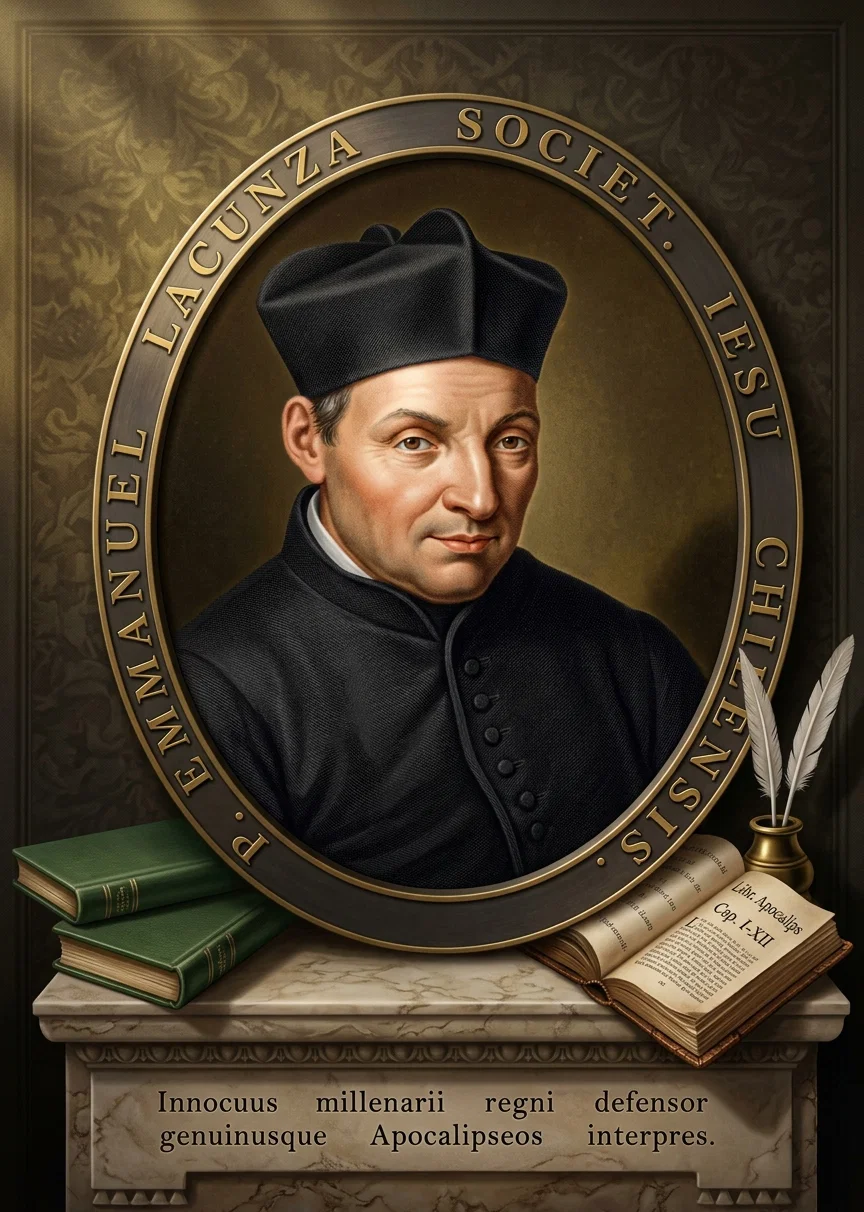
FOR a full third of a century, from 1767 to 1801, in the picturesque old walled town of Imola, in central Italy, there lived a humble Jesuit priest, Manuel Lacunza by name, whose study of Holy Scripture, and particularly of the prophecies of Daniel and the Revelation, was destined to throw much light on the teachings of God’s word with regard to the second advent of Christ.
The age in which Lacunza studied and wrote, has been characterized by an observant clergyman of the Church of England, the Rev. Edward Miller, one-time fellow and tutor of New College, Oxford University, as a period of uneasy desire for a change in the established order of things. “People began to ‘look up and lift up their heads,’ thinking that their ‘redemption was drawing nigh.’” This led to “an eager study of Holy Scripture. . . . And as men were then looking forward, the study of prophecy in particular attracted a great deal of attention.”
“The way had been paved for this,” continues Mr. Miller, “in the works of Sherlock, Newton, Horsley, and Lowth, following upon those of Mede in the seventeenth century. These abounded with general principles ready for application. And now many minds were engaged in finding out modes of adapting the pictures drawn in the Revelation, or in other parts of Holy Scripture, to the events of the age, and in discovering signs, as they supposed, of the approaching end of time.” (“Irvingism,” volume 1, pages 9, 10.)
Light Through a Chilean Jesuit
THE time had arrived for a much clearer comprehension of the prophecies than had hitherto been gained by Biblical scholars; and among those to whom God gave special insight and sound judgment in the interpretation of the books of Daniel and the Revelation, was Manuel Lacunza, the studious recluse of Imola.
Born at Santiago de Chile, South America, July 19, 1731, of noble though not very rich parents, Lacunza had the advantages of as liberal an education as was afforded by the schools of Chile nearly two centuries ago. At the College of the Jesuits, in Santiago, he made good progress in the study of philosophy and theology; and in 1747, he became a member of the Society of Jesus. Later, “he was appointed to the superintendence of the novitiates, in which situation he showed his zeal for the spiritual good of the young people under his care.” (See P. Enrich’s “Historia de la Compañía de Jesús en Chile,” volume 2, page 495; also a recent monograph, by M. R. Urzua, “El P. Manuel Lacunza,” pages 5-7.)
While in Chile, Lacunza took particular pains to instruct the common people publicly in Bible themes, and was held in good repute as a preacher. But in the midst of his labors as a teaching priest, he was suddenly removed far from the scene of his activities. Without warning, and without any apparent reason, Charles III of Spain had sent into all his colonies sealed dispatches, to be opened everywhere on the same day, April 2, 1767, providing for the immediate expulsion of all Jesuits from his realm. Thus Lacunza was compelled to leave his native land, and seek refuge in Italy. Yet by the Lord’s providence, the calamity that had befallen him was turned finally into a wonderful blessing; for Lacunza, living “in retirement, avoiding society, conversing only with his books,” was thus enabled to produce, as the fruit of long study and meditation, a masterly work on the second advent of Christ, which afterwards exercised a profound influence on the minds of students of prophecy in many parts of the world.
A Noteworthy Publication
LACUNZA’S exposition of scriptures bearing on the second advent, was circulated first in manuscript form. Some years after his death, which occurred in 1801, the manuscript, considerably abridged, was printed “at the Isle of Leon” (Cadiz, Spain, 1812). The two small octavo volumes bore the title, “Venida del Mesias en Gloria y Majestad” (“The Advent of the Messiah in Glory and Majesty”).
The time was ripe for the appearance of this scholarly work. Entirely different from any treatises on the second advent which had hitherto been published, and far in advance of them, Lacunza’s work gave definite shape to the study of the signs of the times foreshadowing the approaching Judgment and the end of the world. Not until the next year (1815) did Cunninghame’s “Seals and Trumpets” appear; and the year following, Frere’s “Combined View of the Christian Prophecies.” These men were unacquainted with Lacunza’s work, although in many essentials their interpretations were very similar to his.
MANUEL LACUNZA, THE STUDIOUS RECLUSE OF IMOLA
For some years after the publication of Lacunza’s manuscript, it was not known that a Chilean Jesuit was the author, as the volumes had been issued under the literary pseudonym Juan Josafat Ben-Ezra, a converted Jew — a name even to this day not infrequently assigned as that of the real author. The printing of the volumes had been accomplished during a short period when the laws of Spain were favorable to the liberty of the press. Shortly afterwards, these laws were repealed, and the book was largely suppressed. God’s providence overruled, however
in favor of seekers after truth in old Spain during those troublous times. “When the inquiring mind of the Spanish youth was hindered from the food which it desired, . . . they formed secret societies, of which the object was to procure and read those books expressly which were prohibited by the Inquisition.” Among the volumes thus searched out and read, was this one written supposedly by Ben-Ezra; and in its teachings the spiritual-minded took great delight. (See translator’s “Preliminary Discourse,” pages 15, 16, in 1827 English edition of Lacunza’s “Advent of the Messiah.”)
The Light Shining in Many Lands
NOT alone in Spain did Lacunza’s work have circulation. It was well received in South America — so well, in fact, that from the continent of the author’s birth the volumes were forwarded in 1816 to England, being sent “to the diplomatic or commercial agent of the Buenos Aires government, to be printed; and an edition of fifteen hundred copies was actually printed for the use of the Spanish colonies.” (Id., page 16.)
In 1818, an abridgment was published in Paris, under the title, “Vues sur le second avènement de J. C.” A contemporary religious journal recommends the acquisition of this abridgment, declaring it to be “truly an excellent treatise, full of light, and the most complete and profound we have regarding the subject of the last days.” It also mentions “a Latin translation made in the presence of Lacunza, known only in Italy, where it circulates in manuscript, and seems to have had a good reception by the scholars.” (The Chronique Religieuse, Paris, 1819, volume 1, page 179.)
In 1825, a Spanish edition was published in Mexico, in three volumes, quarto; and in 1826, another edition in Spanish was published in London.
An English Translation
IT was in the year 1826 that a copy of the 1812 Spanish edition of Lacunza’s work fell into the hands of the Rev. Edward Irving, who at that time was preaching to great congregations in London on the prophecies of the second advent. “When I had read a very small portion of it,” Irving declared, “the hand of a master was made manifest to me.” Immediately the London preacher began planning for an English translation, which he himself finally undertook with great enthusiasm. Referring afterwards to this arduous labor prompted by a love for the truths set forth in the pages of the Spanish original, Irving wrote:
“I prevented the dawning of the morning, and I envied the setting in of the shades of evening, to labor in my work; and when my hands and my eyes failed me, because of weakness, the helper whom God hath given meet for me, served me with hers, and so we labored to bring this labor of love to completion. . . . Oh, that my brethren in Christ might have the same divine satisfaction and unwearied delight in reading, that I had in translating this wonderful work!” (“Preliminary Discourse,” pages 20, 21.)
Irving’s translation was published in London, in 1827 (two volumes, octavo). An abridgment was published in Dublin, 1833.
The Author’s Lucid Style
ONE of the chief merits of Lacunza’s writings is his masterly grouping of passages of Scripture bearing on important events. As an example of his lucid and convincing style in the exposition of Bible truths, the following extract is submitted from his chapter on “The Day of the Lord” (1827 London edition, volume 2, pages 215, 216):
“This day is called, in the Scriptures, ‘the great and terrible day.’ Malachi 4. It is called ‘the day of the tumult of the Lord, the day of His wrath and fierce anger.’ Isaiah 13 and 34. It is called ‘the day of Midian,’ in allusion to the famous battle of Gideon. Isa. 9: 4 and 10: 33. It is called ‘a day of wrath, a day of trouble and distress, a day of wasteness and desolation, a day of darkness and gloominess, a day of clouds and thick darkness, a day of the trumpet and alarm.’ Zeph. 1: 15, 16. It is called ‘a day coming at unawares’; which day, ‘as a snare shall it come on all them that dwell on the face of the whole earth.’ Luke 21: 35. It is called ‘the great day of His wrath’; Rev. 6: 17; that is, of the wrath of God Almighty and of the Lamb: and, in fine, for shortness it is called ‘the day of the Lord.’423called
“Behold, He cometh with clouds; and every eye shall see Him, and they also which pierced Him: and all kindreds of the earth shall wail because of Him. Even so, Amen.” Rev. 1: 7. This glorious coming of the Lord Jesus is a divine truth, as essential and fundamental in Christianity as is His first coming in suffering flesh. They say [referring to popular theologians of his day] that this coming shall not happen till the end of the world, when there shall be no longer, in it all, one living man, everything being consumed by fire, and the universal resurrection having succeeded; but if the Holy Scripture saith most frequently, and evidently supposeth, quite the contrary, which ought we to believe?
“This great day, which heaven and earth expect with the greatest longings, being arrived, ‘the Lord Himself shall descend from heaven with a shout, with the voice of the Archangel, and with the trump of God.’ 1 Thess. 4: 16. Then, at His coming from heaven to earth (and, as I figure it to myself), at the very moment of His touching the atmosphere of our globe, there shall happen in it, in the first place, the resurrection of all those saints ‘who shall be counted worthy of that age and of the resurrection from the dead’; Luke 20: 35; of whom St. Paul says (continuing the passage above quoted), ‘and the dead in Christ shall rise first.’ In a moment, in the twinkling of an eye, this first resurrection of the saints of the first order having taken place, the few worthy of that name who shall still be found alive upon the earth, for their uncorrupted faith and righteousness, shall be caught up along with the dead saints who are just raised, and shall ascend along with them ‘to meet the Lord in the air.’ All this is most clear and of the most easy comprehension.”