Death of a Mother in Israel; She Rests From Her Labors
BY THE EDITOR
Of the dead who die in the Lord just preceding the second coming of Christ, the inspired writer declares, “Blessed are the dead which die in the Lord from henceforth: Yea, saith the Spirit, that they may rest from their labors, and their works do follow them.” Rev.
14: 13.
Our dear Sister White, who has been so closely identified with this movement since its earliest history, and who has spent and been spent in the furtherance of this message, rests from her labors. For long years she has borne the heat and burden of the conflict, toiling beyond her strength to do faithfully the task appointed her by the Master. As God’s chosen messenger, she was associated with this movement in much of its wilder-
ness wanderings. With eyes of faith, and oftentimes in holy vision, she saw the glories of the Promised Land; but in God’s providence she was not permitted to go over into the goodly heritage without first passing under the power of death. Like Moses, she was asked to rest from the conflict for a little while, till the Reaper comes to garner the harvest. And rest it is to this weary pilgrim. One had only to look at the quiet, composed face, calm and sweet in death’s marbling, to realize the peace in God and the quiet resignation to the divine will in obedience to which her life was surrendered into the keeping of her Saviour.
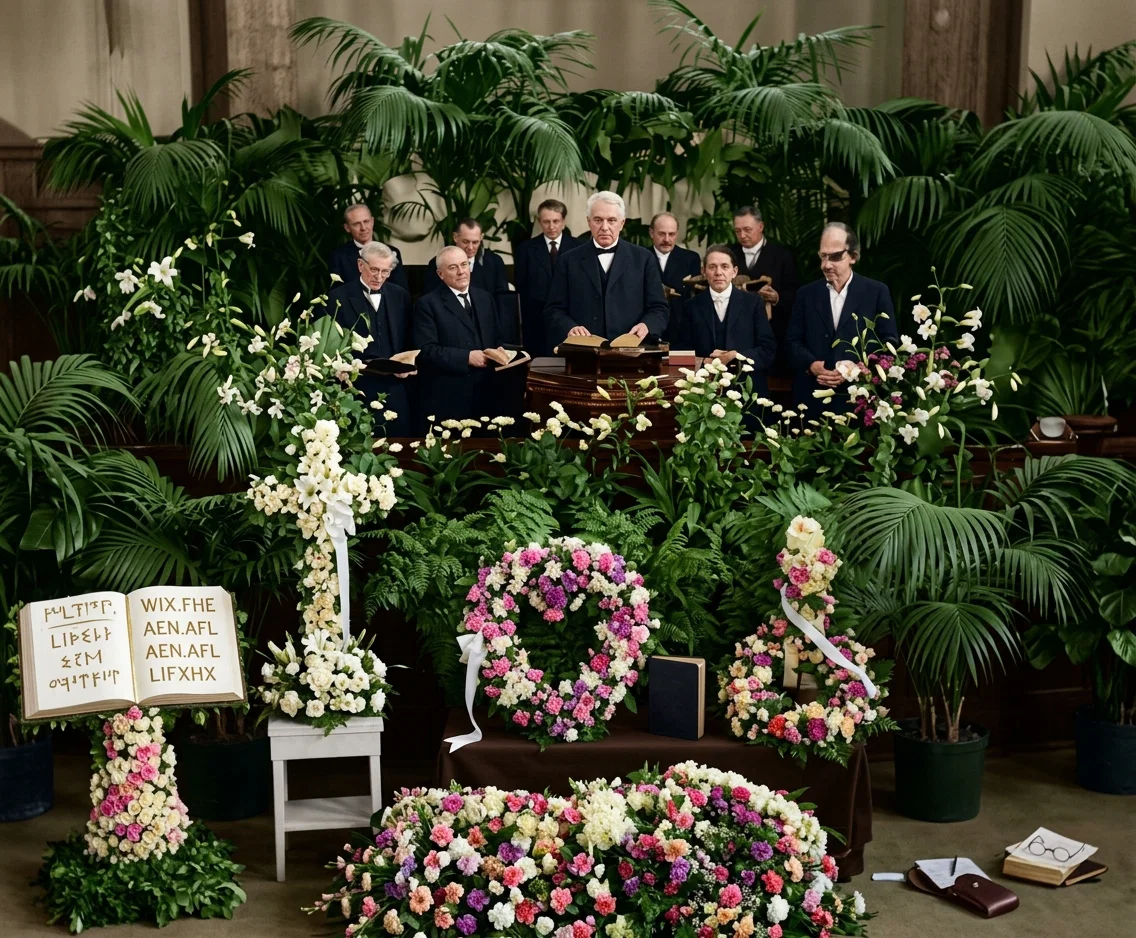
A VIEW OF THE PULPIT WHILE ELDER S. N. HASKELL IS PREACHING
Sister E. G. White had been in declining health for several years. Feb. 13, 1915, she fell, and sustained an intracapsular fracture of the left femur. This doubtless served to hasten her death, which occurred at her home, “Elmshaven,” near St. Helena, Cal., one hundred and fifty-three days later, July 16. Surrounding her deathbed were her son, Elder W. C. White, and wife; her granddaughter, Mrs. Mabel White Workman; her long-time and faithful secretary-nurse, Miss Sara MacEnterfer; her niece and faithful nurse, Miss May Walling; one of her untiring bedside nurses, Mrs. Carrie Hungerford; her housekeeper, Miss Tessie Woodbury; her old-time companion and helper, Mrs. Mary Chinnock Thorp; and a few of her friends and helpers who
had spent many years about her home and in her office.
Sunday, July 18, a funeral service was conducted on the lawn at “Elmshaven,” near the sanitarium. About four hundred friends and neighbors were present. The following day
a second service was held at Oakland, Cal., with fully one thousand persons in attendance.
The third and final funeral service, in the Tabernacle at Battle Creek, Mich., was attended by a large congregation. It is estimated that four thousand persons were present, crowding the Tabernacle to its very doors. Many stood in the lobbies, doorways, and approaches to the building, unable to obtain
seats. There were present not only our own brethren and sisters in Battle Creek, but pastors of the Battle Creek churches, together with many leading citizens. Some of our churches in the near vicinity suspended their services, and attended in a body. Representatives were present from many churches throughout Michigan, Illinois, and Indiana. The services at the sanitarium were suspended, and many of the physicians and nurses came to the Tabernacle. Representing the General and North American Division Conferences were Elders A. G. Daniells, I. H. Evans, W. T.4
Knox, G. B. Thompson, Frederick Griggs, L. H. Christian, C. S. Longacre, S. N. Haskell, C. B. Stephenson.
We recognized in the large congregation many pioneers whose names are familiar to thousands of our readers: Brethren A. C. Bourdeau, H. Nicola, M. S. Burnham, L. McCoy, G. C. Tenney, G. H. Murphy, William Covert, M. J. Cornell, R. A. Hart, J. W. Bacheller, Homer Aldrich, and doubtless many others whom we were unable to recognize were among the mourners gathered on this occasion.
At this final service there were present the two sons, Elders J. E. White and W. C. White, and one niece, Mrs. Addie Walling McPherson. Seated with these as mourners were Miss Sara MacEnterfer, Mrs. L. M. Hall, Mrs. S. N. Haskell, Mr. and Mrs. I. S. Abbey, Mr. and Mrs. Frank Kelsey, Mr. and Mrs. George Kelsey, and Mr. and Mrs. Oliver Kelsey, and other grieving friends whose names we were unable to obtain.
Elder W. C. White and Miss Sara MacEnterfer accompanied the remains from the Pacific Coast to Battle Creek. On their arrival the body was taken to the home of Brother George Israel, where it remained until Sabbath morning. From eight o’clock until half past ten Sabbath morning friends were given opportunity to look upon the familiar face.
Six ministers acted as guards of honor at the Tabernacle, alternating in pairs
every twenty minutes, one at the head and one at the foot of the casket. C. S. Longacre, M. L. Andreasen, W. A. Westworth, E. A. Bristol, L. H. Christian, and C. F. McVagh acted in this capacity. The body was encased in a plain black casket, without ornamentation, except a simple plate engraved with the words “At rest.”
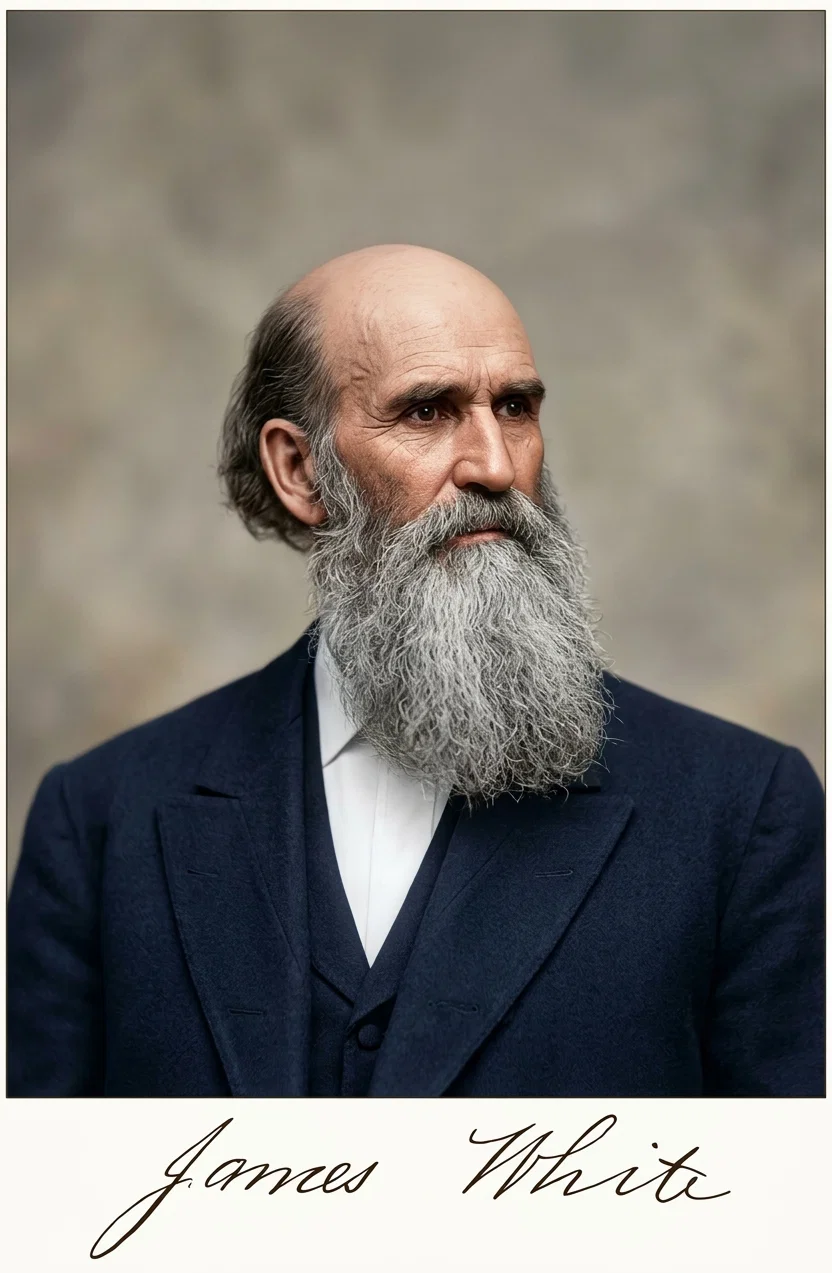
ELDER WHITE DIED AT BATTLE CREEK, MICH.,
AUG. 6, 1881
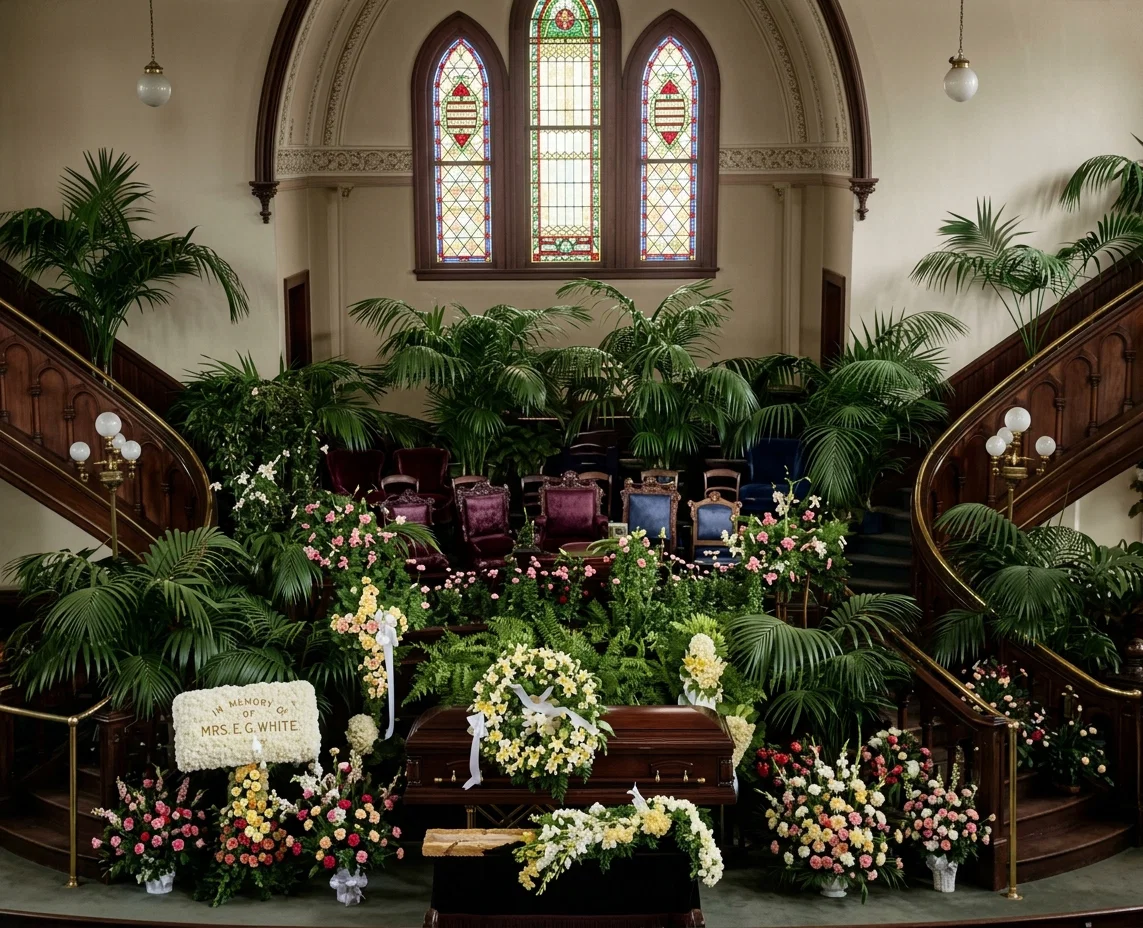
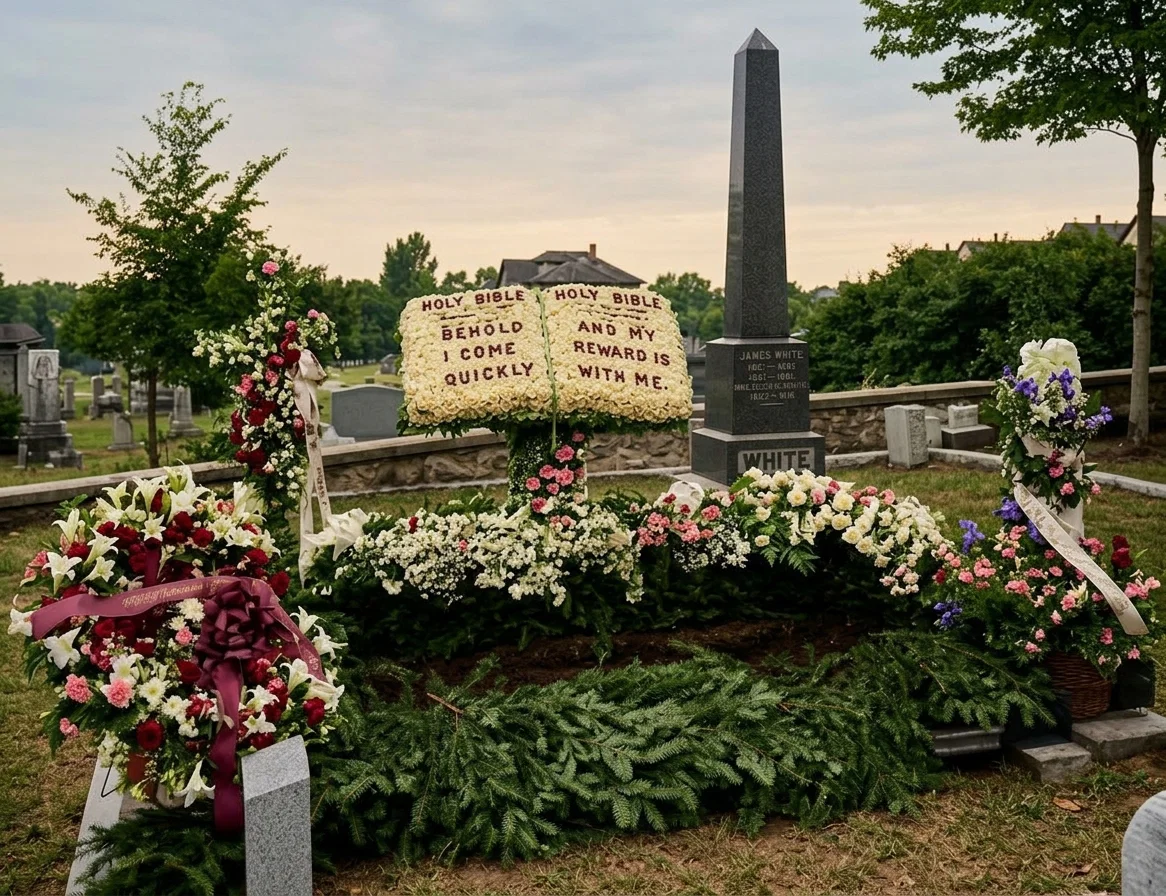
The casket was placed directly in front of the pulpit, which was banked with a rich profusion of palms, ferns, and flowers. The floral tributes were numerous and beautiful. One design of an open Bible, made of white and pink carnations, presented by the Pacific Press Publishing Association, was especially noticeable. Across the open pages in purple flowers were the words, “Behold, I come quickly; and my reward is with me.” A beautiful design representing a broken wheel was presented by the Battle Creek church. A cross of white roses hung in front of the pulpit. On a ribbon attached to this cross were the last words uttered by Sister White, “I know in whom I have believed.” Floral pieces representing a broken column, and other designs were sent by the General and North American
Division Conferences, the Review and Herald Publishing Association, and other institutions, and by individuals.
The funeral service began at eleven o’clock. “Asleep in Jesus,” No. 924, “Hymns and Tunes,” was sung by a double quartet, consisting of Mrs. H. M. Dunlap, Mrs. George R. Israel, Miss Nenna B. Dunlap, Miss Florence Howell, Frank W. Hubbard, Dr. M. A. Farnsworth, F. Griggs, and M. H. Minier. Following this, Elder F. M. Wilcox read as a Scripture lesson Rev. 21:1-7; 22:1-5; and Isaiah 35. A solemn hush pervaded the great assembly while Elder M. C. Wilcox offered prayer.
Following the prayer, “Rest for the
Toiling Hand,” No. 940, “Christ in Song,” was touchingly sung as a solo by Prof. F. Griggs.
It seemed most fitting that Elder A. G. Daniells, with his long years of intimate association with Sister White in her work, should prepare and read a sketch of her life; and though somewhat lengthy, it was listened to with deep interest by those present. A part of this sketch was given last week. We are sure, however, that all will desire to have the complete
account which was read at the funeral. Hence we present it entire in this connection:—
Life Sketch of Sister E. G. White by Elder A. G. Daniells
Ellen G. White was born in Gorham, Maine, Nov. 26, 1827. She passed away July 16, 1915, at the advanced age of nearly eighty-eight years. Only the briefest glance at this remarkable life of strenuous and manifold labors will be possible on this occasion.
Before her marriage to James White her name was Ellen Gould Harmon. Her parents, Robert and Eunice Harmon, came of good New England stock in the State of Maine. They were earnest, devoted members of the Methodist Church. While active in Christian service for the conversion of sinners, Mr. and Mrs. Harmon had the joy of seeing their family of eight children yield their hearts to Him who died for them, and dedicate their lives to his service.
Her Religious Experience
Miss Ellen Harmon seemed to be endowed with a deeply religious nature. In early youth she experi-
enced a keen realization of the exceeding sinfulness of sin. The righteousness of God as revealed in the gospel charmed her, and for it her whole heart and soul seemed to yearn. At the tender age of twelve years, while attending a Methodist camp meeting, she acknowledged Christ as her Saviour, and later was baptized in the sea at Portland.
In 1840, when but thirteen years of age, she attended the religious meetings conducted by William Miller in Portland, Maine. His thrilling sermons on the second coming of Christ made a profound impression on her mind. Thousands were deeply moved by Mr. Miller’s preaching, and many turned from lives of worldliness and sin to live only for their Lord and Saviour. The impressions made on Miss Harmon’s mind grew stronger5
and deeper day by day. But it was not until later, at the age of seventeen, that she found the full salvation in Christ for which her soul longed so earnestly. Of this experience she wrote:—
“Faith now took possession of my heart. I felt an inexpressible love for God, and had the witness of his Spirit that my sins were pardoned. My views of the Father were changed. I now looked upon him as a kind and tender parent, rather than a stern tyrant compelling men to blind obedience. My heart went out toward him in a deep, fervent love. Obedience to
his will seemed joy. It was a pleasure to be in his service. No shadow clouded the light that revealed to me the perfect will of God. . . . My heart was so filled with love to God and the peace that passeth understanding that I loved to meditate and pray.”
This experience proved to be deep and abiding. It marked the beginning of a life of great devotion to God, and of the greatest activity for the salvation of a lost world. She began at once to lead her young associates to the Saviour. Although repulsed by some, she ceased not to pray and labor for them until every one for whom her heart was specially burdened experienced the new life.
Taking the Bible as the supreme guide of her life she became fully convinced by its teaching that the second coming of Christ was near at hand. On this point she never wavered; and believing it with her whole soul, she felt that the supreme purpose of every Christian at this time should be to live a blameless life in and with Christ, and to devote every resource at command to the salvation of the lost.
This view led her to unceasing prayer for the indwelling presence of the Holy Spirit. Her yearning for this divine Presence was answered beyond all that she had conceived. She prayed, as does every sincere Christian, for the gifts of the Spirit as set forth by the apostle Paul in his first letter to the Corinthian church—the gift of wisdom, knowledge, faith, healing, working of miracles, prophecy, discerning of spirits, etc.
Called to Her Life Work
Her life of full surrender, obedience, and unceasing prayer for divine help was rewarded by the bestowal of the gift of prophecy, one of the choicest of all the gifts of the Spirit.
In December, 1844, the Holy Spirit
gave her a revelation of the second coming of Christ. In this vision of the future there was given a view of the glorious reward that awaits the redeemed and the terrible fate that will come to all who refuse to serve their Lord and Master. This view of the destiny of the human family made a profound impression on her. Here she received her appointment as a messenger of God. She felt that God was commanding her to give this message of light and salvation to others.
This was a great trial to her. She was but seventeen years old, small, frail, and retiring; but after a long, severe struggle, she surrendered to the call of her Lord, and then she was given strength for her life work.
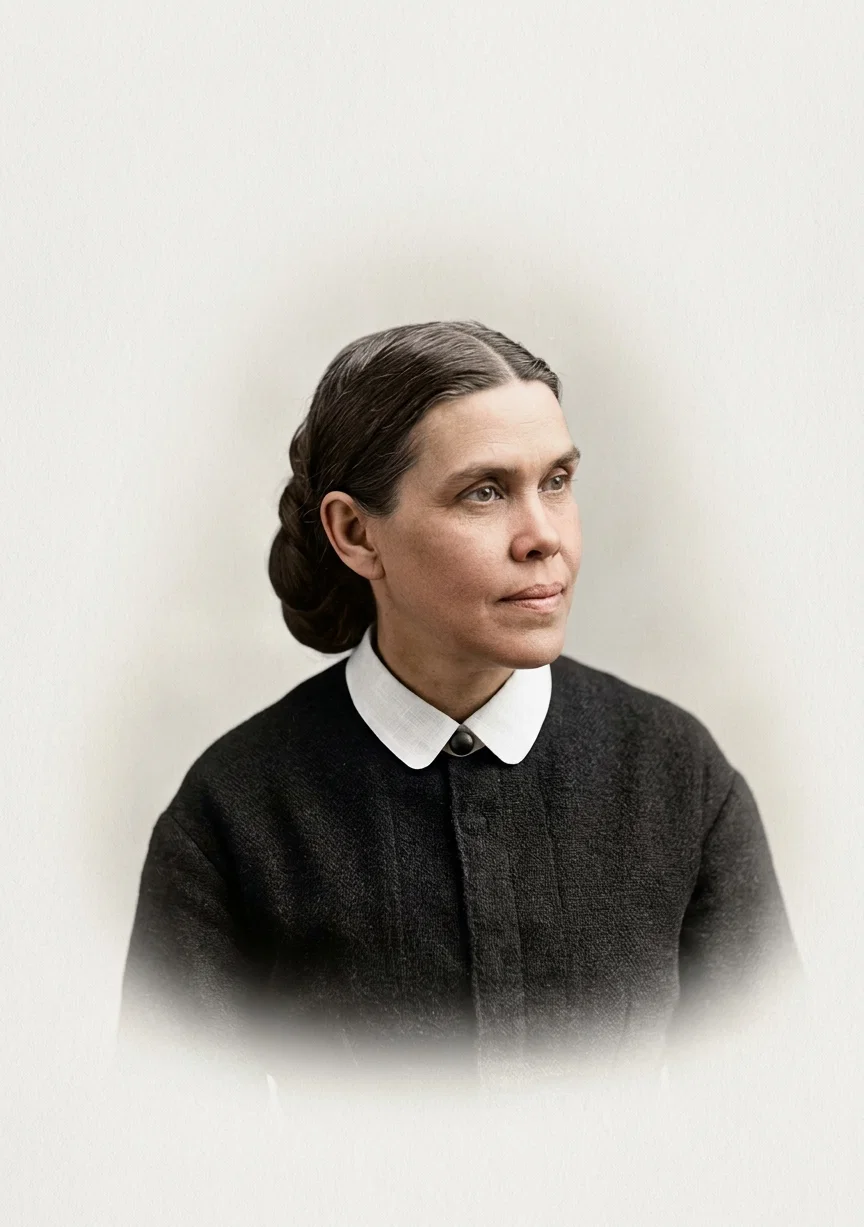
A FAMILIAR PICTURE OF SISTER WHITE
Following this surrender and victory there came to her a series of remarkable spiritual experiences, unmistakably genuine, and regarded by her associate workers of that day as a manifestation of the gift of prophecy promised by Christ to the remnant church. Those who have been associated with her through all the years that have passed since that time never have had occasion to alter their conviction that the revelations which have come to her through the years have come from God.
Elder Uriah Smith’s Estimate of Her Work
The late Uriah Smith, a lifelong associate in this work with both Elder
and Mrs. White, left the following testimony to this gift:—
“Every test which can be brought to bear upon such manifestations proves them genuine. The evidence which supports them, internal and external, is conclusive. They agree with the Word of God and with themselves. They are given, unless those best qualified to judge are invariably deceived, when the Spirit of God is especially present. Calm, dignified, impressive, they commend themselves to every beholder as the very opposite of that which is false or fanatical.
“Their fruit is such as to show that the source from which they spring is the opposite of evil.
“1. They tend to the purest morality. They discountenance every vice, and exhort to the practice of every virtue. They point out the perils through which we are to pass to the kingdom. They reveal the devices of Satan. They warn us against his snares. They have nipped in the bud scheme after scheme of fanaticism which the enemy has tried to foist into our midst. They have exposed hidden iniquity, brought to light concealed wrongs, and laid bare the evil motives of the false-hearted. They have warded off dangers from the cause of truth upon every hand. They have aroused and re-aroused us to greater consecration to God, more zealous efforts for holiness of heart, and greater diligence in the cause and service of our Master.
“2. They lead us to Christ. Like the Bible, they set him forth as the only hope and only Saviour of mankind. They portray before us in living characters his holy life and his godly exam-
ple, and with irresistible appeals they urge us to follow in his steps.6
“3. They lead us to the Bible. They set forth that Book as the inspired and unalterable word of God. They exhort us to take that word as the man of our counsel, and the rule of our faith and practice. And with a compelling power, they entreat us to study long and diligently its pages, and become familiar with its teaching, for it is to judge us in the last day.
“4. They have brought comfort and consolation to many hearts. They have strengthened the weak, encouraged the feeble, raised up the despondent. They have brought order out of confusion, made crooked places straight, and thrown light on what was dark and obscure. And no person with an unprejudiced mind can
read their stirring appeals for a pure and lofty morality, their exaltation of God and the Saviour, their denunciations of every evil, and their exhortations to everything that is holy and of good report, without being compelled to say, ‘These are not the words of him that hath a devil.’”
Her Marriage to Elder James White, and Their United Labors
On Aug. 30, 1846, Miss Harmon was married to James White, a native of Palmyra, Somerset Co., Maine. Mr. White was born Aug. 4, 1821, and was a lineal descendant on his
father’s side of Peregrine White, born on the “Mayflower,” in the harbor of Cape Cod.
About the time of their marriage they were both convinced that the fourth commandment of the decalogue enjoined the observance of the seventh day of the week as the Sabbath of Jehovah. From childhood they had been taught a wholesome reverence for the law of God. When they came to see the plain statement that “the seventh day is the Sabbath of the Lord thy God: in it thou shalt not do any work,” they courageously took their stand for loyal obedience. Their belief in the imminence of the second coming of Christ, and their observance of the seventh-day Sabbath, led to the adoption of the de-
nominational name—Seventh-day Adventists.
From the time of their marriage, Mrs. White’s life was closely linked with that of her husband in strenuous gospel work, until his death, Aug. 6, 1881. They traveled extensively in the United States, preaching and writing, planting and building, organizing and administering. Time and test have proved how broad and firm were the foundations they laid, and how wisely and well they built.
In 1853, in the beginning of their work, they chose Battle Creek as the headquarters of their movement.
THE CASKET CONTAINING THE BODY OF MRS. E. G. WHITE IN THE TABERNACLE
This was done at the solicitation of earnest, progressive believers residing in the State of Michigan. For just fifty years this place remained the headquarters of the cause they established.
Through the counsels given Mrs. White they were instructed to print and circulate a message-filled literature. The small beginning they set on foot has grown, until today we have thirty-seven publishing houses throughout the world, producing literature in eighty different languages, with an annual output of $2,000,000. In those early days they began the publication of the ADVENT REVIEW AND SABBATH HERALD, which still continues as the denominational organ. About the same time they
started the Youth’s Instructor. This has grown to be a very strong periodical for the young people.
In 1872 Mrs. White accompanied her husband across the continent to establish a larger, broader work on the Pacific Coast. Locating in the city of Oakland, they started a printing plant and began the publication of a missionary paper, the Signs of the Times. This paper still lives and enjoys a large circulation. They also founded the St. Helena Sanitarium, a few miles north of San Francisco. This institution has grown until now it maintains a large patronage.
In Battle Creek Brother and Sister White worked for the establishment of the first college and sanitarium of the denomination. The small beginning in educational and medical missionary work made here has extended to all parts of the world. There are being operated at the present time seventy colleges, academies, and intermediate schools, and five hundred elementary schools. About forty sanitariums and a large number of medical treatment rooms and dispensaries are being maintained in both Christian and non-Christian lands for the alleviation of the physical suffering of humanity.7
The Character of Her Teachings
The views held and widely promulgated by Mrs. White regarding vital,
fundamental questions,—the sovereignty of God, the divinity of Christ, the efficacy of the gospel, the inspiration of the Scriptures, the majesty of the law, the character of sin and deliverance from its power, the brotherhood of man and the relationships and responsibilities in that brotherhood,—her teaching regarding these great questions, and her life of devotion to her Lord and of service to her fellow men, were made impressive through the revelations given her by the divine Spirit. They are the fruits of that Spirit,—the fruits by which her life work is to be judged.
They must determine the source and the character of the spirit that has dominated her whole life. “By their fruits ye shall know them.” “To the law and to the testimony: if they speak not according to this word, it is because there is no light in them.”
This question is not involved in any uncertainty whatever. Her teaching is clear, and the influence of her life has been positive.
No Christian teacher in this generation, no religious reformer in any preceding age, has placed a higher value on the Bible. In all her writings it is represented as the Book of all books, the supreme and all-sufficient guide for the whole human family. Not a trace of higher criticism, new thought, or skeptical, destructive philosophy can be found in any of her
writings. Those who still believe that the Bible is the inspired, infallible word of the living God will value most highly the positive uncompromising support given this view in the writings of Mrs. White.
In her teaching, Christ is recognized and exalted as the only Saviour of sinners. Emphasis is placed upon the bold and unqualified announcement of the disciples that “there is none other name under heaven given among men, whereby we must be saved.” The power to redeem from the power and effects of sin is in him alone, and to him all men are directed.
AT THE GRAVE, TAKEN AFTER THE FRIENDS DISPERSED, AND JUST BEFORE THE GRAVE WAS FILLED
Her writings hold firmly to the doctrine that the gospel, as revealed in the Sacred Scriptures, presents the only means of salvation. None of the philosophies of India nor the codes of morals and ethics of Burma and China are given any place whatever with the gospel of the Son of God. This alone is the hope of a lost world.
The Holy Spirit, the third person of the Godhead and Christ’s representative on earth, is set forth and exalted as the heavenly teacher and guide sent to this world by our Lord to make real in the hearts and lives of men all that he had made possible by his death on the cross. The gifts of this divine Spirit, as enumerated in the New Testament, are acknowledged, prayed for, and received as fully as the Spirit imparts them.
The church instituted by our Lord and built up by his disciples in the first century is set forth as the divine model. Its prerogatives and authority are fully acknowledged, and all its ordinances and memorials are observed. Strong emphasis is placed on the value of gospel order and organization revealed in the Scriptures for the efficiency of the church in all its world-wide operations.
Through the light and counsel given her, Mrs. White held and advocated broad, progressive views regarding vital questions that affect the betterment and uplift of the human family
from the moral, intellectual, physical, and social standpoint, as well as the spiritual. Her writings are full of instruction, clear and positive in behalf of a broad, practical Christian education for every young man and young woman. In response to her earnest counsels the denomination with which she was associated now maintains a system of education for all its children and young people.
Her writings present the most comprehensive views regarding temperance reform, the laws of life and health, and the use of rational, effective remedies for the treatment of sickness and disease. The adoption of these principles has placed the people with whom she worked in the front ranks with others who are advocating sane temperance reforms,8
and working for the physical improvement of mankind.
Nor is the social status of the human family lost sight of. Slavery, the caste system, unjust racial prejudices, the oppression of the poor, the neglect of the unfortunate, are set forth as un-Christian and a serious menace to the well-being of the human race, and as evils which the church of Christ is appointed by her Lord to overthrow.
Her Interest in World-Wide Mission Work
The responsibilities of the church in both home and foreign mission service are given the greatest prominence in
the writings of Mrs. White. Every member of the body is admonished to be a light in the world, a blessing to those with whom he may associate. All must live the unselfish life of the Master for others. And the church in Christian lands must put forth its highest endeavors to evangelize those who are groping in the darkness and superstition of heathen lands.
Go to all the world, give to all the world, work for all the world, is the exhortation running through all the writings of Mrs. White, as the following quotation will illustrate:—
“Let the members of the church have increased faith, gaining zeal from their unseen, heavenly allies, from a knowledge of their exhaustless resources, from the greatness of the enterprise in which they are engaged, and from the power of their
Leader. Those who place themselves under God’s control, to be led and guided by him, will catch the steady tread of the events ordained by him to take place. Inspired by the Spirit of him who gave his life for the life of the world, they will no longer stand still in impotency, pointing to what they cannot do. Putting on the armor of heaven, they will go forth to the warfare, willing to do and dare for God, knowing that his omnipotence will supply their need.”
Thus for fully seventy years she gave her life in active service to the cause of God in behalf of sinful, suffering, sorrowing humanity. After traveling extensively through the United States from 1846 to 1885, she visited Europe, where she devoted two years to the work there, which was then in a formative period. In 1891 she went to Australia, where she remained nine years, traveling about the colonies and devoting all her energies to the upbuilding of the work. Her labors there were of untold value to the cause of God in the Southern Pacific.
On returning to the United States in 1900, at the age of seventy-three, she seemed to feel that her duty to travel was about done, and that she should devote the rest of her life to writing. Thus she toiled on until within a short time of her death, at the ripe age of almost eighty-eight years.
The Value of Her Work
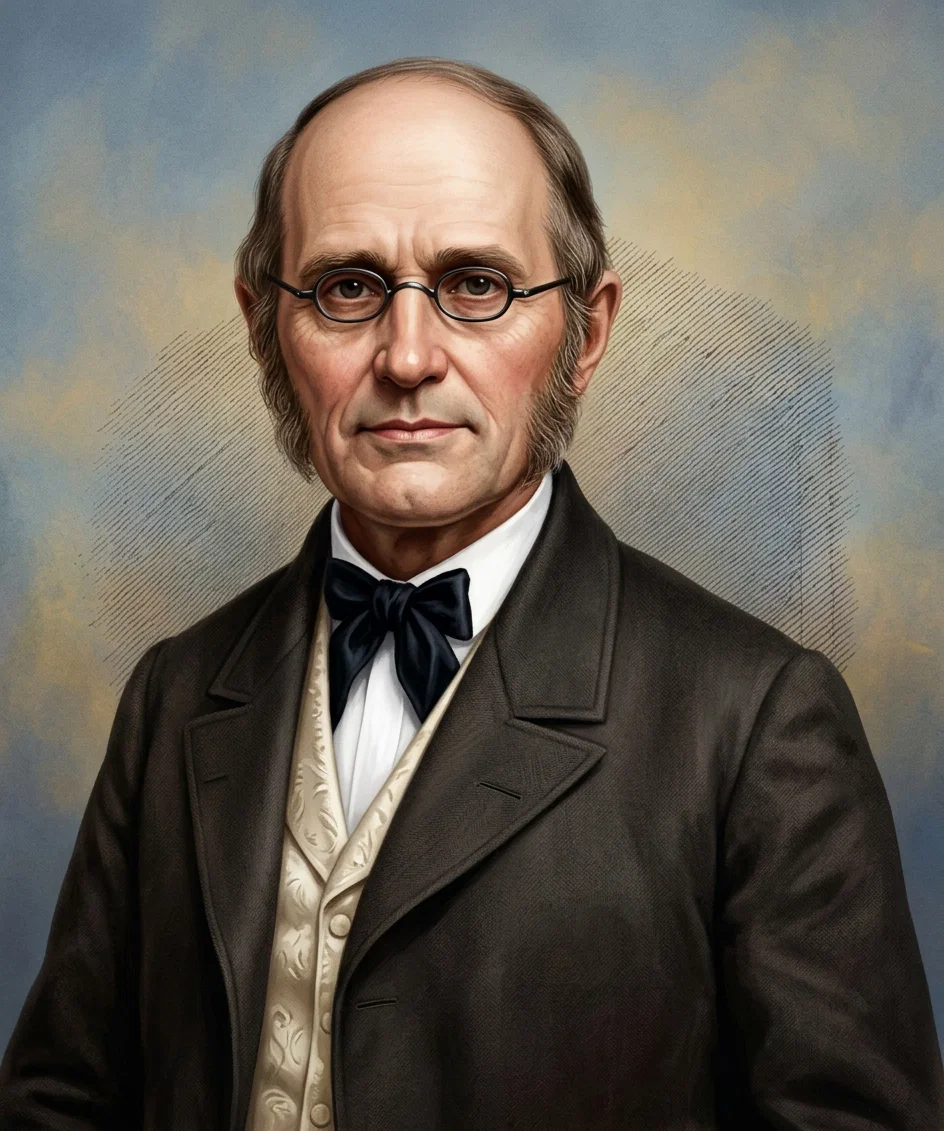
ELDER JOSEPH BATES, WHO DIED AT BATTLE CREEK,
MICH., MARCH 19, 1872
Perhaps we are not wise enough to say definitely just what part of Mrs. White’s life work has been of the greatest value to the world, but it would seem that the large volume of deeply religious literature she has left
would prove to be of the greatest service to mankind. Her books number upward of twenty volumes. Some of these have been translated into many languages in different parts of the world. They have now reached a circulation of more than two million copies, and are still going to the public by thousands.
As we survey the whole field of gospel truth,—of man’s relation to his Lord and to his fellow men,—it must be seen that Mrs. White’s life work has given these great fundamentals positive, constructive support. She has touched humanity at every vital point of need, and lifted it to a higher level.
Now she is at rest. Her voice is silent; her pen is laid aside. But the mighty influence of that active, forceful, Spirit-filled life will continue. That life was linked with the eternal; it was wrought in God. The message proclaimed and the work done have left a monument that will never crumble nor perish. The many volumes she has left, dealing with every phase of human life, urging every reform
necessary to the betterment of society as represented by the family, city, State, and nation, will continue to mold public sentiment and individual character. Their messages will be cherished more than they have been in the past. The cause to which her life was devoted, and which that life molded and advanced to such a great degree, will press forward with increasing force and rapidity as the years go by. We who are connected with it need entertain no fear except the fear of our own failure to do our part as faithfully as we should.
Of our sister and of all who have
died in the Lord Jesus, the apostle Paul gives us the following comforting words: “But I would not have you to be ignorant, brethren, concerning them which are asleep, that ye sorrow not, even as others which have no hope. For if we believe that Jesus died and rose again, even so them also which sleep in Jesus will God bring with him. For this we say unto you by the word of the Lord, that we which are alive and remain unto the coming of the Lord shall not prevent them which are asleep. For the Lord himself shall descend from heaven with a shout, with the voice of the archangel, and with the trump of God: and the dead in Christ shall rise first: then we which are alive and remain shall be caught up together with them in the clouds, to meet the Lord in the air: and so shall we ever be with the
Lord. Wherefore comfort one another with these words.”
And if it was appropriate for the president of the General Conference to present this sketch of the life of one who has been so closely identified with this movement, it was equally as fitting that a pioneer, Elder S. N. Haskell, who from the early days of this movement was intimately associated with Brother and Sister White, and who, as he stated in his remarks, had known Sister White for more than fifty years under nearly every circumstance of life, should set forth from the words of divine revelation the hope of the Christian,—the hope which had inspired him through all the years of his ministry, the hope which sustained the special subject of his remarks through her life and in the hour of death. Brother Haskell spoke as follows:—