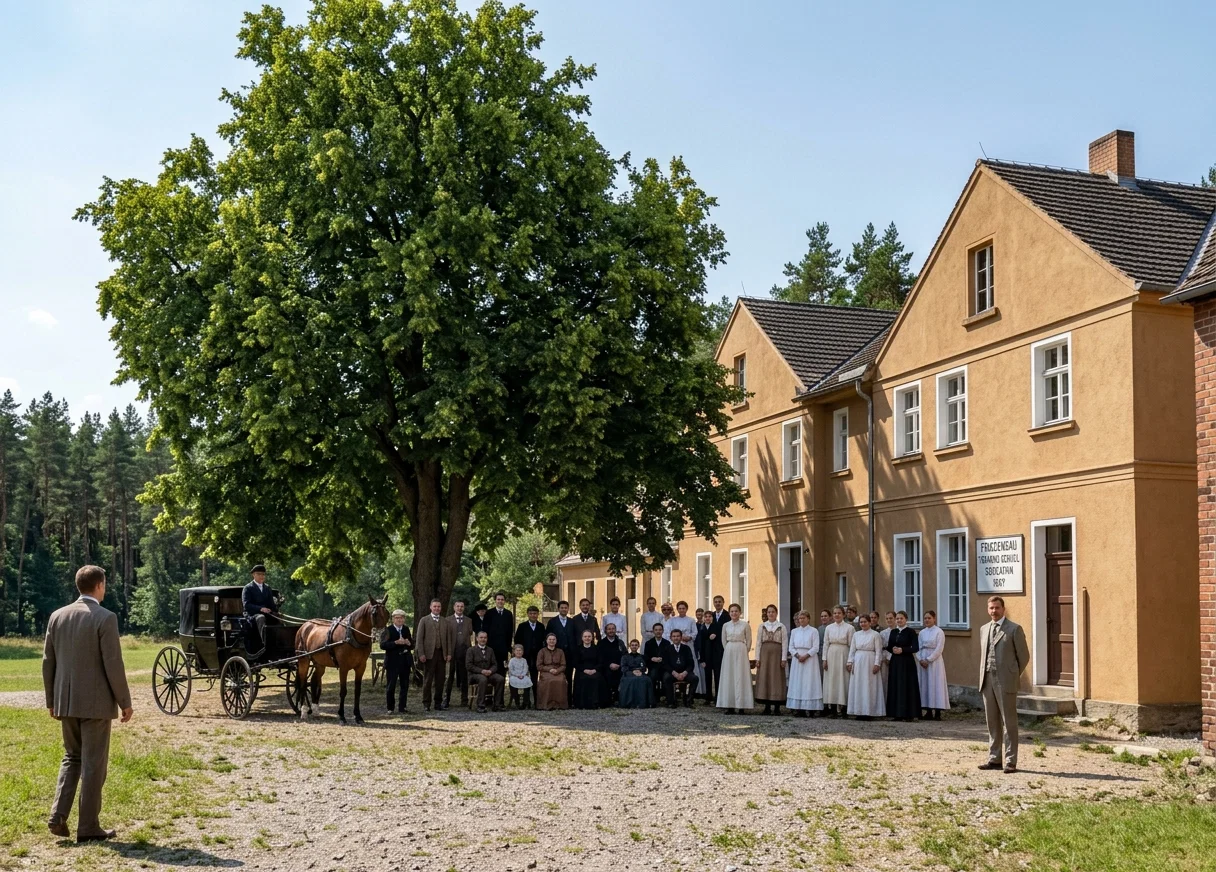
The recent recurrence of the annual meeting of the German Union Conference here in Friedensau, bringing with it the usual influx of hundreds of our people from all parts of Europe, and, indeed, the world, suggested to me that but few of our American brethren and sisters are sufficiently informed concerning Friedensau to realize the magnitude of the work that has grown up here during the last few years, or are aware of the important part it is playing in giving character to the work, not only in the German empire, but throughout Europe. It was, therefore, thought that a short sketch of the history and present status of the institutional work here would be of general interest.
THE MAIN SCHOOL BUILDING AT THE TIME OF THE DEDICATION
It is now more than seven years since the growing demands of the work in the German field compelled the brethren here to recognize the necessity of a training-school for workers. After much searching, a farm of about ninety acres was found, a few miles east of Magdeburg, which seemed to be as suitable as anything to be had for the means at hand. The farm was pleasantly situated in the midst of pine forests, with a small stream, the Ihle, running through from end to end. An old mill, with several houses around it, these forming the village of Klappermuhle, were situated on the farm, which also included a small piece of young timber. Far from the enervating atmosphere of city life, the railroad connections were still sufficient, and the place was finally bought in the autumn of the year 1899, for about
Then began the battle. The place was considerably run down. The central field, where the main building now stands, was a sandy wilderness, sparsely covered with tall weeds. It was difficult to see what could be made out of the place, and few could believe that this wild desert was to become the center of our educational work in Germany. The old buildings were unsuitable and incommodious. But there was no time to wait for new ones, or for money with which to erect them, so a few young people were gathered in, and Brother Lupke started a school in the old mill.
This period is in many ways the most interesting in Friedensau's history. The most ordinary school appliances were entirely wanting. The young men slept in the attic, where things froze up solid every night in the winter, and the snow sifted in through the cracks in thick drifts over the bare floor and cotton
comforters. The young women fared but little better. There was one large room for kitchen and dining-room, through which one was obliged to pass to reach the principal's office—a room about ten by twelve feet, which, by the way, served also as library, study, and bedroom for
Water was carried from the Ihle for all domestic purposes. A little old hut served for laundry and bath-room alike. This establishment boasted at first one, and later, two wooden tubs, which had to do double service. In windy weather, when the old fireplace smoked unendurably, only cold water was obtainable.
But the brethren and sisters did not despise the day of small things. Beginnings were made in other directions. In one corner of the attic a health food factory was started, and with the arrival of Dr. Hoenes from America, another corner was cleared out for a treatment room—the nucleus of the present sanitarium. Definite plans for the future began to crystallize symmetrically. The students spent a large part of their time clearing up and improving the farm, and in working on the new building. A large orchard was planted, and a park was laid out between the plots of land destined for the future school and sanitarium buildings.
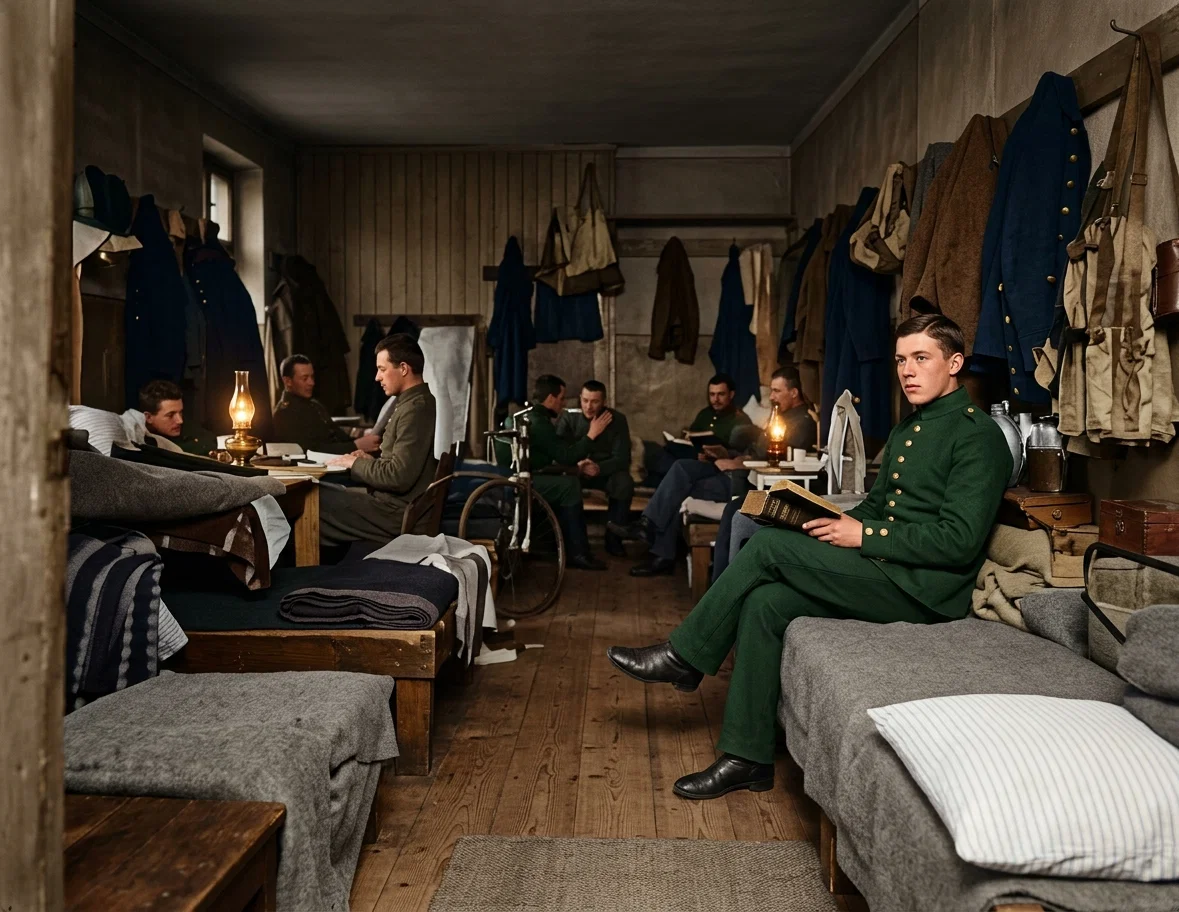
The first buildings to go up were several long, shed-like structures, now known as the “Barracks.” As soon as possible, a part of the school work was moved into these quarters, and the congestion in the old mill was thereby relieved to some degree. But the disadvantages were still very great. The barracks were but lightly constructed, their principal merit being good ventilation; and it was necessary to use them as barns, and storehouses as well. Sacks of grain were piled around the sides of one class room, and the other was cleared out at meal-times, to serve as dining-room. The bill of fare was very simple, consisting of brown-rye bread, oatmeal porridge, with stewed fruit, perhaps, for breakfast; vegetable soup, with boiled beans or potatoes for dinner; and cereal coffee (without sugar), with bread and nut butter, for tea.
INTERIOR OF THE BARRACKS
But in spite of all difficulties, the school grew and flourished. The call for workers was urgent, and the young people in the school were earnest, sincere, and self-sacrificing, thankfully embracing the opportunity to fit themselves for service, and cheerfully bearing inconveniences15actual suffering. The number was small at first, twenty-two being enrolled the first year, and thirty-six the second. But the Lord blessed their efforts, and they are now scattered abroad in many lands, doing efficient service.
The first of the present main buildings to be erected was the sanitarium, which was put up during the first half of the year 1901, at a cost of about $13,500. Then came the present health food factory, in the form of an addition to the old mill. The firm establishment of the earning branches of the enterprise enabled the managers to turn their attention again to the school, where the congestion had become intolerable. In the fall of the year 1901, ground was broken for a school building, and the next year a three-story brick structure, capable of accommodating seventy-five students, was completed and dedicated. Great was the joy of the teachers and students as they moved into the new quarters. True, there were only two class rooms, one of which served also as dining-room, and the other as chapel. The windows were curtainless, and the floors carpetless, but there was a whole bedroom for every five or six students, the building was heated with steam, and the walls were plastered.