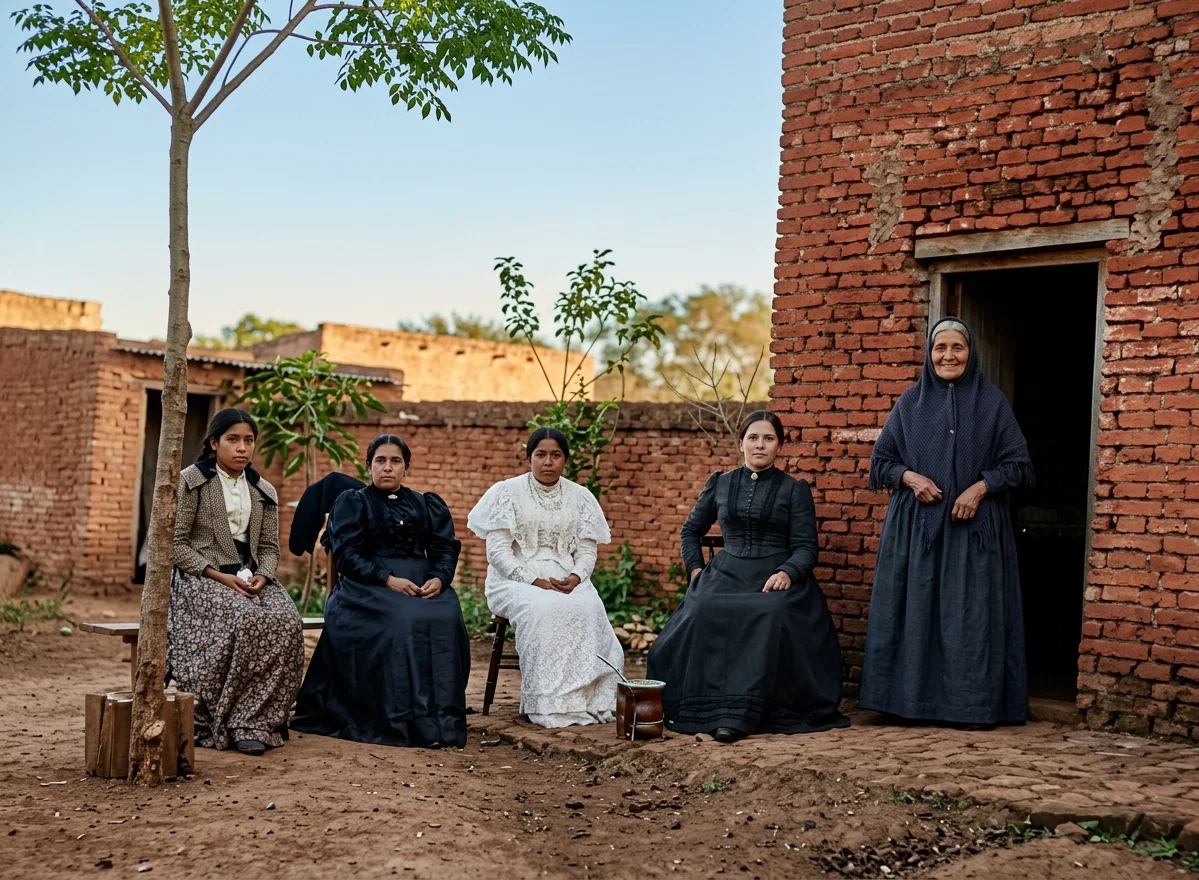
This territory forms the extreme northeast of the Argentine Republic, being bounded on the north, east, and south by Brazil, and on the west by the republic of Paraguay and the province of Corrientes. It has an area of 5,395,400 hectares. The territory takes its name from the missions founded there by the Jesuits in the sixteenth century. Before their expulsion in 1768, Misiones had a population of over one hundred thousand, but the latest geographies give the present number of inhabitants as thirty-three thousand. The capital is Posadas, which has four thousand two hundred inhabitants.
DRINKING MATE
The climate of Misiones is warm, but healthful. The annual mean temperature is seventy degrees Fahrenheit. One writer says that “Misiones is a splendid garden, a bewitching mansion. With its chains of low hills covered with thick forests of orange trees, and the mate tree, its numerous picturesque streams, half hidden in the foliage, this territory is the Argentine Eden.”
But the following from another writer presents a somewhat different picture: “It should be made known, on the other hand, that Misiones is a theater where one pays very dearly for the contemplation of her magnificent natural scenery. The palatable dishes are substituted by a little farina, beans, maize, and charque (meat dried in the sun). These are always cooked and eaten in the same way, and at times make one prefer, instead, a piece of the raw heart of a palm tree, which has a taste similar to the chestnut. Here one should learn to forget the good bed and mattress. These are impossible luxuries. Above all, one should resign himself to support the mirin, a little bee that makes a tart honey in the crevices of dry trees. These bees are so numerous at times that it is almost impossible to open the mouth to speak. They cover the hands and the face, but do not sting. At times they retire, and then come the jegenes in equal numbers, and these bite until the hands and face are swollen. Then there are an infinity of other stinging insects, like the horse mosquito, tabano (a large poisonous fly), and mosca groude, which, when it stings, deposits eggs. These soon hatch into worms, which must be allowed to remain four or five days before one can press them out with the fingers. During the night the gnats are almost insupportable.”
The soil of Misiones is adapted to sugar cane, rice, coffee, and tobacco. The staff of life there is the mandioca, and maize takes the place of all other dishes. Wheat bread is unknown to many of the people.
One of the chief industries is the cultivation of the yerba tree, from which mate, or Paraguay tea, is made. This plant was first introduced into Misiones from Paraguay by the Jesuits. The work in the yerbales, or mate plantations, is done chiefly by Indians, who receive little more than the mate they drink and the tobacco they chew and smoke. The cultivation and use of the yerba mate is one of the greatest curses to these South American countries. Argentina pays to Brazil and Paraguay over four million dollars gold annually for mate.
But what interests us most is the fact that the third angel’s message is gaining a foothold in Misiones. After Brother Westphal arrived in Brazil on his last trip, he wrote back that Brother Schwantes had been across to Misiones, and that in Posadas he found a company of twelve keeping the Sabbath, and that another company of eight at a place called San Juan began to keep the Sabbath as a result of his visit. Those in Posadas received the Sabbath truth from a brother who came from Chile to escape military service. But along with this truth he taught them erroneous doctrines concerning the keeping of the day of atonement, etc. As Brother Schwantes reported that there was an interest on the part of others to hear, and also a prospect of helping the Posadas company out of their error, our conference committee planned for Brethren Habenicht and McCarthy to go there.
The third day after arriving in Posadas, Dr. Habenicht wrote: “I am full of joy to-day. In our meeting Sabbath afternoon we were able to show these people the error in the tracts they were studying from Chile, and the victory was won. One link after another in the chain was broken until this morning we had a bonfire of the Chilian tracts, and two brethren and their families are united in the truth. The field here is ripe for the harvest.”
Six days later he writes this: “I drop you a line to-day to let you know how the work is progressing. We are full of joy at the prospect. We organized a Sabbath-school yesterday with twenty-eight members. Sixteen adults have begun to keep the Sabbath. Others still are interested, and we have all we can do to fulfil our promises to see the people.” Five days later he reports that, including eight children, thirty have begun to keep the Sabbath. There are still others interested.
We are thankful for such a good beginning in that isolated part of our conference. The keynote that is sounding out in the home land, “The message to the world in THIS generation,” touches a responsive chord in our hearts in this dark corner, and we are with our brethren heart and hand in this work.