The Island of Nevis

10%

Seventh-day Adventist Publishing Association · Battle Creek, Mich. · May 5, 1903

FromReview and Herald, Vol. 80, No. 18.

Read the full edition

The Island of Nevis

STERRIE A. WELLMAN
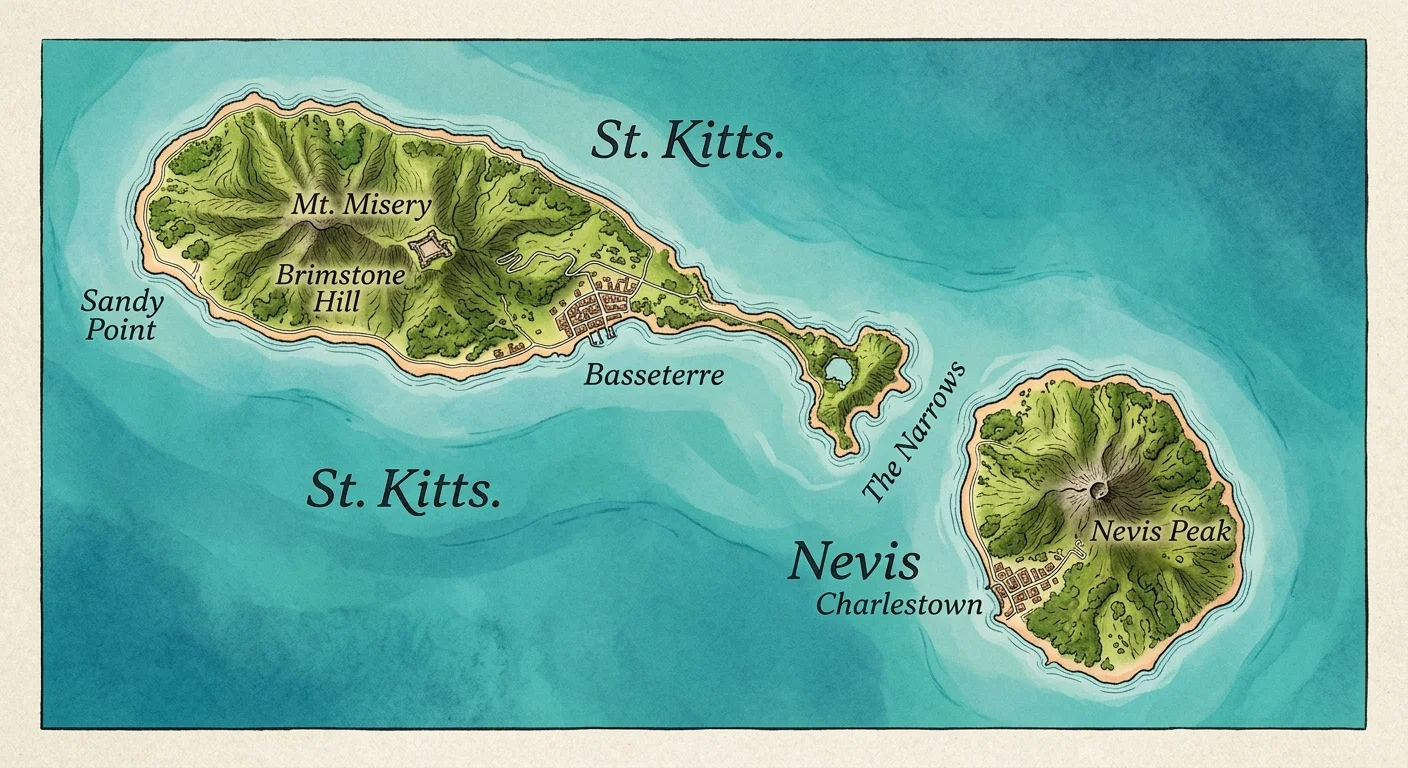
Starting from Basseterre, we take a little yawl lying at the wharf for Nevis. The wind is brisk, and the deep-blue waters of the bay are whipped into motion by it, the sail stiffens as it is run aloft, and ere we hardly realize the situation, we are away, crossing the twelve miles of briny waters which separated us from Charlestown, Nevis, entertained in the meanwhile by the lively chatter of our native captain and crew.
St. Kitts and Nevis.
After an hour and a half of swift flight, we arrive at the Charlestown wharf, greeted by that usual West Indian salute, “Here I am, massa.” We will start out on our travels at once; and turning southeastward from Charlestown, we will go directly into the country parts. We are hardly out of the town, when to our right we behold an old stone building, which fifty years ago was one of the most prosperous pleasure resorts and boarding hotels in the West Indies. To-day, like its island home, it lies a desolate wall, fast falling in decay. Here years ago flocked the élite of the West Indies. Its mineral springs were the attraction to the sufferers of the Carib Islands, from St. Thomas to Demerara. To-day all that remains is its history.
As we pass on, we do not follow the coast closely, but instead, trudging up, up, up, over the hills, close to the base of Nevis Peak, we follow the mountain road, until to the southeast we once more meet the seashore, along which the road runs till we reach the town of Charlestown.
About half-way up the hill we come upon an old English church, in which lie the records of the marriage of Lord Nelson, the great English admiral, who here united with one of the daughters of Nevis. And it was on this island, too, that Alexander Hamilton, the son of a Scotch planter, and the one who, next to Washington himself, did more than any other person to bring about the present stability of American institutions,—an able statesman, lawyer, soldier, and political teacher,—was born. So Nevis is a place of historical interest to both British and American.
As we come toward the east side of the island, it becomes very stony, and on every side are found those reminders of America, the old stone fences, grown black by the beatings of the wind and rain, and covered with the climbing and creeping vines in which these islands abound.
The remaining portion of our way lies along the shore road, to the north. As we travel on, we behold the northern coast of St. Kitts, its hills and mountains, and afar the peaks of St. Martins and St. Barts, to the south Antigua just revealing its low hills, and westward from it the beautiful but unfortunate island of Montserrat and the rock Redonda. We follow the coast by the channel, now at the base of the mountains and again far away from them, over rough roads strewn with stones washed down from the hills by the heavy tropical rains, through wild bush in which the monkey tribe finds a ready retreat, and after passing through several small villages, we arrive at our starting point, Charlestown.
In encircling the islands of St. Kitts and Nevis, it has been our pleasure to view, at varying distances of from twelve to sixty miles, nine of the Caribbean islands which are inhabited. Among these were St. Kitts, Nevis, Saba, Statia, St. Martins, St. Bartholomew, and Anguila, with a population aggregating seventy-three thousand. Such are these little islands of the Caribbean, washed by its warm waters and brightened by the tropic sun—a few of the minor creations of an all-wise and loving God; and they are among those of which it is said, “The isles shall wait for his law.”